Automotive Schools & Auto Mechanic Training

By
| Last Updated

Share on Pinterest Pinterest share button Share on X X - Twitter share button Share on Meta Facebook share button

Automotive schools can help you build the hands-on skills needed to inspect, maintain, and repair cars, trucks, diesel engines, motorcycles, collision damage, and other vehicle systems. Some programs focus on general automotive technology. Others prepare students for more specialized paths like diesel technology, collision repair, high-performance engines, motorcycle repair, heavy equipment, or commercial driving.

Use this guide to compare automotive training options, understand typical costs and timelines, learn how certification works, and find schools near you.


Quick Facts About Automotive Training

Question Short answer
What do automotive schools teach? Vehicle systems, diagnostics, repair, maintenance, shop safety, tools, and sometimes brand-specific technology.
How long does training take? Some certificate programs may take months; associate degree programs are commonly designed around two years.
Do mechanics need certification? Not always to start, but employers may prefer or require certifications. Refrigerant work has specific EPA rules.
What is the median auto mechanic salary? Automotive service technicians and mechanics had a 2024 median wage of $49,670.
What should I compare? Program focus, hands-on lab time, equipment, schedule, cost, certification prep, location, and employer connections.

Automotive service technicians and mechanics had 2024 median pay of $49,670, and employment is projected to grow 4 percent from 2024 to 2034, about as fast as average. The U.S. Bureau of Labor Statistics also projects about 70,000 openings per year, mostly from workers leaving the occupation or retiring.1


Not Sure Which Automotive Program Fits You?

Cars, trucks, diesel engines, motorcycles, and collision repair all live under the automotive umbrella, but they do not lead to the same daily work. Answer a few quick questions to narrow your path before you start comparing schools.

1. What do you most want to work on?
2. Which kind of work sounds most satisfying?
3. What matters most right now?
4. How soon do you want to start working?

Compare Automotive Training Paths


Automotive training is not one single path. One student may want to diagnose engine problems in a dealership. Another may want to repair diesel trucks, paint collision damage, tune performance vehicles, or work on motorcycles. The right school depends on the direction you want to go.

Training path Best for Training focus 2024 median pay
Automotive technician / mechanic Cars and light trucks Engines, brakes, diagnostics, electrical systems, maintenance $49,670
Diesel mechanic Trucks, buses, diesel engines Diesel engines, heavy-duty systems, fleet maintenance $60,640
Collision repair / auto body Exterior vehicle repair Frame repair, refinishing, glass, paint, body panels $50,680
Motorcycle mechanic Motorcycles, scooters, ATVs Engines, transmissions, brakes, ignition systems $48,240 for small engine mechanics overall
Heavy equipment technician Construction, farming, industrial equipment Hydraulics, diesel systems, heavy mobile equipment $62,740
CDL / truck driving Driving instead of repairing Vehicle operation, safety, inspections, logistics $57,440

Small engine mechanics include workers who specialize in motorcycles, scooters, mopeds, dirt bikes, and ATVs; the BLS lists 2024 median pay of $48,240 for small engine mechanics overall.4 Heavy and tractor-trailer truck drivers had 2024 median pay of $57,440, but CDL training is a driving path, not a mechanic path.6


Automotive Programs

Use these links to dig into a specific automotive training path, or search by ZIP code to compare nearby schools.


Lincoln Tech

  • Denver
  • East Windsor
  • East Point
  • Melrose Park
  • Indianapolis
  • Columbia
  • Mahwah
  • South Plainfield
  • Union
  • Queens
  • Levittown
  • Grand Prairie
  • Automotive Technology
  • Collision Repair and Refinishing
  • Diesel Technology

Nashville Auto-Diesel College

  • Nashville, Tennessee
  • Automotive Technology
  • Collision Repair and Refinishing
  • Diesel Technology
  • Heavy Equipment

UEI College

  • Mesa
  • Bakersfield
  • Chula Vista
  • Garden Grove
  • Gardena
  • Oceanside
  • Sacramento
  • Stockton
  • West Covina
  • Tacoma
  • Automotive Technician

United Education Institute

  • Morrow, Georgia
  • Las Vegas, Nevada
  • Automotive Technician

J-Tech Institute

  • Jacksonville, Florida
  • Automotive Technology
  • Diesel Technology

All-State Career

  • Baltimore, Maryland
  • Lester, Pennsylvania
  • Pittsburgh, Pennsylvania
  • Advanced Tractor Trailer Driving
  • Class A CDL Driving
  • Class A CDL Preparatory
  • Class B CDL Driver Training
  • Class B CDL Truck Driving
  • Commercial Truck Driver Training

Advanced Technology Institute

  • Virginia Beach, Virginia
  • Automotive Technology
  • Automotive Technology with Service Management
  • Diesel/Heavy Vehicle Technology
  • Diesel/Heavy Vehicle Technology with Service Management

Tidewater Tech

  • Norfolk
  • Auto Technician

Fortis

  • Scranton, Pennsylvania
  • Class A CDL Driving
  • Commercial Truck Driver Training

Porter and Chester Institute

  • Bridgeport
  • Waterbury
  • Chicopee
  • Worcester
  • Automotive Technology

Universal Technical Institute

  • Avondale
  • Long Beach
  • Rancho Cucamonga
  • Sacramento
  • Miramar
  • Orlando
  • Lisle
  • Bloomfield
  • Mooresville
  • Exton
  • Austin
  • Dallas/Fort Worth
  • Houston
  • Automotive Technology
  • Collision Repair & Refinish Technology
  • Diesel & Industrial Technology
  • NASCAR Technician

Canadian Automotive and Trucking Institute

  • Cambridge, Ontario
  • Automotive Service Advisor
  • Automotive Technician
  • Transportation Operations and Dispatching
Automotive Training Centres

  • Surrey, British Columbia
  • Toronto, Ontario
  • Online
  • Auto Body & Refinishing Prep Technician
  • Auto Body Collision Estimating
  • Auto Body Technician
  • Automotive Business Manager
  • Automotive Detailing
  • Automotive Parts & Warehousing
  • Automotive Refinishing Prep Technician
  • Automotive Sales & Leasing
  • Automotive Service Operations Specialist
  • Automotive Service Technician
  • Automotive Technology
  • CFC Regulation Air Conditioning
  • Dispatching & Transportation Operations
  • Dispatching & Transportation Operations Specialist
  • Hybrid & Electric Vehicles
  • Hybrid Technology and Service
  • Ozone Depletion Prevention
  • Transportation Operations and Dispatching
  • Transportation Safety Supervisor


What You Can Learn in Automotive School

Automotive training programs vary by school and specialty, but many combine classroom instruction with hands-on shop practice. Depending on the program, you may study:

  • Engine repair and performance
  • Brakes, steering, and suspension
  • Electrical and electronic systems
  • Computerized diagnostics and scan tools
  • Heating and air conditioning systems
  • Preventive maintenance and inspections
  • Hybrid and electric vehicle basics
  • Shop safety and environmental procedures
  • Customer communication and repair documentation
  • Tools, lifts, parts, and service procedures

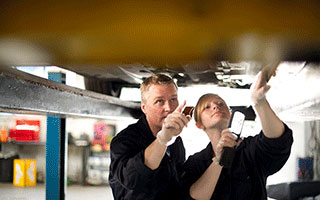
Two mechanics inspecting the underside of a car in a workshopModern automotive work is increasingly technical. The BLS notes that service technicians often use computerized diagnostic equipment and must understand electronic systems and sensors, including systems used for braking, transmission, and accident avoidance. Some technicians focus on electric vehicles, including battery performance, regenerative braking, and electric motor efficiency.1

Why Hands-On Training Still Matters

Online lessons can help with theory, vocabulary, and basic systems knowledge. But automotive work is physical and diagnostic. You need to handle tools, inspect real parts, work around lifts, follow safety procedures, and practice with vehicles or equipment.

For most students, the strongest training option includes real shop time. That does not mean online training is useless. It means you should know what it can and cannot do before you spend money.


How to Choose an Automotive School Near You

The best automotive school is not always the closest one or the one with the newest-looking shop photo. Compare programs based on what you actually want to do after training.

Ask these questions before requesting information:

  • Does the program focus on automotive technology, diesel, collision repair, motorcycles, or another specialty?
  • How much hands-on shop time is included?
  • What vehicles, diagnostic tools, lifts, and lab equipment will students use?
  • Does the program prepare students for ASE Entry-Level Certification or other industry credentials?
  • Are tools included, loaned, discounted, or purchased separately?
  • Does the school offer day, evening, weekend, or hybrid options?
  • Are internships, externships, apprenticeships, or employer partnerships available?
  • What are the total tuition, fees, tool, book, and certification costs?
  • Does the school publish completion, placement, or certification outcome information?

Four Questions Worth Asking First

Before you request information, ask whether tools are included, how much hands-on shop time students get, whether the program supports ASE Entry-Level preparation, and what employer or manufacturer connections are available. Those answers matter more than a glossy shop photo.

The BLS says high schools, community colleges, and technical institutes offer automotive service technology programs that usually provide classroom instruction and hands-on practice. These programs may lead to a certificate or associate degree, and some are sponsored by manufacturers or dealers.1


Automotive Program Types

Automotive programs come in several formats. The best choice depends on your budget, timeline, location, and career goal.

Program type Common length Best for Notes
Certificate 18 weeks to 2 years Focused technical training Can be a good fit for entry-level automotive skills.
Diploma About 1 to 2 years Broader hands-on preparation Common at career and technical schools.
Associate degree About 2 years Technical training plus general education May support advancement or future transfer options.
Apprenticeship / employer training Varies Paid on-the-job learning Availability depends on employers and local demand.
Manufacturer training Varies Brand-specific dealership work May focus on one automaker's systems and repair procedures.
Online coursework Variable Introductory theory or supplemental learning Usually not a full substitute for hands-on shop training.

For heavy vehicle and mobile equipment service technicians, the BLS notes that vocational and postsecondary diesel technology or heavy equipment mechanics programs may last 1 to 2 years and lead to a certificate, while associate degree programs generally take 2 years.5


How Much Does Automotive School Cost?

Automotive school costs depend on the school, location, program length, credential, and whether the program includes tools, books, certification exams, or manufacturer-specific training.

Training option Estimated cost range
Online automotive training Often under $1,000
Automotive certificate program $6,000 to $20,000
Associate degree in automotive technology $10,000 to $25,000
Books, tools, and enrollment costs Often adds $1,000 to $3,000
Housing/relocation Can add much more if needed

Imagine America estimates that online automotive training programs often cost less than $1,000, automotive certificate programs can cost $6,000 to $20,000, and associate degree programs in auto technology can cost $10,000 to $25,000. It also notes that books, tools, and other enrollment costs can add $1,000 to $3,000.7

Don't compare tuition alone. Ask each school for the full estimated cost, including tuition, fees, tools, books, uniforms, supplies, certification exams, transportation, and housing if relocation is required. Also ask whether students can use financial aid, scholarships, military benefits, payment plans, or employer-sponsored training.

Plan for More Than Tuition

Before you choose a program, ask each school for a full cost estimate that includes tools, supplies, books, fees, certification exams, transportation, and any required housing or relocation costs.


Do You Need ASE Certification?

You do not always need certification to start training or land an entry-level job, but certifications can matter as you build experience. Many employers prefer technicians who can show formal training, practical skill, and industry-recognized credentials.

The ASE Education Foundation says it sets standards for auto, diesel, and collision repair training, certifies career-ready students, accredits schools, and connects education with transportation careers. Its 2025 report area lists 118,000 students in ASE-accredited programs, 148,864 Entry-Level test passes, and 1,800 schools with ASE training programs.8

ASE Entry-Level Certification

ASE Entry-Level Certification can help students show foundational knowledge as they move toward the workforce. It is not the same as being an experienced master technician, but it can be a useful early credential.

Professional ASE Certification

Professional ASE certification usually comes later, after training, testing, and work experience. Schools can help prepare you, but completing school is not the same thing as becoming professionally ASE-certified.

EPA Section 609 Certification

If you repair or service motor vehicle air conditioning systems for payment or barter, the EPA says you must be properly trained and certified under Clean Air Act Section 609 by an EPA-approved program. EPA-approved programs cover MVAC servicing equipment, regulatory requirements, refrigerant recovery, and refrigerant handling, and certification requires passing a test.9

Learn more about ASE certification.


Automotive Career Salary and Outlook

Automotive training can lead to several related career paths. Pay varies by role, location, employer, experience, certification, and specialization.

Career path 2024 median pay 2024 to 2034 outlook
Automotive service technicians and mechanics $49,670 4 percent growth
Diesel service technicians and mechanics $60,640 2 percent growth
Automotive body and glass repairers $50,680 2 percent growth
Small engine mechanics $48,240 4 percent growth
Heavy vehicle and mobile equipment service technicians $62,740 6 percent growth
Heavy and tractor-trailer truck drivers $57,440 4 percent growth

The clean takeaway: automotive service has broad demand, but some related specialties can pay more. Diesel and heavy equipment are worth comparing if you want a hands-on path connected to trucks, large machinery, fleet maintenance, construction, agriculture, or industrial equipment. The BLS projects about 70,000 openings per year for automotive service technicians and mechanics over the decade, mostly because workers leave the occupation or retire.1


Find Automotive Schools Near You

Man lying on a creeper under a car, using a wrench to work on the underside of the vehicle in a garage.Automotive training is usually location-sensitive because hands-on shop work matters. A nearby program can make commuting easier, but don't choose by distance alone. Compare the program focus, lab equipment, instructor experience, schedule, cost, certification prep, and employer connections.

Use your ZIP code to find automotive schools near you, then request information from the programs that match your goals.


Automotive Training FAQs

How long is auto mechanic school?

Some automotive certificate programs may take several months, while associate degree programs are commonly designed around two years. The exact timeline depends on the school, credential, schedule, and whether you study full-time or part-time.

How much does automotive school cost?

Costs vary by school and program type. Online automotive training may cost under $1,000, certificate programs may cost $6,000 to $20,000, and associate degree programs may cost $10,000 to $25,000. Books, tools, and other fees can add more.7

Do I need school to become a mechanic?

Not always. Some workers enter the field with a high school diploma and learn on the job. But many automotive service technicians complete a program in automotive service technology or a related field, and some employers prefer formal training.1

What is the difference between an automotive mechanic and an automotive technician?

The terms overlap. "Technician" often suggests more diagnostic and electronic-systems work, while "mechanic" is the older, more familiar term. In real job postings, employers may use either title for similar roles.

What is the difference between automotive mechanic training and collision repair training?

Automotive mechanic training usually focuses on mechanical, electrical, diagnostic, and maintenance work for cars and light trucks. Collision repair training focuses more on body panels, structural damage, refinishing, glass, paint, and restoring a vehicle's exterior after damage.

Do automotive schools teach electric vehicles?

Some do, especially programs that emphasize modern diagnostics, electrical systems, hybrid technology, or manufacturer-specific training. Since EV and hybrid systems involve high-voltage safety, ask schools exactly what EV-related training is included.

Is ASE certification required?

ASE certification is not always required for entry-level work, but employers may prefer it. EPA refrigerant certification is different: technicians who service motor vehicle air conditioning systems for payment or barter must be trained and certified under Section 609 by an EPA-approved program.9

Can I take automotive training online?

Online automotive courses can help with theory, terminology, and basic systems knowledge. But automotive work is hands-on. If your goal is to repair vehicles professionally, compare whether a program includes practical shop experience, labs, externships, or employer-supported training.

What jobs can automotive training lead to?

Depending on your training, you may pursue roles such as automotive service technician, diesel mechanic, collision repair technician, motorcycle mechanic, heavy equipment service technician, service advisor, parts specialist, or shop supervisor.

Should I choose automotive, diesel, or heavy equipment training?

Choose automotive if you want to work mainly on cars and light trucks. Choose diesel if you're interested in trucks, buses, and diesel-powered systems. Choose heavy equipment if you want to work on construction, farming, rail, or industrial mobile equipment. If you're unsure, start with a broad automotive or diesel program and ask schools about specialization options.

How do I find auto mechanic schools near me?

Start with your ZIP code, then compare program focus, distance, schedule, tuition, hands-on lab time, certification prep, and employer connections. A close school is useful, but the best fit is the one that actually supports the kind of automotive career you want.


Sources

  1. U.S. Bureau of Labor Statistics, Automotive Service Technicians and Mechanics
  2. U.S. Bureau of Labor Statistics, Diesel Service Technicians and Mechanics
  3. U.S. Bureau of Labor Statistics, Automotive Body and Glass Repairers
  4. U.S. Bureau of Labor Statistics, Small Engine Mechanics
  5. U.S. Bureau of Labor Statistics, Heavy Vehicle and Mobile Equipment Service Technicians
  6. U.S. Bureau of Labor Statistics, Heavy and Tractor-Trailer Truck Drivers
  7. Imagine America Foundation, Automotive School Cost
  8. ASE Education Foundation
  9. U.S. Environmental Protection Agency, Section 609 Technician Training and Certification Programs

What's Next?

Featured Automotive School Locations