Welder vs. Electrician: Pay, Training, Work & Career Fit



Compare pay, training, licensing, physical demands, and day-to-day work before choosing a skilled trade.
Quick answer: Electricians currently have the stronger national pay and job-growth baseline, and most learn through a paid 4- or 5-year apprenticeship. Welding offers more varied entry routes and a direct fabrication craft, but the work can involve heavier exposure to heat, fumes, and awkward positions.
The better fit depends on whether you prefer troubleshooting systems and licensing milestones or hands-on metalworking and performance-based skill testing.
If you are choosing between welding and electrical work, the useful question is not “which trade is better?” It is which trade fits the way you want to train, work, and build a career.
On national labor-market numbers, electricians currently have the stronger baseline. The U.S. Bureau of Labor Statistics (BLS) reports a May 2025 median wage of $63,190 for electricians versus $53,750 for welders, cutters, solderers, and brazers. Electrician employment is projected to grow 9.2% from 2025 to 2035, compared with 2.4% for the welding occupation group. Electricians also have more projected annual openings: 72,700 versus 40,300.
But those numbers do not settle the decision. Electrical work usually means a longer, structured apprenticeship and state or local licensing rules. Welding offers more ways in, including technical school, employer training, and some apprenticeships, and the craft rewards hands-on precision in a very different way.
Quick take: If you want a paid apprenticeship, stronger national pay and growth, troubleshooting, and a clearer route into licensed contracting, electrical work deserves a hard look. If you want a more direct metalworking craft, enjoy fabrication, and value multiple training routes without one universal licensing path, welding may fit better.
On This Page
Welder vs. Electrician at a Glance
| Factor | Electrician | Welder* |
|---|---|---|
| May 2025 median pay | $63,190 | $53,750 |
| 2025-35 projected growth | 9.2% | 2.4% |
| Projected annual openings | 72,700 | 40,300 |
| Typical BLS entry education | High school diploma/equivalent | High school diploma/equivalent |
| Typical BLS training | Apprenticeship | Moderate-term OJT |
| Common training reality | 4-5 year paid apprenticeship; technical school can come first | Technical program, employer training, apprenticeship, or combinations |
| Regulation | Most states require electrician licensing; rules vary | Some states/localities license welders; employer/code credentials often matter |
| Core work style | Install, test, troubleshoot, repair electrical systems | Join/cut metal, prepare joints, control heat and process quality |
| Major work settings | Contractors, construction, manufacturing, service | Manufacturing, fabrication, specialty contracting, repair |
*BLS national data for SOC 51-4121 covers welders, cutters, solderers, and brazers, not welders alone. Specialized pipe, boilermaker, ironworker, and commercial-diving jobs may be classified elsewhere.
What Electricians and Welders Actually Do
The trades overlap in one obvious way: both reward people who would rather make something work than sit through a meeting about making something work. The day-to-day problems, though, are different.
Electricians troubleshoot systems
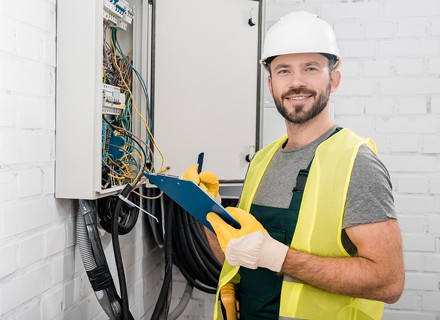
Electricians install, maintain, and repair power, lighting, communications, and control systems. BLS lists duties such as reading technical diagrams, installing wiring and controls, inspecting components, using testing devices to find faults, and following electrical codes.
That means the job often mixes physical installation with diagnosis. You may bend conduit and pull wire in the morning, then spend the afternoon tracing a fault that is invisible until your meter tells you where the problem lives.
Electrical work can be a good fit if you like:
- troubleshooting and logical diagnosis;
- diagrams, codes, and rules that have to be followed precisely;
- varied job sites and changing tasks;
- a mix of hands-on work and technical thinking;
- working with customers, contractors, apprentices, or other trades.
If that sounds good, see TSNET’s guides to electrician training and how to become an electrician.
Welders create and repair physical joints
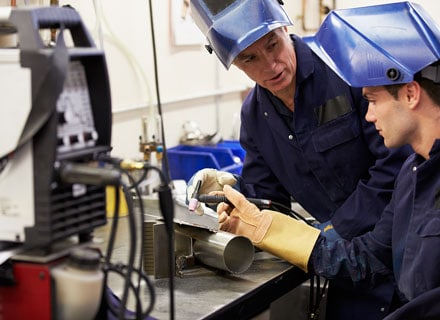
Welders and related workers read blueprints, measure components, inspect materials, adjust heat, and use welding or cutting equipment to join or shape metal. The skill is extremely physical and immediate: joint prep, torch or electrode control, travel speed, heat input, and positioning all show up in the finished work.
Welding can be a good fit if you like:
- visible craftsmanship and making physical parts;
- precise hand-eye coordination;
- fabrication, fit-up, layout, and metalworking;
- repeating a process until your technique gets genuinely clean;
- work where quality is demonstrated directly in the finished joint.
Explore welding training or TSNET’s how to become a welder guide for the pathway details.
Training: The Biggest Difference Between the Two Paths
This is where the choice gets interesting.
Electrician training is usually a long paid apprenticeship
BLS says most electricians learn through a 4- or 5-year apprenticeship. Apprentices typically receive about 2,000 hours of paid on-the-job training for each year of the program, plus technical instruction in electrical theory, blueprints, math, code requirements, safety, and related topics.
Some people attend technical school first. BLS notes that graduates may receive credit toward an apprenticeship, but technical school is not a universal substitute for the supervised experience required by licensing systems.
The upside is obvious: the dominant route is built around earning while learning. The downside is also obvious: becoming fully qualified takes years, and apprenticeship entry and licensing rules vary by state and locality.
For the detailed route, see the electrician apprenticeship guide.
Welding has more entry routes
BLS describes a less standardized path. Training may come from vocational-technical institutes, community colleges, private welding schools, employer-based apprenticeships, or direct employer training. Some employers hire inexperienced workers and train them on the job; others prefer applicants who already completed technical training or credentials.
That flexibility can make welding quicker to enter in some markets, because you do not always have to complete a multi-year apprenticeship before doing entry-level production or fabrication work. But there is no single national timeline. A person learning a straightforward production process and someone becoming a multi-process pipe welder are not on the same path.
TSNET’s welding apprenticeship guide covers the paid apprenticeship option specifically.
Licensing vs. Welding Certification: Do Not Mix These Up
This is one of the most useful differences to understand before paying for training.
Electricians commonly work under government licensing systems
BLS says most states require electricians to pass a test and be licensed, with requirements varying by state. Licensing exams commonly cover the National Electrical Code plus state and local rules. Some jurisdictions also require continuing education.
That makes electrical career portability less automatic. If you move, do not assume your current license transfers cleanly. Check the destination state’s or locality’s licensing board before making plans.
Welding credentials are often performance-based
BLS says welders must be licensed in some states and localities, but requirements vary. Separately, employers may require general or job-specific certifications.
The American Welding Society’s Certified Welder program is a good illustration of the difference. AWS describes it as strictly performance-based, with no prerequisite course or certification required before testing. The test demonstrates ability under a specific welding procedure, process, material, and position.
In plain English: passing one welding test does not magically certify you for every process, metal, position, employer, or code. That is why “certified welder” is not the same kind of blanket legal authority that an electrician license may provide within its issuing jurisdiction.
Pay: Electricians Lead the National BLS Distribution
The wage comparison is unusually clean at the national level. In May 2025, electricians earned more at every published BLS percentile.
| Wage percentile | Electricians | Welders, cutters, solderers & brazers |
|---|---|---|
| 10th | $42,640 | $39,240 |
| 25th | $49,430 | $46,790 |
| Median | $63,190 | $53,750 |
| 75th | $83,940 | $63,010 |
| 90th | $108,510 | $77,530 |
Do not read those percentiles as career stages. The 10th percentile is not “apprentice pay,” and the 90th percentile is not “master pay.” They are national wage-distribution points across workers, employers, industries, and locations.
Welding pay also varies substantially by industry. BLS reports a May 2025 median of $59,440 for the occupation group in specialty trade contractors, versus $51,210 in manufacturing. That matters because manufacturing employed about 63% of the occupation group in 2025.
Electricians were concentrated differently: about 66% worked for electrical contractors and other wiring installation contractors, while 7% were self-employed and 6% worked in manufacturing.
So yes, the national numbers favor electricians. But your local market, industry, overtime, union status, specialty, and employer can matter enough that a real job offer beats an internet median every time.
Job Outlook: Electricians Also Have the Stronger National Baseline
The current BLS Employment Projections cycle covers 2025 to 2035.
- Electricians: 821,000 jobs in 2025, projected to 896,900 in 2035, a 9.2% increase. About 72,700 openings per year are projected.
- Welders, cutters, solderers, and brazers: 437,700 jobs in 2025, projected to 448,100 in 2035, a 2.4% increase. About 40,300 openings per year are projected.
BLS expects electrician demand to benefit from ongoing installation and replacement of power systems, renewable-generation connections, grid upgrades, and new infrastructure associated with rising electricity demand, including data centers.
For welding, BLS points to infrastructure repair and continuing manufacturing demand, while also noting that automation in manufacturing may limit overall employment growth.
One nuance matters: openings are not the same thing as net new jobs. Both trades generate many openings because people retire, leave the labor force, or switch occupations. Welding can have tens of thousands of openings per year even with modest net growth.
For more context on that distinction, see TSNET’s skilled trades shortage analysis.
Work Environment and Physical Wear
Neither job is a spa day with a tool belt.
Electrician work is mobile, varied, and sometimes high-risk
BLS says electricians work indoors and outdoors, often travel between job sites, may work in cramped spaces, and can spend long periods standing or kneeling. Construction work can involve heights, weather exposure, dust, noise, and other site conditions.
Electrical work also carries obvious hazards. BLS lists electrical shocks, falls, and burns among common injury risks. PPE and safe procedures are not optional details when the thing you are troubleshooting can kill you without making a sound.
Welding adds heat, fumes, glare, and awkward positioning
Welders may work outdoors, in shops, on platforms, or in confined areas. BLS specifically notes heavy lifting and awkward positions such as overhead work, bending, stooping, and standing.
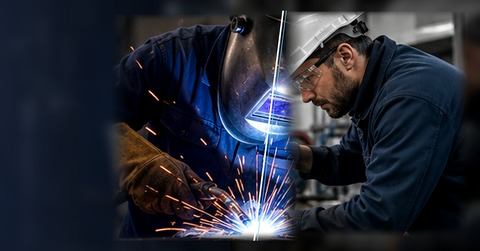
The major hazards are different: fumes, very hot materials, intense arc light, sparks, and related burn or respiratory risks. Welding helmets, hearing protection, heat-resistant gloves, and ventilation matter because the work environment can be punishing even when everything goes correctly.
If physical longevity is a major factor in your decision, compare both careers with TSNET’s broader physical-demands guide for trade careers.
Schedule and Lifestyle
There is no universal schedule for either trade, but the employment mix creates some patterns.
Electricians: BLS says almost all work full time; evenings and weekends may be required, and overtime is common. Service, maintenance, shutdown, and construction work can all change the schedule.
Welders: Most work full time, and some work more than 40 hours per week. Manufacturing employers may run two or three daily shifts, sometimes 8 to 12 hours each, so evening and weekend work is common in some settings.
If you strongly prefer local service work and eventual self-employment, electrical work may offer more obvious routes. BLS counted 7% of electricians as self-employed in 2025, compared with 4% of the welding occupation group. That does not guarantee an easier business path, but it is a useful snapshot of how the occupations are currently structured.
Which Trade Uses More Math?
Both do, but the math shows up differently.
Electrician apprentices receive technical instruction in mathematics along with electrical theory and code. In practice, the trade can involve algebraic formulas, load calculations, measurements, and layout work.
BLS notes that welding training often includes shop mathematics, blueprint reading, and mechanical drawing. Welders use measurement, fractions and decimals, geometry, fit-up, and spatial reasoning constantly.
If school algebra makes you want to fake your own death, do not assume welding is “the no-math trade.” It is not. But electrical work generally places more emphasis on formal electrical calculations and code-based technical study.
Which Career Has the Better Long-Term Path?
There is no universal winner, but the tradeoffs are pretty clear.
Electrician may fit you better if you want:
- a structured paid apprenticeship as the standard route;
- stronger current national median pay and projected growth;
- troubleshooting and system diagnosis;
- work built around electrical code and licensing milestones;
- a career where self-employment and contracting are common enough to be visible in national data;
- varied construction, service, or industrial environments.
Welding may fit you better if you want:
- a craft centered on metal fabrication and visible physical output;
- multiple possible entry routes rather than one dominant national pathway;
- technical training that can lead to entry-level work without first completing a four- or five-year apprenticeship;
- a skill where performance can be demonstrated directly through qualification testing;
- manufacturing, fabrication, repair, or specialty-contracting environments;
- less dependence on a state electrician-style licensing framework.
Think twice about electrical work if:
- you hate code study and troubleshooting;
- you want to be fully qualified in a few months;
- you strongly dislike heights, ladders, crawlspaces, or changing job sites;
- you do not want to deal with state/local licensing requirements.
Think twice about welding if:
- heat, fumes, glare, heavy PPE, or awkward postures are dealbreakers;
- you assume every welding specialty pays like the wildest salary claim on TikTok;
- you want a career with faster projected national growth;
- you dislike repetitive technique practice and being judged on the quality of a physical result.
Still torn? TSNET’s trade career quiz can help you compare preferences across more than two occupations, and the electrician vs. HVAC vs. plumber comparison is useful if electrical work appeals to you but welding does not quite fit.
Questions to Ask Before Choosing Training
Whether you are considering a welding program or an electrical pre-apprenticeship, ask questions that expose what you are actually buying.
- What job or apprenticeship does this program prepare me for? Ask for specific employers, occupations, or apprenticeship pathways, not “career-ready” fog.
- How much hands-on training is included? Lab or booth time matters in both trades.
- For electrical training, does the program receive any credit toward local apprenticeship or licensing requirements? Verify the answer with the licensing board or apprenticeship sponsor.
- For welding training, what processes, materials, and positions will I actually practice? Ask whether qualification testing is included or separate.
- What is the full cost? Include tools, PPE, consumables, books, testing fees, and any other required expenses.
- What do graduates actually do next? Ask for verifiable placement information and the names of employers or apprenticeship sponsors that recruit graduates.
- Can I reach the same goal through paid apprenticeship or employer training? A school may still be the right move, but you should know the alternatives before signing debt paperwork.
FAQ
Who makes more, welders or electricians?
Nationally, electricians currently earn more across the published BLS wage distribution. The May 2025 median was $63,190 for electricians versus $53,750 for welders, cutters, solderers, and brazers. Local market and specialty can change individual outcomes.
Which trade takes longer to learn?
The standard electrician route is longer. BLS says most electrician apprenticeships last 4 to 5 years. Welding has several entry routes, and some employers train inexperienced workers on the job, so entry-level employment can happen sooner in some markets. Advanced welding specialties can still take years to master.
Is welding harder than electrical work?
They are hard in different ways. Welding puts heavy demands on hand-eye coordination, posture, heat tolerance, and consistent physical technique. Electrical work adds more formal code study, troubleshooting, testing, and licensing responsibility. Your definition of “hard” matters.
Do welders need a license?
Sometimes. BLS says welders must be licensed in some states and localities, and requirements vary. Employers may also require specific certifications or performance qualifications for particular work.
Do electricians need a license?
Usually at the state or local level. BLS says most states require electricians to pass a test and be licensed, but requirements vary by jurisdiction.
Which trade has more job openings?
Electricians. BLS projects about 72,700 electrician openings per year from 2025 to 2035, compared with about 40,300 for welders, cutters, solderers, and brazers.
Can an electrician also weld?
Yes, an electrician can learn welding, but welding ability does not automatically provide whatever qualification a specific welding job requires. Treat it as a separate skill set with its own testing and employer expectations.
Can a welder become an electrician?
Yes. Welding experience can provide useful job-site, tool, measurement, and safety skills, but it generally does not replace the electrical apprenticeship or licensing requirements that apply in the destination jurisdiction.
Sources and Data Notes
Labor-market figures were independently verified September 16, 2026.
- U.S. Bureau of Labor Statistics, Occupational Employment and Wage Statistics (OEWS), May 2025. National wage and employment data for Electricians (SOC 47-2111) and Welders, Cutters, Solderers, and Brazers (SOC 51-4121). Released May 15, 2026.
- U.S. Bureau of Labor Statistics, Employment Projections 2025-2035, occupational projections and characteristics. Released August 27, 2026.
- U.S. Bureau of Labor Statistics, Occupational Outlook Handbook: Electricians, last modified August 27, 2026.
- U.S. Bureau of Labor Statistics, Occupational Outlook Handbook: Welders, Cutters, Solderers, and Brazers, last modified August 27, 2026.
- American Welding Society, Certified Welder Program, checked September 16, 2026.
- U.S. Department of Labor, Apprenticeship.gov, Registered Apprenticeship occupation resources, checked September 16, 2026.
Important scope note: National welding statistics on this page use SOC 51-4121, which includes welders, cutters, solderers, and brazers. Specialized occupations that also perform welding may be classified separately and should not be used to inflate ordinary welder earnings.
Explore Training Options
If one path is starting to fit, compare the actual training routes before committing money. Use the school finder below, or start with the dedicated electrician and welding guides.