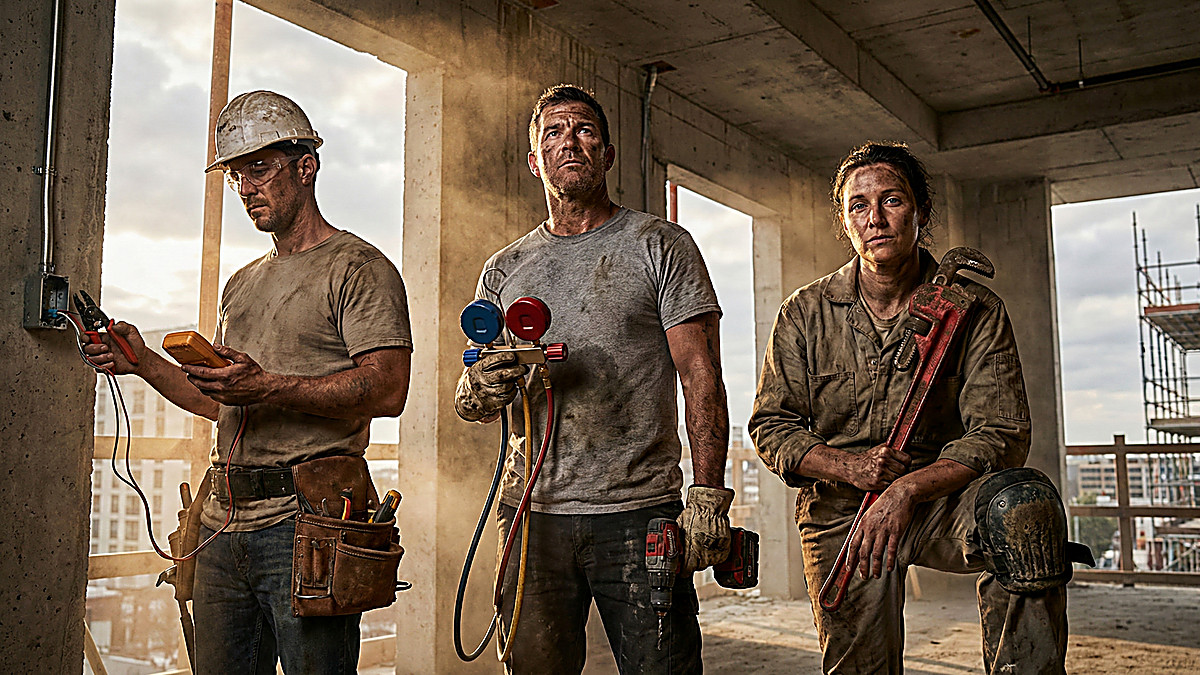
How Physically Demanding Are the Trades? Compare 31 Skilled Careers



Pay and training time matter. So do heights, awkward positions, outdoor weather, noise, repetitive motion, customer contact, and whether your schedule behaves itself. This guide and free comparator use U.S. occupational data to show how those conditions differ across skilled careers.
What you can do: Select two to four careers, choose optional working-condition preferences, and compare source-backed patterns side by side.
What this cannot do: Decide whether a job is medically safe or personally suitable for you. Working conditions vary by employer, specialty, worksite, equipment, region, seniority, and assignment.
Trade Career Working Conditions Comparator
Compare up to four U.S. skilled careers. Preferences change the order and highlight tradeoffs; they never hide a career.
Choose two to four careers
Your comparison
Questions to take with you
These questions are generated from your selections. Specific employers and schools can tell you more than a national occupation average can.
Ask an employer
Ask a school
What Does “Physically Demanding” Actually Mean?
A job can be demanding in several different ways. Lifting is only one of them, and it is not available as a universal comparison across all 31 careers in the current federal data.
Movement
Standing, walking, climbing, balancing, bending, and working in low postures.
Repetition
Repeated hand, arm, or body movements can matter even when individual items are light.
Environment
Outdoor weather, noise, heights, cramped spaces, and changing worksites.
Schedule
Regular, irregular, or seasonal schedules can affect sleep, transportation, and family routines.
Interaction
Customer, patient, coworker, and public contact can shape the pace and emotional demands of a role.
Variation
Specialty, employer, tools, and setting can make two jobs with the same title feel very different.
How to Read the Comparison
The tool leads with the most common O*NET response for each occupation. It also shows a 0-to-100 score created from O*NET's 1-to-5 mean. That score is only for sorting the same variable across careers. A standing score cannot be compared directly with a customer-interaction score.
Open Why this result? to see the response distribution, sample size, standard error, confidence bounds, source date, and respondent type. Small differences should not be treated as precise rankings.
Careers With More Height or Climbing Exposure
Linework, wind turbine service, solar installation, elevator work, carpentry, and some electrical assignments can involve height exposure or climbing. But those are two different measures: O*NET separately asks about time spent climbing ladders, scaffolds, or poles and how often workers are exposed to high places.
If heights matter to you, ask employers what equipment is used, how often the task occurs, whether it is an essential function of the specific position, and how specialty assignments differ.
Outdoor and Weather Exposure
Electrical linework, wind and solar work, construction, heavy-equipment repair, and field service can involve more outdoor exposure than many shop, laboratory, drafting, pharmacy, dental, or clinical roles. Region and employer matter enormously: outdoor work in Minnesota is not the same gig as outdoor work in Arizona.
Kneeling, Awkward Positions, and Repetitive Motion
Plumbing, HVAC/R, automotive repair, diesel work, construction, and equipment maintenance may involve low postures or tight spaces. Healthcare and production roles can involve long standing or repeated fine hand tasks. None of those patterns automatically makes a career good or bad. The useful question is which demands occur, how often, and what equipment or work practices are used.
Indoor and More Seated Technical Careers
Drafting, electronics-related work, biomedical equipment service, avionics, CNC programming, pharmacy technology, and some healthcare roles may offer more indoor or seated time than outdoor construction careers. That does not mean effortless. Precision, repetition, time pressure, patient contact, and sustained attention can be important parts of the job.
Schedules and Interaction Can Matter as Much as Posture
O*NET provides a regular, irregular, or seasonal schedule distribution, plus measures for time pressure, contact with others, and the importance of dealing with customers or the public. Shift work, overnight travel, emergency callouts, and on-call requirements are not consistently available for every occupation in a comparable federal dataset, so the tool does not invent those answers. Ask specific employers.
How to Evaluate a Career Before Enrolling
- Use the comparator to identify two or three conditions that matter most to you.
- Visit a lab, shop, clinic, hangar, or worksite if the school or employer permits it.
- Ask what entry-level workers do during a normal shift, not only what experienced specialists do.
- Ask about lifting equipment, personal protective equipment, scheduling, travel, and specialty differences.
- Confirm licensing, certification, clinical, apprenticeship, or internship requirements in your state and program.
- If you need an accommodation, ask about the formal process rather than assuming a national average predicts what is possible.
Then use the relevant TSNET career guide linked from each comparison card to research training routes, pay, and schools.
Frequently Asked Questions
Are all trade careers physically demanding?
No. Skilled careers differ across movement, posture, repetition, environment, schedules, and interaction. A role with lighter lifting may still involve standing, repetition, or time pressure.
Which skilled careers involve heights?
Linework, wind turbine service, solar installation, elevator work, carpentry, construction, and some electrical work can involve heights. Frequency varies by specialty and employer.
Which skilled careers are mostly indoors?
Drafting, pharmacy technology, biomedical equipment work, electronics-related work, CNC programming, and many clinical roles generally show lower outdoor exposure than field construction and utility occupations.
Why can working conditions differ within the same career?
Employer, specialty, worksite, tools, region, seniority, and assignment can all change the day-to-day demands.
Does this tool tell me whether a job is safe for a medical condition?
No. It provides occupation-level career information, not individualized medical or disability advice.
Sources and Methodology
- O*NET Database 30.3, Work Context: the universal working-conditions source for all 31 careers. O*NET database
- BLS Occupational Requirements Survey 2025: supplemental detailed estimates for 14 covered occupations. Estimates are preliminary and include sampling uncertainty. ORS data
- BLS Occupational Employment and Wage Statistics, May 2025: national employment and median annual wages. OEWS
- BLS Employment Projections, 2024-34: national growth, annual openings, entry education, and on-the-job training. Employment Projections
Data version 1.0.0, checked July 17, 2026. O*NET collection dates vary by occupation and appear in the tool. ORS excludes federal government, military, agriculture, private household workers, and self-employed workers.
Explore Training Options
Once you have a shortlist, compare training length, credential requirements, school labs, and local employer expectations.