Healthcare Career Quiz: Which Medical Career Fits You?



Healthcare is not one kind of job. Use the quiz to narrow 22 careers by the things that actually change your workday: training time, blood and clinical exposure, patient contact, pressure, schedule, physical workload, technology, and data.
What this quiz can tell you
It can build a useful shortlist. It cannot tell you your destiny, diagnose your personality, or replace job shadowing. The tool uses TSNET editorial career profiles informed by current BLS and O*NET occupational data.
No email gate. No pay-to-unlock result. No advertiser weighting. Your answers stay in your browser, and pay or school availability does not influence the ranking.
Take the Healthcare Career Quiz
Answer for the workday you can realistically live with, not the version of yourself who wakes up at 5 a.m., loves every bodily fluid, and has infinite tuition money.
How the Matching Works
- Training and strict exposure preferences act as filters. If you say blood and bodily fluids are a hard no, the quiz removes careers where clinical exposure is a meaningful part of the work.
- The remaining careers are compared with your workday preferences. Patient contact, pace, physical activity, schedule, equipment, and data work all matter.
- Your preferred kind of work and outcome get extra weight. Someone who wants diagnostic imaging should not get pushed toward medical records simply because both can have relatively controlled environments.
- Money is deliberately kept out of the fit score. Median pay and job openings appear in the result card so you can evaluate the trade-off after the match.
The 1-to-5 occupation profiles are TSNET editorial normalizations informed by BLS occupation descriptions and O*NET Work Context/Work Activities. They are not government-issued fit scores and this is not a psychometric test.
Fast Ways to Narrow the Field
If blood is a hard no
Start with healthcare jobs with less blood exposure, especially medical records, health information, optician work, pharmacy technology, and some imaging paths.
If you want technology
Compare sonography, radiologic technology, MRI, cardiovascular technology, clinical laboratory work, and health information technology.
If you want lots of people contact
Nursing, therapy-assistant careers, dental roles, medical assisting, respiratory therapy, phlebotomy, imaging, and EMS all put you face-to-face with people.
If training time matters most
Start with nondegree routes such as medical assisting, dental assisting, pharmacy technology, phlebotomy, surgical technology, sterile processing, LPN/LVN, EMT, optician work, and medical records.
Compare the 22 Healthcare Careers
Wages are May 2025 national median annual wages from the BLS Occupational Employment and Wage Statistics program. Growth and annual openings are BLS 2025-35 projections released August 27, 2026.
| Career | SOC | Median pay | Growth | Annual openings | Typical entry education |
|---|---|---|---|---|---|
| Medical Assistant | 31-9092 | $45,690 | 12.9% | 109,700 | Postsecondary nondegree award |
| Dental Assistant | 31-9091 | $48,070 | 7.4% | 53,000 | Postsecondary nondegree award |
| Dental Hygienist | 29-1292 | $98,100 | 8.0% | 15,000 | Associate's degree |
| Pharmacy Technician | 29-2052 | $45,750 | 6.4% | 44,700 | High school diploma or equivalent; moderate-term OJT |
| Phlebotomist | 31-9097 | $45,230 | 6.8% | 18,000 | Postsecondary nondegree award |
| Diagnostic Medical Sonographer | 29-2032 | $96,590 | 13.9% | 6,000 | Associate's degree |
| Radiologic Technologist | 29-2034 | $80,110 | 5.0% | 13,000 | Associate's degree |
| MRI Technologist | 29-2035 | $95,480 | 7.7% | 2,300 | Associate's degree |
| Cardiovascular Technologist or Technician | 29-2031 | $74,310 | 3.7% | 3,400 | Associate's degree |
| Respiratory Therapist | 29-1126 | $82,280 | 8.5% | 8,600 | Associate's degree |
| Surgical Technologist | 29-2055 | $64,650 | 5.0% | 7,100 | Postsecondary nondegree award |
| Sterile Processing Technician | 31-9093 | $47,700 | 10.8% | 10,700 | High school diploma or equivalent; moderate-term OJT |
| Clinical Laboratory Technician BLS publishes this wage/outlook at combined 29-2010 grain. |
29-2010 | $62,930 | 2.7% | 20,800 | BLS combined occupation lists a bachelor's degree; technician pathways often differ |
| Occupational Therapy Assistant | 31-2011 | $72,300 | 21.5% | 8,100 | Associate's degree |
| Physical Therapist Assistant | 31-2021 | $68,380 | 23.0% | 18,500 | Associate's degree |
| Licensed Practical or Vocational Nurse | 29-2061 | $64,400 | 3.0% | 51,800 | Postsecondary nondegree award |
| Registered Nurse BLS lists a bachelor's degree as typical entry education; ADN pathways also exist. |
29-1141 | $97,550 | 5.6% | 180,800 | BLS typical entry education: bachelor's degree; ADN routes also exist |
| Emergency Medical Technician (EMT) | 29-2042 | $44,470 | 5.8% | 13,800 | Postsecondary nondegree award |
| Paramedic | 29-2043 | $60,600 | 5.7% | 4,300 | Postsecondary nondegree award |
| Dispensing Optician | 29-2081 | $47,260 | 4.2% | 5,600 | High school diploma or equivalent; long-term OJT |
| Medical Records Specialist | 29-2072 | $51,140 | 7.8% | 14,000 | Postsecondary nondegree award |
| Health Information Technologist or Medical Registrar | 29-9021 | $68,020 | 15.9% | 3,000 | Associate's degree |
Important: a national median is not a starting salary. BLS wage percentiles also are not experience bands. Pay varies by employer, location, industry, schedule, specialty, and other factors.
Which Kind of Healthcare Work Actually Fits You?
Imaging and diagnostic technology
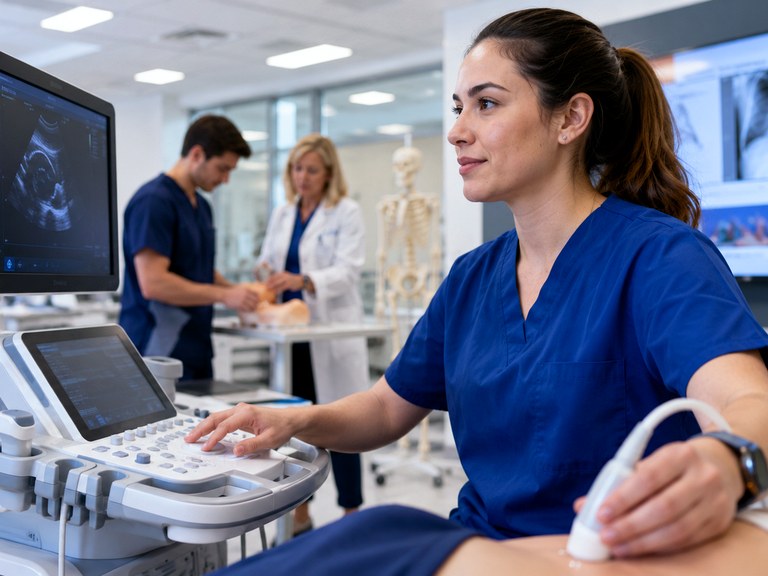
Sonography, radiologic technology, MRI, and cardiovascular technology combine equipment, anatomy, patient positioning, and diagnostic workflows.
Direct clinical and nursing care
Medical assisting, LPN/LVN nursing, RN nursing, respiratory therapy, EMT, and paramedicine put human care at the center and usually demand more tolerance for clinical messiness.
Rehabilitation
Occupational therapy assistants and physical therapist assistants spend a lot of time coaching, observing, motivating, and physically assisting patients.
Lab, pharmacy, procedural, and sterile work
Clinical lab technicians, pharmacy technicians, phlebotomists, surgical technologists, and sterile processing technicians all reward precision, but patient contact ranges from almost none to constant.
Health information and records
Medical records specialists and health information technologists put healthcare knowledge into coding, data quality, registries, records, and systems. They are worth a serious look if you want healthcare without bedside care.
Career Fit Is Mostly About the Parts Nobody Puts on the Brochure
A job can sound fascinating and still be a terrible fit at 3:17 p.m. on a Tuesday. Before you choose a program, think about the work conditions that repeat every day.
- Patient contact: Imaging can be highly technical and still involve constant patient interaction. O*NET reports very high contact-with-others scores for sonographers and radiologic technologists.
- Physical load: Dental hygiene involves less walking than many hospital jobs but substantial bending and static posture. PTA work is much more whole-body active.
- Clinical exposure: Behind-the-scenes does not automatically mean biologically clean. Sterile processing and laboratory work can involve contaminated instruments or specimens even with little bedside care.
- Schedule: The same broad career can feel different in an outpatient office versus a hospital. Employer and specialty matter.
- Responsibility: Pharmacy technology, imaging, respiratory care, nursing, lab work, and sterile processing all require precision even when the type of consequence differs.
Before Enrolling, Verify the Actual Credential Path
Healthcare education is full of acronyms, and they are not decorative alphabet soup. A program can look legitimate without necessarily meeting the eligibility rules for the credential or license you need.
- Radiography and MRI: ARRT's primary pathway requires an associate degree or higher and completion of an ARRT-approved educational program in the discipline. State licensing is separate and varies by state.
- Sonography: ARDMS publishes multiple prerequisite pathways. Graduation from an appropriately programmatically accredited sonography program is one route, but it is not the only possible route.
- Occupational therapy assisting: NBCOT says U.S.-educated COTA candidates must graduate from an ACOTE-accredited OTA program to be eligible for the certification exam.
- Physical therapist assisting: CAPTE is the recognized programmatic accreditor for entry-level PTA education, and state licensure requirements should be checked before enrollment.
- Respiratory therapy: CoARC states that graduation from a CoARC-accredited or qualifying provisional program is tied to eligibility for NBRC credentialing exams. State licensure requirements also apply in most jurisdictions.
- Pharmacy technology: PTCB's CPhT pathway can be met through a PTCB-recognized education/training program or qualifying work experience, but state board rules are separate.
For nursing, dental assisting, dental hygiene, EMS, phlebotomy, opticianry, and other regulated roles, check the state board or agency where you intend to work. National certification and state permission to practice are not the same thing.
Use Your Quiz Result as a Shortlist, Then Try to Break It
- Shadow or interview someone doing the job. Ask what a normal shift is like, what hurts after ten years, what schedules new hires actually get, and what they wish school had made clearer.
- Check the legal path in your state. Verify licensure, certification, background-check, exam, and continuing-education rules with the relevant official body.
- Verify the program's eligibility value. Ask which credentialing exam or license graduates are eligible for and confirm the answer with the credentialing or licensing organization.
- Ask about clinical placements. Find out who arranges them, how far students may travel, whether nights/weekends are possible, and what happens if a placement falls through.
- Compare the complete cost. Include fees, uniforms, equipment, immunizations, background checks, exams, transportation, and lost work time.
If your result is mostly driven by a two-year training limit, you may also want our guide to two-year medical degrees that pay well. If you care more about minimizing clinical exposure, use the deeper healthcare jobs without blood guide.
Healthcare Career Quiz FAQ
Is this a real healthcare aptitude test?
What healthcare career is best if I hate blood?
Which two-year healthcare careers pay well?
Can I work in healthcare without a four-year degree?
Does the highest-paying match automatically rank first?
Why do some healthcare careers have state-specific warnings?
Sources and Methodology
Career pay and employment outlook were independently rebuilt for this page using current federal datasets rather than copied from older TSNET pages or third-party career sites.
- U.S. Bureau of Labor Statistics, Occupational Employment and Wage Statistics - May 2025 national wages and employment, released May 15, 2026.
- U.S. Bureau of Labor Statistics, Employment Projections - 2025-35 occupational projections, released August 27, 2026.
- BLS Occupational Outlook Handbook, Healthcare Occupations - occupation descriptions, work environments, and education context.
- O*NET OnLine - Work Context and Work Activities used as evidence for TSNET's simplified workday profiles.
- ARRT primary eligibility requirements and ARRT state licensing guidance.
- ARDMS examination prerequisites.
- NBCOT eligibility.
- CoARC student accreditation guidance.
- CAPTE accredited-program directory.
- PTCB Certified Pharmacy Technician eligibility.
Data verified September 14, 2026. O*NET survey dates differ by occupation, so O*NET values are used directionally, not presented as a single synchronized federal ranking.
Explore Healthcare Training Options
Once you have two or three careers worth investigating, compare programs with the credential path in mind. The school finder can help you see available options, but verify program eligibility and state requirements before you commit.