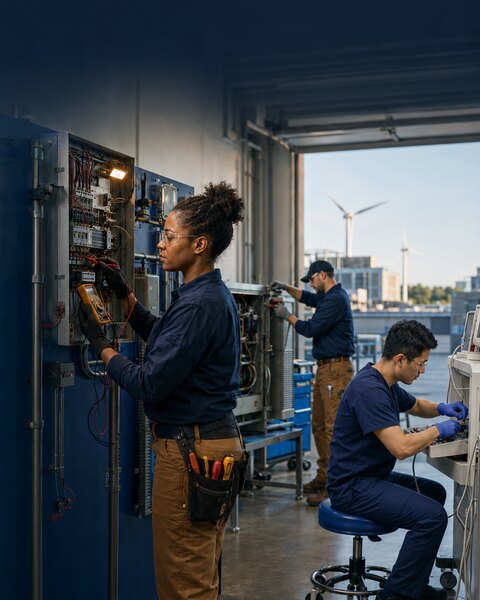
Wind Turbine Technician Career: Pay, Training, Travel, and What the Work Is Really Like



Wind turbine technician has one of the most eye-catching growth numbers in the U.S. Bureau of Labor Statistics handbook: employment is projected to grow 50 percent from 2024 to 2034.
Useful? Absolutely.
Enough to choose a career? Not even close.
Wind turbine technicians work on complex power-generation equipment that can sit hundreds of feet above the ground. The job can involve climbing, confined spaces, outdoor weather, physical labor, electrical and mechanical troubleshooting, electronic monitoring, strict safety procedures, and, in some positions, substantial travel.
For the right person, that's the appeal.
So the better question isn't just, "Is wind turbine technician a good career?"
Could you realistically handle the work, and would you enjoy the technical career that comes with it?
Wind Turbine Technician Career Snapshot
| Career factor | U.S. data |
|---|---|
| Official occupation | Wind Turbine Service Technicians |
| SOC code | 49-9081 |
| Median annual wage | $64,120 |
| Median hourly wage | $30.83 |
| Wage data year | May 2025 |
| Typical entry-level education | Postsecondary nondegree award |
| Related work experience typically required | None |
| Typical on-the-job training | Long-term |
| Employment baseline | 13,600 jobs in 2024 |
| Projected employment | 20,500 jobs in 2034 |
| Projected growth | 50% |
| Projected numeric growth | 6,800 jobs |
| Average projected openings | About 2,300 per year |
BLS projects employment to rise from 13,600 workers in 2024 to 20,500 in 2034. That makes wind turbine service technician one of the fastest-growing occupations percentage-wise, but it is still a relatively small occupation. The 50-percent projection represents about 6,800 additional jobs over the decade, not hundreds of thousands.
The May 2025 median wage was $30.83 per hour, equivalent to about $64,120 per year for full-time year-round work.
Sources: BLS Occupational Outlook Handbook and BLS May 2025 Occupational Employment and Wage Statistics.
What Does a Wind Turbine Technician Do?
Wind turbine technicians inspect, maintain, diagnose, and repair wind turbines.
The official federal occupational title is wind turbine service technician, but you may also see:
- Wind turbine technician
- Wind technician
- Wind tech
- Wind energy technician
- Wind farm technician
- Site technician
- Field service technician
- Troubleshooting technician
The U.S. Department of Energy also lists windsmith as an alternate title, although it's less common in everyday job searching.
Titles can be fuzzy. "Field service technician" at one employer might mean traveling among multiple sites. Another company may use similar wording for a technician who works primarily at one facility.
The actual job description matters more than the label.
Typical wind-tech duties include:
- Inspecting turbine components
- Performing scheduled maintenance
- Diagnosing equipment problems
- Repairing or replacing components
- Troubleshooting electrical, mechanical, and hydraulic systems
- Reviewing electronic monitoring data
- Using computers to help diagnose faults
- Documenting inspections and completed work
- Climbing towers to access turbine equipment
BLS describes windtechs as maintaining mechanical, electrical, hydraulic, braking, and programmable control systems. Modern turbines also use electronic monitoring equipment that can alert technicians when problems occur.
That multidisciplinary mix is one of the occupation's defining features.
You're not simply a mechanic who happens to work in the sky. You're working on a machine that combines industrial mechanics, electricity, hydraulics, sensors, controls, communications, and computer diagnostics.
Sources: BLS and U.S. Department of Energy Wind Technician Career Map.
What Does a Typical Day Look Like?
There isn't one universal wind-tech workday.
A scheduled maintenance day may involve inspecting equipment, servicing components, checking operating conditions, replacing worn parts, and recording what was done.
A troubleshooting day may begin with electronic monitoring data showing that a turbine has developed a fault. Technicians review available information, inspect the turbine, determine what is wrong, make the necessary repair within their training and responsibilities, and document the work.
Some days involve more computer diagnostics.
Others involve more climbing, tools, mechanical work, and awkward body positions.
Documentation matters throughout. BLS specifically identifies recordkeeping, precise measurements, ordered procedures, and safety requirements as important parts of turbine maintenance.
So if your ideal maintenance record is "fixed the weird noise, seems fine," this occupation may find your paperwork philosophy distressing.
How Much Climbing Is Involved?
Working at height is not a side feature of this job.
It's central to it.
BLS says turbine towers are commonly more than 200 feet tall, and technicians must climb to reach the nacelle while using fall-protection equipment and carrying tools.
Modern turbines can be considerably taller. According to the U.S. Department of Energy, the average hub height of newly installed U.S. land-based wind turbines reached about 339 feet in 2023.
O*NET's current work-context data makes the point even clearer:
97 percent of surveyed wind turbine service technicians report exposure to high places every day.
You do not need to be thrilled by heights.
You do need to be capable of working effectively at them.
If heights cause significant fear or loss of focus, that's something to take seriously before spending money on training.
How Physical Is Wind Turbine Technician Work?
Wind turbine maintenance combines height with physical work, cramped equipment spaces, and outdoor conditions.
BLS says technicians need the stamina to climb turbine towers and enough strength to carry tools, parts, and equipment, some weighing 50 pounds or more.
O*NET provides a useful picture of the working environment:
What the Job Really Requires
Working at heights97% report daily exposure to high places.
Cramped or awkward spaces83% report daily exposure.
Hazardous conditions91% report daily exposure.
Outdoor weather79% report daily exposure in all weather conditions.
Very hot or cold temperatures66% report daily exposure.
Specialized safety equipment100% report daily use.
Hands-on tool/equipment work87% report nearly continuous use of their hands, tools, or controls.
Documentation and accuracyErrors can have serious consequences, and maintenance records are part of the job.
The useful takeaway isn't any single percentage.
It's the combination.
You may be fine with heights. You may enjoy physical work. You may not mind bad weather. Wind maintenance can ask you to deal with all three while diagnosing expensive equipment in a setting where attention to detail matters.
Sources: BLS and O*NET Work Context.
Do Wind Turbine Technicians Travel?
Travel varies enormously by job.
Some technicians work primarily at one wind farm or a small group of nearby facilities.
Others work in field-service, commissioning, or multi-site roles that involve much more travel.
BLS says wind technicians may travel to rural wind farms or offshore installations. It also says most work full time and may be on call during evenings or weekends.
That means two people with the same basic occupation can have very different lifestyles.
Site-Based Technicians
A site-based technician generally works at one wind facility or within a relatively limited area.
That can mean:
- More predictable commuting
- Less overnight travel
- Familiar equipment and coworkers
- Greater familiarity with one site's turbine fleet
It doesn't necessarily mean a perfect Monday-to-Friday schedule. Evening or weekend on-call work can still be part of the occupation.
Traveling or Field-Service Technicians
Field-service positions can involve moving among multiple wind sites or projects.
Those jobs may suit somebody who likes changing locations and doesn't mind spending time away from home.
They can be a lousy fit if you need:
- Minimal overnight travel
- A highly predictable home schedule
- The same worksite every day
- Easy coordination around family or other responsibilities
Never infer the travel requirement from the occupation title alone. Read the actual posting.
Offshore Wind Technicians
Offshore work adds marine transportation and longer periods away from home.
BLS says offshore wind assignments may require technicians to be away for several days or weeks at a time.
Additional offshore-specific training may also apply. For example, the current Global Wind Organisation Basic Safety Training framework includes Sea Survival alongside modules such as Working at Heights, First Aid, Fire Awareness, and Manual Handling.
Specific vessel arrangements, schedules, medical standards, and qualification requirements depend on the employer and project.
There is no useful universal statement like "all offshore wind technicians work a 14-on/14-off rotation." Reality is messier than LinkedIn career porn.
Sources: BLS and GWO Basic Safety Training.
Site-Based vs. Traveling vs. Offshore Wind Work
| Factor | Site-based | Traveling / field service | Offshore |
|---|---|---|---|
| Main assignment | One site or local group | Multiple sites or projects | Offshore facility |
| Overnight travel | Usually lower | Potentially substantial | Often part of the role |
| Time away from home | Usually lower | Role-dependent | May be days or weeks |
| Environment | Land-based wind farm | Varies | Marine / offshore |
| Schedule | Often more consistent | Project-dependent | Employer / project-dependent |
| Additional training | Site / employer dependent | Site / employer dependent | Offshore-specific safety preparation may apply |
| Best fit | Wants location stability | Comfortable with mobility | Comfortable with turbine and marine environments |
The travel question deserves serious attention before accepting a job.
For many people, it will matter more to quality of life than the salary number.
What Technical Skills Do Wind Techs Need?
Wind turbine service is an electromechanical career.
Technicians need enough breadth to understand how several systems interact.
Electrical and Control Systems
Wind turbines contain generators, motors, electrical equipment, control systems, sensors, and communications hardware.
Technicians need to read technical information, identify abnormal conditions, and troubleshoot equipment within the limits of their training and employer qualifications.
Mechanical Systems
Mechanical components include shafts, bearings, gearing, braking systems, and yaw equipment.
Mechanical aptitude is essential.
If you enjoy figuring out why machinery isn't behaving like machinery should, that's a useful signal.
Hydraulic Systems
Hydraulics are used in some turbine systems, including braking and blade-control functions.
Wind-energy training commonly includes hydraulic fundamentals alongside electrical and mechanical subjects. BLS specifically identifies hydraulic systems as part of windtech education and maintenance work.
Controls and Sensors
Modern turbines use sensors and programmable control systems to monitor and manage operation.
Windtech coursework can include programmable logic controls, and DOE describes technicians as needing familiarity with controls, communications, electronics, mechanical systems, hydraulics, and electrical systems.
Computer Diagnostics and Monitoring
BLS says turbines use electronic monitoring equipment to detect problems, and technicians may access that information either onsite or remotely before traveling to the turbine to make repairs.
That makes wind technology a potentially good fit for someone who likes both hands-on machinery and computer-assisted troubleshooting.
Documentation
Technicians also need to interpret technical documents and record inspections, measurements, repairs, and equipment problems clearly.
The wrench matters.
So does the keyboard.
How Do You Become a Wind Turbine Technician?
BLS classifies postsecondary nondegree education as the typical entry pathway for wind turbine service technicians, followed by long-term on-the-job training.
That doesn't mean there is one mandatory school credential.
Several routes can lead toward the field.
Wind-Energy Certificate Programs
Technical schools and community colleges may offer certificates specifically in wind energy technology.
BLS says coursework can include:
- Electrical systems
- Hydraulic systems
- Mechanical and braking systems
- Programmable logic controls
- Tower-climbing preparation
- Safety and rescue training
- First aid and CPR
Many programs also include hands-on training.
Associate Degrees
Some colleges offer associate degrees in wind energy technology.
Compared with a shorter certificate, an associate degree can provide broader technical and general-education coursework.
It may also make sense for somebody who wants a broader base for related careers later.
Related Technical Programs
Relevant education doesn't always have "wind" in the program title.
Programs involving:
- Industrial maintenance
- Mechatronics
- Electromechanical technology
- Electrical technology
- Electronics
can teach skills that overlap with wind-turbine systems.
Whether a particular background meets an employer's requirements is ultimately up to that employer.
Apprenticeships
Registered apprenticeship can also be a pathway.
The U.S. Department of Labor's Apprenticeship.gov includes a competency framework for wind turbine technician within the energy industry. Availability varies by employer and location, so apprenticeship is a real option without being the standard route everywhere.
Employer and Manufacturer Training
School is not the end of training.
BLS says newly hired windtechs typically receive employer- or manufacturer-provided training related to the specific turbines they will service.
That's important because turbine platforms, software, procedures, and equipment vary.
Ready to compare training?
See wind-focused schools and programs without turning this career guide into a school directory.
Explore wind turbine technician training programsSources: BLS and Apprenticeship.gov.
What Certifications or Licenses Do Wind Technicians Need?
This is where otherwise decent career guides frequently faceplant.
A school certificate, professional certification, safety course, employer qualification, and occupational license are not the same thing.
School Certificate or Degree
A college or technical school may award a certificate, diploma, or associate degree.
Those are educational credentials.
Employer or Manufacturer Qualification
An employer may provide additional training for particular turbine platforms, tools, software, procedures, or work responsibilities.
That qualification is specific to the company or equipment.
GWO Training
The Global Wind Organisation (GWO) publishes standardized wind-industry training.
As of March 10, 2026, the current standards include:
- Basic Safety Training V20
- Basic Technical Training V11
Basic Safety Training includes areas such as working at height, first aid, manual handling, fire awareness, and Sea Survival for offshore environments.
Basic Technical Training covers foundational mechanical, electrical, hydraulic, bolt-tightening, installation, and hazardous-energy topics. Importantly, GWO itself says BTT does not make someone qualified to perform those technical tasks independently without further company-specific training and supervision.
A specific employer or worksite may require particular GWO training.
That is different from saying every U.S. wind technician is legally required to hold the same GWO credential.
OSHA 10 and OSHA 30
Some job postings or worksites may ask for an OSHA 10-hour or 30-hour Outreach card.
But OSHA is explicit about what those cards are:
- The Outreach program is voluntary at the federal level.
- It is hazard-awareness training.
- It does not satisfy training requirements under specific OSHA standards.
- An OSHA Outreach card is not a certification or occupational license.
States, employers, unions, contractors, or other organizations can still require one.
NFPA 70E
You may also see NFPA 70E referenced around electrical-safety training.
NFPA 70E is the Standard for Electrical Safety in the Workplace. Employers may base electrical-safety procedures and training on it.
That's different from a universal "NFPA 70E wind technician license."
Occupational Licensing
There is no single nationwide wind-turbine-technician license.
BLS says professional certification is not mandatory nationally and that employers often direct workers toward the certifications they need.
However, CareerOneStop currently reports that some states require an occupational license for this career, based on licensing information collected by state labor-market agencies. Requirements may also depend on the specific duties being performed.
Practical takeaway: Check the requirements for the state, employer, facility, and actual job you're pursuing. There is no one credential checklist that applies perfectly everywhere.
Sources: GWO BST, GWO BTT, OSHA Outreach Training Program, NFPA 70E, and CareerOneStop.
Wind Turbine Technician Salary
The national median wage for wind turbine service technicians was $30.83 per hour in May 2025, or about $64,120 per year for full-time year-round work.
The national wage distribution was:
| Wage percentile | Hourly | Annual |
|---|---|---|
| 10th | $23.67 | $49,230 |
| 25th | $28.29 | $58,840 |
| Median | $30.83 | $64,120 |
| 75th | $37.51 | $78,010 |
| 90th | $44.45 | $92,460 |
Do not turn those percentiles into fake career stages.
The 10th percentile is not automatically "entry-level pay," and the 90th percentile is not automatically "senior technician pay."
Actual earnings can vary with:
- Location
- Employer
- Experience
- Specialization
- Overtime
- Travel
- Schedule
- Industry
- Job responsibilities
The useful number for comparing careers is the verified national median. Treat recruiter anecdotes about enormous overtime checks as what they are: possible compensation scenarios, not national wage statistics.
Source: BLS May 2025 OEWS.
Wind Turbine Technician Job Outlook
BLS projects wind turbine service technician employment to grow 50 percent between 2024 and 2034.
Employment is projected to rise:
13,600 workers in 2024 → 20,500 workers in 2034
That represents about 6,800 additional jobs.
BLS also projects about 2,300 openings per year, on average, during the decade. Many of those openings are expected to come from workers leaving the occupation or labor force rather than from brand-new positions.
That's a very strong growth rate.
But context matters.
Wind turbine technician is much smaller than occupations such as electrician or industrial machinery mechanic, so a large percentage increase doesn't mean wind jobs will suddenly exist on every street corner.
Geography will still matter.
Why Is Wind Technician Employment Growing So Quickly?
BLS gives a straightforward explanation.
Demand for electricity is expected to lead to more wind turbines being built, which creates additional need for technicians to install and maintain them.
That installed equipment also needs ongoing inspection, troubleshooting, maintenance, and repair.
That's the career-relevant argument.
You don't need to bet your livelihood on one political target or press release. The occupation exists because large, complex machines require people who can keep them working.
Source: BLS Occupational Outlook Handbook.
What Are the Hardest Parts of the Career?
Heights
The obvious one deserves to stay obvious.
If working hundreds of feet above the ground significantly affects your ability to concentrate or function, don't hand-wave that away.
Tight Spaces
Height gets most of the marketing photography.
Cramped nacelles and awkward working positions get considerably fewer inspirational posters.
Yet O*NET says 83 percent of technicians report daily exposure to cramped or awkward spaces.
Physical Demands
Climbing, carrying equipment, bending, twisting, standing, and working with tools require stamina.
Weather
Wind farms are outdoor industrial environments.
O*NET reports frequent exposure to all-weather conditions and hot or cold temperatures.
Safety Discipline
BLS describes numerous safety procedures and a strict order of operations as part of turbine maintenance. O*NET also reports high responsibility when mistakes are difficult to correct.
The ability to follow procedure is not optional personality seasoning.
Schedule Variability
Evening or weekend on-call work may be part of the job.
Travel
Travel can range from modest to lifestyle-defining depending on the employer.
Don't choose the occupation without also choosing the kind of wind-tech role you actually want.
What Are the Advantages?
For the right person, the career has several attractive features.
Technical Variety
Wind turbines combine electrical, mechanical, hydraulic, control, sensor, and computer systems.
That creates more variety than many narrowly specialized maintenance roles.
Hands-On Troubleshooting
You're diagnosing and repairing physical equipment, not merely discussing it in a Teams meeting titled "Turbine Alignment Synergy Touchpoint."
Strong Projected Growth
The 50-percent BLS projection is genuinely notable, even after accounting for the occupation's smaller size.
No Bachelor's Degree Is Typically Required
BLS identifies a postsecondary nondegree award as the typical entry education.
Transferable Technical Skills
Electrical troubleshooting, industrial mechanics, hydraulics, controls, sensors, technical documentation, and computerized diagnostics also appear in related technical fields.
That doesn't guarantee you can walk directly into another occupation, but it gives you a broader technical foundation than a wind-only job title might suggest.
How Technology Is Changing Wind-Turbine Maintenance
Wind turbines already use electronic monitoring equipment to detect problems and provide technicians with diagnostic information. BLS notes that technicians can access monitoring information both onsite and remotely, although physical repairs still require somebody to go to the turbine.
That basic pattern matters:
Better monitoring can reduce diagnostic guesswork. It does not magically repair a bearing from a laptop.
Condition-monitoring research has also examined vibration and other data for identifying drivetrain problems and improving maintenance decisions.
What About Digital Twins and AI?
Digital twins are real wind-energy technology, but they're better described as an evolving engineering and research tool than as something every field technician uses daily.
The National Renewable Energy Laboratory has developed wind-turbine digital-twin software that combines turbine models with SCADA measurements to estimate operating loads and conditions.
That's a good example of where the industry is heading: richer sensor data, better modeling, and earlier detection of problems.
The likely effect is not "robots delete wind technicians."
It's that technicians increasingly work alongside smarter monitoring and diagnostic systems while the physical machinery still needs inspection, maintenance, and repair.
Sources: BLS and NREL Wind Turbine Digital Twin.
Wind Technician Career Paths and Advancement
There isn't one universal ladder.
DOE's wind career mapping places wind technicians at multiple levels within construction and operations and shows related progression toward roles such as site or plant management and technical training.
An illustrative path might look like:
Technical education or relevant experience
↓
Entry-level wind technician
↓
Experienced technician
↓
Potential directions:
- Senior or lead technician
- Troubleshooting specialist
- Field-service technician
- Commissioning technician
- Blade/composite specialist
- Site supervisor
- Site or plant management
- Manufacturer technical support
- Safety or training roles
Employer structures differ, so don't attach universal years or salary bands to those titles.
Some people advance by managing others.
Others advance by becoming exceptionally good at solving ugly technical problems nobody else wants.
Both count.
Wind Turbine Technician vs. Similar Careers
Wind isn't the only option if you like technical work.
Wind Turbine Technician vs. Electrician
Electricians focus primarily on installing, maintaining, and repairing electrical power, wiring, control, communications, and related systems.
Most electricians learn through apprenticeship, and most states require electricians to be licensed. Windtechs have a broader mechanical, hydraulic, and turbine-specific systems mix, with much more routine exposure to major heights.
Consider electrician if: electricity is the part you care about most and you want a mature apprenticeship/licensing pathway.
Consider wind if: you want electromechanical troubleshooting and are comfortable making height part of your normal work environment.
See TSNET's electrician training guide for the education and licensing side of that path.
Wind Turbine Technician vs. Lineworker
Electrical power-line installers and repairers build and maintain transmission and distribution infrastructure. Their work also involves heights, outdoor weather, electrical hazards, and physical demands.
The difference is the equipment.
Lineworkers maintain the network that moves electricity.
Wind technicians maintain machines that generate it.
For a broader look at generation, transmission, and distribution roles, see Power Grid Careers.
Wind Turbine Technician vs. Industrial Machinery Mechanic
Industrial machinery mechanics maintain factory and production equipment. BLS says they usually work in manufacturing facilities.
The technical overlap can include:
- Mechanical systems
- Motors
- Sensors
- Hydraulics
- Troubleshooting
- Preventive maintenance
But industrial maintenance usually removes the defining wind-tech feature:
The machinery isn't sitting on top of a tower.
If you love the technical side of wind and hate the height side, industrial maintenance training or mechatronics deserves a serious look.
Is Wind Turbine Technician a Good Career for You?
You don't need a personality test.
You need a reality check.
Wind May Be a Good Fit If You:
- Are comfortable working at significant heights
- Can handle tight or awkward workspaces
- Enjoy mechanical and electrical troubleshooting
- Prefer hands-on work
- Are interested in computers, sensors, and diagnostics
- Can tolerate outdoor weather
- Have the stamina for climbing and physical tasks
- Follow procedures carefully
- Don't mind detailed documentation
- Can accommodate evening or weekend work when required
- Are open to travel if your chosen role involves it
Think Carefully If You:
- Have a strong fear of heights
- Struggle badly in confined spaces
- Need a predictable indoor workplace
- Want to avoid physically demanding work
- Strongly dislike outdoor weather
- Need every evening and weekend protected
- Cannot accommodate travel for the roles available in your area
None of those automatically means a technical career is wrong for you.
It may simply mean this technical career is wrong for you.
Industrial maintenance, mechatronics, electronics, electrical work, or other field-service occupations can use overlapping skills in very different environments.
If the physical side is your biggest uncertainty, TSNET's trade-career physical demands guide can help you compare options.
The work sounds like a fit. Now compare the training.
Use the wind-energy program page for actual school and program discovery. This article stays focused on deciding whether the career itself makes sense for you.
Explore wind turbine technician training programsSo, Is Becoming a Wind Turbine Technician Worth It?
It can be.
The national median wage reached about $64,120 in May 2025, and BLS projects 50-percent employment growth between 2024 and 2034.
But those numbers shouldn't make the decision for you.
The better reason to choose wind is that the actual work fits you:
- Technical troubleshooting
- Mechanical equipment
- Electrical systems
- Computer diagnostics
- Heights
- Physical work
- Outdoor conditions
- Strict safety procedures
- Potential travel or on-call responsibilities
If that combination sounds interesting rather than awful, wind technology offers an unusual technical career that typically doesn't require a bachelor's degree and can provide room to build broader electromechanical skills.
The next step is comparing training paths and seeing what employers in the areas where you want to work actually require.
Sources
Wage, employment, and projection figures are labeled by year because they come from different federal statistical programs and should not be treated as though they describe the same reference period.
- U.S. Bureau of Labor Statistics: Wind Turbine Technicians, Occupational Outlook Handbook
- U.S. Bureau of Labor Statistics: May 2025 Occupational Employment and Wage Statistics
- O*NET OnLine: 49-9081.00 Wind Turbine Service Technicians
- CareerOneStop: Wind Turbine Service Technicians occupation profile
- U.S. Department of Energy: Wind Technician Career Map
- U.S. Department of Energy: Wind Turbines: The Bigger, the Better
- Apprenticeship.gov: Energy industry apprenticeships
- Global Wind Organisation: Basic Safety Training Standard
- Global Wind Organisation: Basic Technical Training Standard
- OSHA: Outreach Training Program
- NFPA: NFPA 70E, Standard for Electrical Safety in the Workplace
- National Renewable Energy Laboratory: Wind Turbine Digital Twin software