Power Grid Careers: Skilled Jobs Building and Maintaining America’s Electrical Infrastructure



Quick Answer
The electrical grid depends on far more than the lineworkers you see repairing wires after a storm. Keeping electricity moving requires people who build transmission lines, maintain substations, test protective relays, operate control rooms, repair utility vehicles, manage vegetation, and troubleshoot increasingly automated equipment.
Many of these power grid careers do not require a bachelor’s degree. Entry paths include paid apprenticeships, employer training, technical certificates, and two-year associate degrees.
The catch: Better-paying grid careers often come with heights, high-voltage hazards, rotating shifts, emergency callouts, travel, heavy physical work, or high-consequence decisions. The best choice depends on which combination of technical demands, physical conditions, and schedule disruptions you can realistically handle.
Table of Contents
How Workers Fit Across the Electrical Grid
The power grid is not one giant machine. It is an interconnected system with several major stages:
- Generating stationsProduce electricity
- Step-up transformersRaise voltage for long-distance transmission
- Transmission linesMove large amounts of electricity across regions
- SubstationsTransform voltage, route power, protect equipment, and isolate faults
- Distribution linesCarry electricity through communities
- Customer systemsDeliver power within homes, businesses, and industrial facilities
Different workers are responsible for different parts of that chain:
- Lineworkers construct and repair transmission and distribution lines.
- Substation technicians maintain transformers, breakers, switches, and related equipment.
- Relay and protection technicians test systems designed to detect and isolate electrical faults.
- Power system operators monitor electricity flows and coordinate switching from control rooms.
- Utility electricians install and maintain electrical systems owned by utilities.
- SCADA and controls technicians support the sensors, communications, alarms, and automation used to monitor and control equipment.
- Fleet technicians keep bucket trucks, digger derricks, generators, and other utility equipment operating.
- Vegetation-management workers clear trees and brush that could damage lines or obstruct access.
Power plant operators are also essential to the electricity system, but they work primarily on the generation side. Electricians who wire homes and commercial buildings generally work on the customer side of the meter. Those occupations are related to the grid, but they are not interchangeable with linework, substation maintenance, protection and control, or system operations.
Why Electrical-Grid Work Is Changing
U.S. electricity demand is rising after a long period of relatively modest growth. Data centers, domestic manufacturing, electric vehicles, building electrification, and other large new loads are putting additional pressure on generating capacity, substations, transmission networks, and local distribution systems.
A June 2026 update from Lawrence Berkeley National Laboratory estimated that data centers could account for about 11.8 percent of total U.S. electricity consumption by 2030, with scenarios ranging from 9.5 to 15.3 percent. Those estimates remain uncertain because computing efficiency, construction rates, economic growth, and power availability can all change the outcome.
Grid equipment cannot always be replaced quickly. The Department of Energy reported that lead times for distribution transformers had increased from three to six months in 2019 to roughly 12 to 30 months in 2023. Large power transformers are often custom-built, difficult to transport, and subject to lead times of a year or longer. That makes inspection, testing, maintenance, and repair especially important.
Utilities are also training a comparatively younger workforce. A Center for Energy Workforce Development survey found that 56 percent of workers had fewer than 10 years of service. That does not prove the industry is facing one universal labor shortage, but it does reinforce the need for structured training, mentoring, and knowledge transfer.
None of these trends guarantees rapid growth in every grid occupation. Automation is expected to reduce employment in some control-room roles, and hiring varies by region, utility, contractor, and infrastructure project. Replacement needs, however, still create openings even in occupations with flat or declining employment.
For careers located inside data centers rather than on the external grid, see our guide to data center jobs without a degree.
Power Grid Careers at a Glance
National labor statistics do not always line up neatly with utility job titles. A “substation technician” at one employer may be classified differently from someone doing similar work elsewhere.
Pay also varies by region, union agreement, employer, experience, overtime, travel, and storm assignments. The figures below are national medians, not starting salaries or promises of what any individual worker will earn.
| Career or Occupational Proxy | Median Pay | Typical Entry Preparation | Projected Change | Annual Openings | Work Pattern |
|---|---|---|---|---|---|
| Electrical power-line installer and repairer | $95,320 | High school diploma plus long-term employer training or apprenticeship | 6.6% | 10,700 | Outdoor, heights, storms, travel, physical work |
| Powerhouse, substation, and relay repairer | $103,020 | Technical training, related experience, and employer training | 5.5% | 2,000 | Substations, shops, field testing, on-call work |
| Power distributor or dispatcher | $106,730 | High school diploma plus extensive employer training | -3.2% | 800 | Control room, rotating shifts, high-consequence decisions |
| Electrician | $63,190 | High school diploma plus apprenticeship | 9.5% | 81,000 | Buildings, industrial sites, and utility facilities |
| Electrical or electronic engineering technologist or technician | $78,190 | Associate degree is typical | 0.6% | 8,400 | Labs, offices, industrial sites, substations, and control facilities |
| Bus, truck, and diesel mechanic | $61,770 | High school diploma plus technical or employer training | 2.4% | 26,500 | Fleet shops and field repair locations |
| Tree trimmer or pruner | $50,960 | High school diploma plus employer training | 3.3% | 7,400 | Outdoor, rights-of-way, climbing, saws, and weather |
Diesel-mechanic and tree-trimmer data cover workers across all industries, not only electric utilities.
1. Electrical Power-Line Installer and Repairer
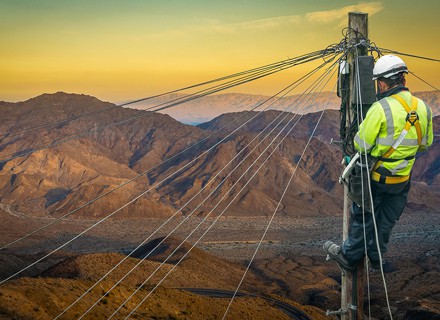
Electrical power-line installers and repairers, commonly called lineworkers or linemen, construct and maintain the overhead and underground systems that move electricity through transmission and distribution networks.
Their duties can include:
- Setting poles and transmission structures
- Stringing and repairing conductors
- Installing transformers, switches, and voltage regulators
- Inspecting lines and related equipment
- Diagnosing outages
- Operating bucket trucks, cranes, and digger derricks
- Replacing damaged equipment after storms
- Installing or repairing underground cable systems
Some lineworkers maintain local distribution systems serving neighborhoods and businesses. Others work on regional transmission networks or for contractors that travel between projects.
What the Work Is Really Like
Linework is one of the most physically demanding grid careers. Workers may climb poles or towers, work from aerial lifts, carry heavy equipment, and perform precise tasks while exposed to rain, heat, cold, wind, traffic, and electrical hazards.
Storm restoration can mean traveling with little notice and working extended shifts for several days. Overtime can raise annual earnings substantially, but it usually comes attached to bad weather, disrupted sleep, and a utility pole that has chosen violence at 2 a.m.
BLS notes that lineworkers frequently work at heights, face serious hazards, and may travel long distances or work extended hours during emergencies. Employment is projected to grow 7 percent from 2024 to 2034, with about 10,700 openings annually.
Training and Entry Routes
Most lineworkers enter with a high school diploma and complete an apprenticeship or another long-term employer-sponsored training program.
Training can include:
- Electrical theory
- Climbing
- Pole-top and bucket rescue
- Equipment operation
- Rigging
- Distribution-system construction
- Safety procedures
- Supervised fieldwork
A technical or community-college lineworker program may provide initial climbing practice, electrical fundamentals, equipment exposure, and CDL preparation. It does not make someone a journey-level lineworker or guarantee acceptance into an apprenticeship.
A commercial driver’s license is commonly required when the job involves operating heavy commercial vehicles. The required license class depends on the vehicle, its weight, its configuration, and applicable state rules, not simply on the worker’s job title.
Learn more about lineworker schools and training options.
Lineworker vs. Electrician
Lineworkers and electricians both work with electricity, but they typically work on different parts of the electrical system.
A lineworker generally works on transmission and distribution infrastructure, often outdoors and at heights. An electrician usually installs and repairs electrical systems within homes, commercial buildings, industrial facilities, or utility-owned buildings.
Electricians are more likely to work with building wiring, lighting, service equipment, motors, and controls. Lineworkers are more likely to work with poles, towers, overhead conductors, underground cables, utility transformers, and distribution equipment.
One occupation is not merely a higher-voltage version of the other. They are separate trades with different tools, training systems, hazards, and working conditions.
2. Substation Technician or Substation Electrician
Substations are the junction points that transform voltage, route electricity, connect transmission and distribution networks, and help protect the system when something fails.
Substation technicians and electricians may work with:
- Power transformers
- Circuit breakers
- Disconnect switches
- Voltage regulators
- Capacitor banks
- Batteries and chargers
- Buswork
- Grounding systems
- Control cabinets
- Monitoring equipment
- Station-service electrical systems
Duties vary considerably by employer. Some workers focus on inspections and preventive maintenance. Others install equipment, perform electrical tests, troubleshoot failures, operate switches, or respond to emergencies.
Is Substation Work Less Physical Than Linework?
Sometimes, but not always.
Substation jobs generally involve less routine pole or tower climbing than linework. They can still expose workers to high voltages, arc-flash hazards, heavy equipment, outdoor weather, awkward positions, and emergency callouts.
Some positions involve substantial construction and mechanical work. Others focus more heavily on testing, maintenance, and diagnostics.
BLS classifies many of these workers as electrical and electronics repairers who maintain equipment used in generating stations, substations, and in-service relays.
Training and Entry Routes
Possible pathways include:
- A utility apprenticeship
- An electrical apprenticeship
- A substation trainee program
- Prior electrician or lineworker experience
- A certificate in electrical or electronics technology
- An electrical engineering technology associate degree
- Military electrical or power-system experience
The BLS occupation covering powerhouse, substation, and relay repairers had a May 2025 national median wage of $103,020. Employment is projected to grow 5.5 percent from 2024 to 2034, producing about 2,000 openings per year.
3. Relay and Protection-and-Control Technician
Protective relays monitor electrical conditions and trigger actions when they detect faults or abnormal conditions. They help isolate damaged equipment before a local failure spreads through a larger section of the system.
Relay and protection-and-control technicians may:
- Install and test protective relays
- Verify current and voltage inputs
- Test control circuits
- Inspect wiring and communications
- Review fault and event records
- Commission new equipment
- Troubleshoot unexpected operations
- Read electrical schematics
- Maintain substation control systems
- Document test results and settings
Older relays were primarily electromechanical. Many newer devices use microprocessors to combine protection, monitoring, communications, and event recording.
That does not make relay technicians software developers wearing hard hats. The work still requires an understanding of electrical systems, wiring, controls, test equipment, and what should happen when a device detects a fault.
What Skills Matter?
Relay work may suit people who enjoy:
- Electrical theory
- Precise testing
- Troubleshooting
- Logic and sequencing
- Schematics
- Computers and communications
- Methodical documentation
- Investigating why equipment behaved unexpectedly
Training may come through a utility apprenticeship, an employer development program, or technical education in electrical engineering technology, electronics, instrumentation, or controls.
BLS notes that employers hiring electrical and electronics repairers may prefer applicants with electronics coursework, and that practical technical programs can provide useful hands-on experience. Workers typically receive additional employer-specific training after hiring.
Related training can include electronics technology programs, automation and controls training, and industrial maintenance programs.
4. Power System Operator or Dispatcher
Power distributors and dispatchers, often called system operators, monitor and control the movement of electricity through transmission and distribution networks.
They may:
- Monitor voltage, frequency, equipment status, and power flows
- Coordinate electrical switching
- Issue operating instructions
- Route power around equipment that needs maintenance
- Respond to outages and abnormal conditions
- Communicate with generating stations, substations, field crews, and neighboring systems
- Help manage emergencies
- Maintain detailed operating records
This work usually takes place in a secure control room rather than on poles or construction sites.
The Physical Work Is Lighter. The Responsibility Is Not.
System operators may spend long periods monitoring displays while maintaining constant attention. A quiet shift can become extremely busy when storms, equipment failures, or unexpected operating conditions occur.
Control centers operate around the clock, so operators commonly work rotating shifts that include nights, weekends, and holidays. BLS reports that power plant operators, distributors, and dispatchers commonly work 8- or 12-hour rotating shifts.
The detailed power distributor and dispatcher occupation had a May 2025 national median wage of $106,730. Employment is projected to decline 3.2 percent from 2024 to 2034, but about 800 openings are still expected annually as workers leave the occupation.
Training and Certification
A high school diploma may meet the formal entry requirement, but employers may prefer technical education, utility experience, military power-system experience, or a strong background in math and mechanical concepts.
New operators generally complete extensive employer training.
NERC certification is required for operators performing specified reliability functions as a reliability coordinator, balancing authority, or transmission operator while filling a real-time position responsible for control of the Bulk Electric System. NERC currently offers four system-operator credentials.
5. Utility or High-Voltage Electrician
Utility electricians maintain electrical systems and equipment owned by electric utilities rather than primarily wiring customer buildings.
Depending on the employer, they may work on:
- Substations
- Control wiring
- Switchgear
- Motors and pumps
- Station-service systems
- Battery banks and chargers
- Emergency generators
- Industrial controls
- Utility buildings and maintenance facilities
The title is not standardized. One employer may advertise a utility electrician, while another uses substation electrician, station electrician, industrial electrician, or electrical maintenance technician.
How This Differs From Ordinary Electrical Work
Residential and commercial electricians typically work with electrical systems inside customer buildings. Utility electricians may work in specialized environments involving substations, generating facilities, industrial controls, or utility infrastructure.
Not every worker called a utility electrician handles energized high-voltage equipment. The job description matters more than the title, because utility employers apparently enjoy occupational taxonomy almost as much as electrical reliability.
Electricians had a May 2025 national median wage of $63,190. Employment is projected to grow 9.5 percent from 2024 to 2034, with approximately 81,000 openings annually. Those figures cover the entire electrician occupation and are not utility-specific.
Training and Licensing
Common routes include:
- A paid electrical apprenticeship
- Employer-sponsored utility training
- Trade-school or community-college electrical training
- Industrial electrical experience
- State or local licensing where required
Licensing rules vary substantially by state and locality. A license required for independent construction or contracting work may not apply in the same way to an employee maintaining equipment inside a utility facility.
Explore electrician training options and learn how electrician apprenticeships work.
6. Instrumentation, Controls, and SCADA Technician
Modern utilities rely on sensors, communications systems, alarms, programmable controls, and supervisory control and data acquisition systems, commonly known as SCADA.
Technicians supporting those systems may work with:
- Sensors and transmitters
- Remote terminal units
- Programmable logic controllers
- Networked control equipment
- Alarms
- Control panels
- Communications links
- Equipment-status signals
- Data-acquisition systems
- Testing and calibration tools
A SCADA technician might investigate why a control center is receiving an incorrect equipment status. An instrumentation technician might test a sensor that measures temperature, pressure, flow, or another operating condition. A controls technician might troubleshoot a programmable controller operating utility equipment.
One Career Family, Many Job Titles
These roles are difficult to summarize with one national occupation because utilities classify them differently. Depending on the employer, they may fall under:
- Electrical engineering technician
- Electronics technician
- Instrumentation technician
- Industrial maintenance technician
- Electrical repairer
- Automation technician
- Communications technician
Electrical and electronic engineering technologists and technicians had a May 2025 national median wage of $78,190. Employment is projected to grow 0.6 percent from 2024 to 2034, with about 8,400 openings annually. An associate degree is the typical entry-level education for the national occupation.
Relevant programs may include:
- Electrical technology
- Electrical engineering technology
- Electronics technology
- Instrumentation and controls
- Automation
- Mechatronics
- Industrial maintenance
Explore automation and controls training, electronics technology programs, or industrial maintenance programs.
7. Utility Fleet Diesel or Heavy-Equipment Technician
Electric utilities cannot perform fieldwork without reliable vehicles and machinery.
Fleet technicians may maintain and repair:
- Bucket trucks
- Digger derricks
- Cranes
- Excavators
- Trenchers
- Material handlers
- Emergency generators
- Hydraulic systems
- Diesel engines
- Braking and electrical systems
- Specialized utility attachments
A vehicle failure during ordinary maintenance is expensive. A failure during storm restoration can delay an entire crew.
Some technicians work primarily in fleet shops. Others travel to repair equipment in the field. Because utility vehicles combine diesel, hydraulic, electrical, and lifting systems, the work can require broader troubleshooting skills than ordinary truck maintenance.
Bus, truck, and diesel mechanics had a May 2025 national median wage of $61,770. Employment is projected to grow 2.4 percent through 2034, with approximately 26,500 openings annually across all industries. Utility fleet positions make up only a fraction of that total.
Training routes include:
- Employer training
- Diesel technology programs
- Heavy-equipment technician programs
- Military vehicle-maintenance experience
- Manufacturer-specific training
- Industry certification
Explore diesel technician training and heavy-equipment repair programs.
8. Utility Vegetation-Management Worker
Trees are a major threat to overhead power lines. Utilities and contractors employ vegetation-management workers to reduce outage risks, maintain access to rights-of-way, and remove damaged trees after storms.
Work can include:
- Trimming branches near electrical conductors
- Removing hazardous trees
- Clearing brush
- Operating chippers
- Using chainsaws and pole saws
- Working from aerial lifts
- Climbing
- Inspecting vegetation along rights-of-way
- Performing storm cleanup
This is not ordinary landscaping. Working near electrical infrastructure requires specialized procedures, communication with utility crews, and strict clearance rules.
Some positions require climbing. Others are ground-based or involve operating machinery. The work is physical, outdoors, and potentially hazardous.
Tree trimmers and pruners had a May 2025 national median wage of $50,960. Employment is projected to grow 3.3 percent through 2034, with roughly 7,400 openings annually. Those figures also include landscaping, municipal forestry, and other non-utility work.
Which Power Grid Career Is Right for You?
No single grid career is best for everyone. The better question is which demands and working conditions fit your abilities and priorities.
| Your Priority | Careers Worth Exploring |
|---|---|
| Highest national median pay | System operator, relay or substation repairer, lineworker |
| Outdoor work | Lineworker, vegetation-management worker, fleet field technician |
| Avoiding routine climbing | System operator, relay technician, controls or SCADA technician |
| Mechanical troubleshooting | Fleet technician, substation technician |
| Electronics and logic | Relay technician, instrumentation technician, SCADA technician |
| Paid apprenticeship | Lineworker, electrician, and some substation roles |
| School-first preparation | Electrical technology, electronics, automation, diesel, and instrumentation |
| Rural opportunities | Cooperative linework, substation maintenance, fleet repair, vegetation management |
| Less physical strain | System operations and some relay, controls, or electronics roles |
| Transferable skills | Electrician, controls technician, engineering technician, diesel technician |
Employer matters almost as much as occupation.
A local municipal utility may offer a defined service territory and relatively predictable travel. A regional contractor may provide more overtime and time away from home. A rural cooperative may expect workers to perform a broader range of duties. A large transmission operator may offer highly specialized technical roles with rigorous hiring and training requirements.
Read actual job descriptions before choosing a program. The same title can describe very different work.
For a broader look at electricity, water, gas, and municipal-service careers, see whether public utilities can be a good career path.
How to Start Training for a Power Grid Career
There is no universal power-grid credential. The most appropriate route depends on the occupation and the employers operating in your region.
Paid Apprenticeship
Registered apprenticeships combine paid work, structured on-the-job learning, classroom instruction, mentoring, progressive wage increases, and an industry-recognized credential. They are common in linework and electrical trades and may also be offered for substation, metering, communications, or utility-maintenance roles.
Admission may involve:
- Algebra or aptitude testing
- A driver’s license or CDL
- Physical testing
- Interviews
- Employer screening
- Willingness to travel
- Waiting for an opening
An apprenticeship lets you earn while learning, but it is not necessarily easy to secure.
Employer Trainee Program
Some utilities hire workers directly into trainee positions for occupations such as:
- System operator
- Substation operator
- Relay technician
- Meter technician
- Lineworker
- Utility maintenance technician
These programs may provide months or years of classroom, simulation, lab, and supervised field training.
The obvious advantage is that the employer pays for much of the preparation. The disadvantage is that trainee openings may be infrequent and highly competitive.
Technical School or Community College
School-based training can help when employers want applicants with stronger electrical, electronic, mechanical, or controls fundamentals.
Relevant programs include:
- Electrical technology
- Electrical engineering technology
- Electronics technology
- Instrumentation and controls
- Automation
- Mechatronics
- Industrial maintenance
- Diesel technology
- Heavy-equipment repair
- Lineworker training
Before enrolling, determine which occupations the program is actually designed to support. “Electrical technology” can describe very different curricula at different schools.
Lineworker School or Pre-Apprenticeship
A lineworker program may provide exposure to climbing, rescue, tools, equipment, and distribution-system concepts. Some programs also include or coordinate CDL preparation.
School may improve your readiness, particularly in a competitive hiring market. It does not replace an apprenticeship, guarantee utility employment, or eliminate the need for extensive employer training.
Common Credentials and Requirements
Commercial Driver’s License
A CDL is common in linework and other roles involving heavy utility vehicles. It is legally required based on the vehicle being driven and the type of operation, not merely because someone works for an electric utility. State governments issue CDLs under federal minimum standards.
NERC System-Operator Certification
Applicable real-time Bulk Electric System positions require an appropriate NERC credential. Which credential applies depends on whether the worker performs reliability coordinator, transmission operator, balancing authority, or combined functions.
OSHA Training
Employers must train workers for the hazards and duties they actually face under standards such as OSHA’s electric-power generation, transmission, and distribution requirements.
OSHA 10- and 30-hour Outreach courses are voluntary under federal OSHA and do not replace the training required by OSHA standards. Some states, employers, unions, municipalities, and individual projects still require an Outreach card.
First Aid and CPR
Electric-power work carries additional CPR and first-aid requirements because employees may be exposed to voltages capable of causing cardiac arrest. The number and placement of trained workers depend on the work location, crew arrangement, and applicable OSHA provisions.
Electrician Licensing
Electrician licensing varies by state and locality. Requirements can also differ depending on whether the worker performs construction, maintenance, contracting, or work exclusively on employer-owned utility systems.
Verify the rules where you intend to work before selecting a program.
Questions to Ask a School or Training Provider
Before paying tuition, ask:
- Which specific utility occupations does this program prepare students for?
- Does the program include hands-on labs?
- What equipment will I actually use?
- Does the curriculum include electrical theory, protective relays, PLCs, instrumentation, or SCADA?
- Is the program intended to prepare me for an apprenticeship, or is the school claiming it replaces one?
- Does it include CDL preparation?
- Which certifications are included in tuition?
- Which credentials are optional or employer-specific?
- What employers have hired recent graduates?
- Are placement figures independently verified?
- Does successful placement usually require relocation?
- Are there physical, climbing, driving, or screening requirements?
- Are credits transferable to an associate degree?
- What additional employer training will still be required after graduation?
A program that gives specific answers is more useful than one promising that you can “launch an exciting career in the booming energy sector.” That sentence has paid for a disturbing number of brochures.
Frequently Asked Questions
Can you work on the power grid without a four-year degree?
Yes. Lineworkers, electricians, substation repairers, system operators, fleet technicians, and vegetation-management workers commonly enter without bachelor’s degrees.
However, many still need substantial preparation through an apprenticeship, technical program, associate degree, employer training, or related experience. No bachelor’s degree does not mean no training.
What is the highest-paying power grid career?
Among the occupations covered here, power distributors and dispatchers and powerhouse, substation, and relay repairers have national median wages above $100,000.
Lineworkers also have a high national median and may earn more through overtime, emergency work, or travel. Those higher totals should not be mistaken for ordinary base pay.
Actual compensation varies by employer, region, experience, union agreement, and schedule.
What is the difference between an electrician and a lineworker?
Electricians generally install and maintain electrical systems within buildings or facilities. Lineworkers construct and repair the transmission and distribution infrastructure that carries electricity between generating stations, substations, and customers.
Linework more commonly involves outdoor high-voltage systems, poles, towers, bucket trucks, storms, and emergency travel.
Which power grid careers do not require climbing?
System operators, relay technicians, SCADA technicians, controls technicians, and many utility electricians do not routinely climb utility poles or transmission towers.
Some positions still involve ladders, equipment platforms, aerial lifts, or occasional work at height. Read the job description rather than assuming that “technician” means permanently seated in air conditioning.
Do lineworkers need a CDL?
Many do because they operate or move bucket trucks, digger derricks, trailers, and other heavy vehicles.
The required CDL class and endorsements depend on the vehicle and employer. Some employers require applicants to already hold a CDL, while others provide or coordinate training.
Is trade school required for utility work?
Not always.
Some workers enter through paid apprenticeships or utility trainee programs. Others use trade school or community college to develop electrical, electronics, automation, climbing, or mechanical skills before applying.
School is most useful when the curriculum matches actual employer requirements and provides credible hands-on experience.
Are power grid apprenticeships paid?
Registered apprenticeships are paid jobs. Apprentices receive structured work experience, instruction, mentoring, and progressive wage increases as their skills improve.
A pre-apprenticeship or school-based program is different. Students generally pay tuition and are not yet utility or contractor employees.
Are power grid careers dangerous?
Some involve serious hazards.
Lineworkers face electricity, heights, traffic, severe weather, and heavy equipment. Substation and utility electrical workers face high voltage and arc-flash hazards. Vegetation workers may use chainsaws and aerial equipment near conductors. Fleet technicians work with heavy machinery and hydraulic systems.
Control-room and technical occupations generally involve less physical danger but can carry significant mental pressure and responsibility.
Safety training, procedures, protective equipment, communication, and supervision are not administrative decorations. They are what keep hazardous work from becoming reckless work.
Can someone start a utility career in their 30s or 40s?
Potentially, yes.
Employers generally care whether you meet the qualifications and can perform the work. Physical occupations such as linework may be harder to enter later if climbing, lifting, weather exposure, or recovery are significant concerns.
Technical, maintenance, and control-room paths may be especially worth exploring for career changers with electrical, industrial, mechanical, military, telecommunications, or operations experience.
Does AI increase demand for electrical-grid workers?
AI is contributing to rapid data-center expansion, which is increasing electricity demand in several U.S. regions. That may contribute to new substations, transmission connections, distribution upgrades, generating capacity, and maintenance requirements.
It would still be misleading to claim that AI automatically creates jobs in every grid occupation. Hiring depends on regional projects, utility investment, automation, regulation, permitting, and the type of infrastructure being built.
For careers located inside data centers rather than on the external grid, see TSNET’s guide to data center jobs without a degree.
Build a Career That Keeps the Power Moving
Power grid careers offer several routes into work that is technical, essential, and tied to infrastructure people depend on every hour of the day.
Each path demands something different.
Linework may demand height tolerance, strength, travel, and storm duty. Relay work demands precision and electrical theory. System operations demand constant attention and rotating shifts. Fleet maintenance demands mechanical versatility. Vegetation management demands outdoor stamina and profound respect for gravity, sharp machinery, and electrical clearances.
Do not choose a career based only on the most impressive salary screenshot.
Choose the path whose training, schedule, environment, and drawbacks you can realistically live with. Then verify the route before spending money.
Sources
Key factual claims and occupational data were checked against current primary or authoritative sources. Wage figures use May 2025 Occupational Employment and Wage Statistics. Employment projections cover 2024 through 2034.
- U.S. Bureau of Labor Statistics: Occupational Employment and Wage Statistics tables
- U.S. Bureau of Labor Statistics: 2024–2034 occupational projections and characteristics
- BLS Occupational Outlook Handbook: Line installers and repairers
- BLS Occupational Outlook Handbook: Electrical and electronics installers and repairers
- BLS Occupational Outlook Handbook: Power plant operators, distributors, and dispatchers
- BLS Occupational Outlook Handbook: Electricians
- BLS Occupational Outlook Handbook: Electrical and electronic engineering technologists and technicians
- Lawrence Berkeley National Laboratory: United States Data Center Energy Usage Report 2025 update
- U.S. Department of Energy: Transformer supply-chain and grid-equipment information
- North American Electric Reliability Corporation: PER-003-2 system personnel certification requirements
- Occupational Safety and Health Administration: Electric power generation, transmission, and distribution standard
- Occupational Safety and Health Administration: Outreach Training Program overview
- Federal Motor Carrier Safety Administration: Commercial driver’s license guidance
- Apprenticeship.gov: Registered Apprenticeship information for career seekers
- Center for Energy Workforce Development: Energy workforce report executive summary