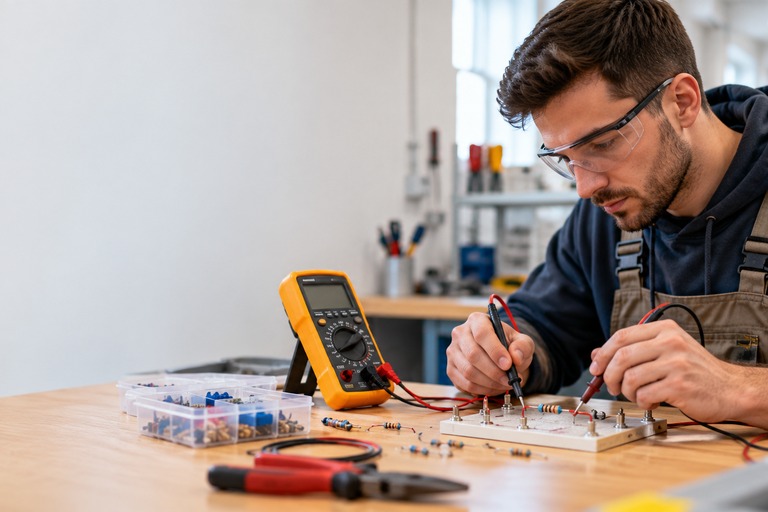
Math for Electricians: What You Need for Training, Apprenticeships, and the Job


Think you need to be a math genius to become an electrician? You don't. But you do need to know which math matters, when you'll need it, and what your chosen program expects before you apply.
Quick answer: The everyday foundation is arithmetic, fractions, decimals, measurements, percentages, ratios, and basic algebra. Electrical training then adds circuit formulas such as Ohm's law, blueprint scales, geometry, and, in later or specialty work, more advanced electrical calculations. You generally don't need calculus to start. Some apprenticeships require a prior algebra course; technical colleges may instead assess your math level or offer a preparation route.
Before you pay tuition: Check the actual math rule for your specific program or apprenticeship sponsor. General admission to a college does not necessarily clear its electrician courses, an apprenticeship's selection test, or future licensing exams.
There isn't one electrician math test. There are six different checkpoints.
When someone says, “You need algebra to be an electrician,” ask what they're talking about. An entrance requirement is not the same thing as what you'll learn in class or calculate years later on the job.
| Checkpoint | What the math may involve | Your next question |
|---|---|---|
| 1. College admission | General school entrance rules, sometimes with a placement process. | Does the institution admit me before I meet the electrician program's prerequisites? |
| 2. Electrician course entry | Placement into an applied-math or algebra course; prerequisite credits may be required. | Can I take a preparatory math course if I don't place high enough? |
| 3. Apprenticeship selection | Transcripted algebra and/or an aptitude assessment, depending on the local sponsor. | What does this particular JATC or employer require? |
| 4. Classroom electrical theory | Rearranging formulas, Ohm's law, power, basic AC theory, measurements, and prints. | Which math skills are taught in the first term? |
| 5. Jobsite layout and estimating | Lengths, offsets, material quantities, drawing dimensions, and practical geometry. | What math will I practice in supervised labs and work? |
| 6. Licensing and advanced work | Code-related calculations, load methods, voltage drop, and specialty formulas. | Which license and locally adopted code edition apply where I plan to work? |
For the broader distinction between school admission and career eligibility, see our trade school requirements guide. For the sponsor application itself, use the separate electrician apprenticeship guide.
Which math skills do electricians actually use?
Start with measurement and ordinary arithmetic. That isn't a watered-down answer. NCCER's Core curriculum includes an Introduction to Construction Math module, and its electrical curriculum builds from the basics into electrical theory, construction documents, and code applications. The order matters more than pretending every beginner needs advanced formulas on day one.
| Stage | Skills | Example |
|---|---|---|
| Foundation: prepare now | Four operations; fractions and mixed numbers; decimal and percent conversions; tape measurements; feet, inches, and metric units. | Subtract 19 5/8 inches from 48 3/4 inches, or add a percentage allowance to a material estimate. |
| Early training: algebra and plans | Ratios, basic algebra, rearranging equations, blueprint scales, area, right triangles, electrical units, and simple Ohm's and power laws. | Find an unknown resistance from voltage and current in a classroom circuit model. |
| Later training or specialties | AC concepts, power factor, transformer and motor calculations, voltage-drop methods, and code-specific load calculations. | Learn to apply a prescribed calculation method from the applicable electrical code under instruction. |
Do you need to be good at algebra?
It helps enormously to be comfortable solving a simple equation like 3x + 360 = 4,860 and isolating a variable in V = I × R. Some apprenticeship programs require proof of algebra before admitting applicants; others allow placement or a recognized preparation course. That does not mean you must arrive already knowing every electrical formula.
Do electricians use geometry or trigonometry?
Yes, especially for layout, right triangles, slopes, angles, and conduit geometry. More advanced trigonometry can appear in technical training. The useful early target is being able to measure accurately, work with scales, and understand simple right-angle relationships. For drawing conventions, use our blueprint-reading guide.
What about calculus?
Calculus is not a typical prerequisite for entry-level electrician training in the verified programs below. It is much more closely associated with engineering coursework. Don't self-reject from an electrical career because calculus was a nightmare years ago. Check your program's published prerequisites instead.
Real electrician program math requirements: Five verified examples
These aren't interchangeable admissions policies. The point is to show what schools and sponsors actually do, not create a fictional national standard. Each example was checked against an official provider page on November 18, 2026; terms can change for new applicant cohorts.
| School or sponsor | Published rule | Important distinction |
|---|---|---|
| Electrical Training Alliance / local IBEW–NECA JATCs | Typical criteria include one year of high-school algebra and a qualifying aptitude-test score. | This is apprenticeship selection. Local JATCs can add conditions; the Alliance also offers Online Tech Math for applicants who don't meet the math requirement. |
| Bellingham Technical College, Washington | First-quarter electrical courses list placement into AMATH 100 (and English placement); AMATH 100 covers applied arithmetic through elementary algebra. | BTC uses guided self-placement, which recommends an appropriate math course. Placement isn't the same as a pass/fail apprenticeship exam. |
| Rogue Community College, Oregon | Requires one year of algebra (or equivalent) with C or better, or placement into the required math level. | Its apprenticeship technologies program also requires acceptance into an approved apprenticeship. Math clearance alone does not secure sponsorship. |
| Salt Lake Community College, Utah | Accepts placement competence for MATH 1010, C or better in MATH 0990 (or equivalent), or C or better in ELI 1470, Math for the Trades. | The college's AAS page says the school doesn't provide on-the-job training or sponsorship. Students must arrange their own sponsor. |
| Cerritos College, California | For its published 2027 Electrician Trainee application cycle, applicants must score at least 80% on an English and math exam to reach the interview stage; two attempts are offered. | Math preparation is offered, but successful applicants must also arrange a licensed electrical-contractor sponsor before classes begin. |
What this means for you: A missing algebra credit isn't necessarily the end of the road. It might mean taking a local equivalent, placing into the required level, or completing a recognized technical-math course. Ask the receiving program what it accepts before buying an unrelated online course.
Eight electrician math examples, with the steps shown
These are deliberately simplified classroom problems, not instructions for wiring, sizing circuits, bending conduit, or testing energized equipment. They show how a few core skills build on each other.
1. Fractions and measurements
Problem: You have a practice length of 48 3/4 inches and subtract 19 5/8 inches. How much remains?
Work: 48 6/8 − 19 5/8 = 29 1/8 inches.
Need help visualizing eighths and sixteenths? Try our free tape-measure practice.
2. Percents in estimating
Problem: A fictional layout uses 420 feet of material. Add a 15% classroom allowance.
Work: 420 × 0.15 = 63; 420 + 63 = 483 feet.
The 15% is an example input, not a recommended real-world ordering factor.
3. Feet, inches, and metric
Problem: Convert 18 feet 9 inches.
Work: (18 × 12) + 9 = 225 inches; 225 ÷ 12 = 18.75 feet; 225 × 25.4 ÷ 1,000 = 5.715 m (5.72 m to two decimals).
4. Blueprint scale
Problem: At a stated scale of 1/4 inch = 1 foot, a line on a correctly printed drawing is 4 3/8 inches long.
Work: 4 3/8 ÷ 1/4 = 17.5 feet, or 17 feet 6 inches. In real projects, prefer written dimensions; printed drawings may not be to scale.
5. Solve for the unknown
Problem: Three identical fictional loads plus 360 W total 4,860 W. Find each identical load, x.
Work: 3x + 360 = 4,860; 3x = 4,500; x = 1,500 W.
The skill is isolating the variable, not memorizing a particular number.
6. Ohm's law in an ideal DC model
Problem: In a paper exercise, a fixed resistor has 240 V across it and 12.5 A through it. Find R.
Work: R = V ÷ I = 240 ÷ 12.5 = 19.2 ohms (Ω).
Practice related formulas with our Ohm's law learning lab. It does not design or approve installations.
7. Power and energy
Problem: An ideal resistive classroom load is 120 V at 8.5 A and runs for six hours.
Work: P = 120 × 8.5 = 1,020 W = 1.02 kW; energy = 1.02 × 6 = 6.12 kWh.
Assumes an ideal resistive load; real AC systems can involve power factor and other considerations.
8. Right-triangle layout
Problem: A rectangular practice layout is 9 feet wide and 12 feet long. Find its diagonal.
Work: d = √(9² + 12²) = √225 = 15 feet.
Conduit layout builds on the same geometry. Use our conduit-bending planner for learning concepts, not as a substitute for actual bender instructions and safe work procedures.
Try the free 12-question electrician math readiness check
This short self-check samples four skill groups: measurements, percentages and conversions, algebra, and introductory electrical calculations. It isn't timed, doesn't require an account, and shows where to study next. You can also print the questions with a full answer key.
Important: This is an independent study-planning exercise, not an official school placement test, IBEW/ETA aptitude exam, licensing assessment, or prediction of admission or apprenticeship selection.
View the worked answer key for all 12 questions
- Q1. 78. 18 × 4 + 6 = 72 + 6 = 78.
- Q2. 29 1/8 in.. Rewrite 3/4 as 6/8. Then 48 6/8 − 19 5/8 = 29 1/8 inches.
- Q3. 16 15/16 in.. 31 6/16 − 14 7/16 requires borrowing: 30 22/16 − 14 7/16 = 16 15/16 inches.
- Q4. 483 ft. 15% of 420 = 0.15 × 420 = 63; total = 420 + 63 = 483 feet. The percentage is illustrative.
- Q5. 2.5%. (24.0 − 23.4) ÷ 24.0 × 100 = 2.5%. This is arithmetic, not live-testing guidance.
- Q6. 225. 18 × 12 + 9 = 225 inches (also 18.75 feet).
- Q7. 1,500. Subtract 360: 3x = 4,500. Divide by 3: x = 1,500.
- Q8. 19.2 Ω. R = 240 ÷ 12.5 = 19.2 ohms. This does not determine safe installation requirements.
- Q9. 17.5 ft. 4 3/8 ÷ 1/4 = 4.375 × 4 = 17.5 feet. Use annotated dimensions in actual construction documents.
- Q10. 1,020 W. P = V × I = 120 × 8.5 = 1,020 watts (1.02 kW).
- Q11. 6.12 kWh. Energy = power × time = 1.02 kW × 6 h = 6.12 kWh.
- Q12. 15 ft. √(9² + 12²) = √(81 + 144) = √225 = 15 feet.
Remember: This check measures only how you did on these 12 practice questions. A high score doesn't guarantee acceptance; a low score doesn't disqualify you from training. Follow your actual program's rules.
A free study plan if your math is rusty
You don't need to reread every page of a high-school algebra textbook to figure out whether to apply. Use this targeted sequence, then adjust it to your chosen school's actual requirements.
- Rebuild measurement and fractions first. Practice equivalent fractions, mixed-number subtraction, unit conversion, and common tape marks. Start with OpenStax Prealgebra 2e (fractions, decimals, percentages), then use our visual tape test.
- Refresh algebra and geometry. Work through one- and two-step equations, proportions, basic area, and the Pythagorean theorem using OpenStax Elementary Algebra 2e. Use your missed questions, not an arbitrary study-hour target, to choose topics.
- Practice electrical contexts. Try the Ohm's law practice lab after you can rearrange basic formulas. If your goal is a JATC aptitude exam, switch to the distinct IBEW aptitude practice tool and confirm which assessment your local training center actually uses.
- Check the receiving program. Ask whether you need a transcript, a placement test, a specific algebra grade, an accepted math replacement, and a separate apprenticeship sponsor. The answer determines what preparation will actually count.
Questions worth sending to admissions or the training director
- Is algebra required to apply, or only to start certain courses?
- Can I meet the requirement through placement, an equivalent course, or an approved online math course?
- What documentation and minimum grade do you accept?
- Is the math exam timed, and are calculators allowed?
- Does enrollment include an apprenticeship sponsor and paid on-the-job training, or must I find those separately?
- Are there free tutoring, bridge classes, or placement retakes available?
Do you need to know the electrical code before training?
Not to do the readiness exercises on this page. Later coursework covers electrical theory and code-based methods. NCCER's Electrical 12th Edition, released in 2026, aligns its curriculum to the 2026 National Electrical Code. That does not mean every state or locality has adopted the 2026 code. Electrical installations are governed by the requirements applicable in the relevant jurisdiction. NCCER curriculum details; NFPA code adoption information.
None of the classroom examples or the quiz below should be used to size conductors, select protection devices, assess whether equipment is safe, or guide energized work. That's a separate professional task with training, supervision, manufacturer instructions, and applicable codes.
What should you do after the math check?
Common electrician math questions
Can I become an electrician if I struggled with math in school?
Possibly, yes. A weak math background means you may need preparation, not that you're permanently ineligible. Check the target program's algebra or placement rules and build the specific skills you'll be assessed on.
Do I need calculus to become an electrician?
Calculus isn't a typical entry requirement among the electrical programs reviewed here. Arithmetic, fractions, elementary algebra, geometry, and applied electrical formulas are much more immediate priorities. Some specialized technical or engineering pathways have different expectations.
Is the IBEW aptitude test just an electrician math test?
No. The electrical training ALLIANCE lists a qualifying aptitude score among typical JATC requirements, and the full selection process depends on the local JATC. Use the separate practice guide for exam-specific preparation; this article's self-check is not a substitute.
Can I take an online math course instead of high-school algebra?
Some programs accept qualifying alternatives. For example, the Electrical Training Alliance offers Online Tech Math for people unable to meet its math requirement. Don't assume any random online course will satisfy a sponsor: get its acceptance in writing first.
Will passing the quiz here qualify me for an apprenticeship?
No. It's a study-planning tool only. Actual admission, apprenticeship selection, course placement, and licensing are controlled by the relevant school, sponsor, or regulator.
Sources and editorial method
Research checked November 18, 2026. We checked official training organizations and college pages for entry requirements. Skill examples are original educational problems based on arithmetic, algebra, and idealized circuit relationships. We deliberately excluded unverifiable course cutoffs, changing code-adoption counts, and claims about licensing eligibility.
- Electrical Training Alliance: Apprenticeship training requirements; Online Tech Math
- Bellingham Technical College: Electrical Construction courses; Math Guided Self-Placement
- Rogue Community College: Electrician Apprenticeship Technologies requirements
- Salt Lake Community College: Electrical Apprenticeship; AAS program and sponsorship policy
- Cerritos College: Electrician Trainee program
- NCCER Core; NCCER Electrical
- OpenStax Prealgebra 2e; OpenStax Elementary Algebra 2e
- NFPA: NEC enforcement and code adoption