Is Welding Hard to Learn? Try Our Free Welding School Readiness Lab


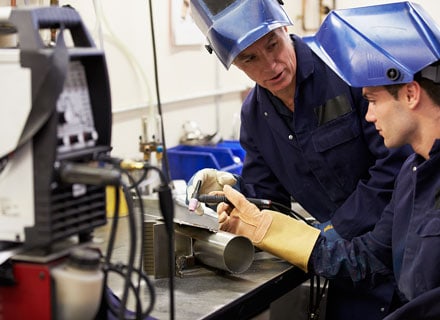
Welding can be challenging to learn, but you do not need to have welded before to start many beginner training programs. The difficult part is usually not understanding what welding does. It is learning to control your movements consistently, read instructions accurately, work safely, and produce a weld that meets the requirements of a particular job. Those skills develop through supervised practice, not a single good-looking bead.
Worried about math, working in a hot shop, or showing up without any experience? Try the free lab below. Then compare the actual admissions policies of eight U.S. training providers. You might discover that the barrier you imagined is not the one you need to solve.
What makes welding hard to learn?
Think of learning to weld as four separate milestones. Confusing them is a great way to convince yourself you are failing when you are actually doing exactly what a beginner should be doing.
Understand the task
Recognize materials, joint types, safety requirements, measurements, and drawing instructions.
Build repeatable skills
Practice in a supervised lab. Learn to control the process and respond to instructor feedback.
Complete your program
Meet your school's coursework, practical assessment, and attendance requirements.
Demonstrate qualification
Pass any applicable industry or employer performance test. This is separate from earning a diploma.
Five things beginners tend to underestimate
- Hand-eye coordination
- Knowing the theory is not the same as maintaining consistent movement while wearing a helmet and gloves. Repetition and feedback matter. A rough early practice weld is not proof you lack the ability to learn.
- Shop math
- Fractions, decimals, tape measurements, and basic geometry help you understand drawings and check parts. Some college programs also require math courses. If fractions are rusty, start with our welding math guide.
- Preparation and fit-up
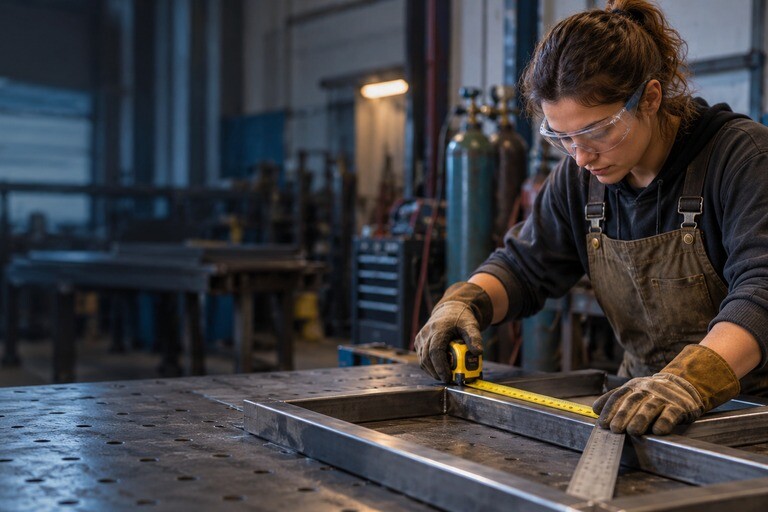
- Welding involves more than joining metal. Measuring, identifying materials, preparing surfaces, and checking alignment are important parts of the job. A bad fit-up can create a problem before welding begins.
- Reading drawings
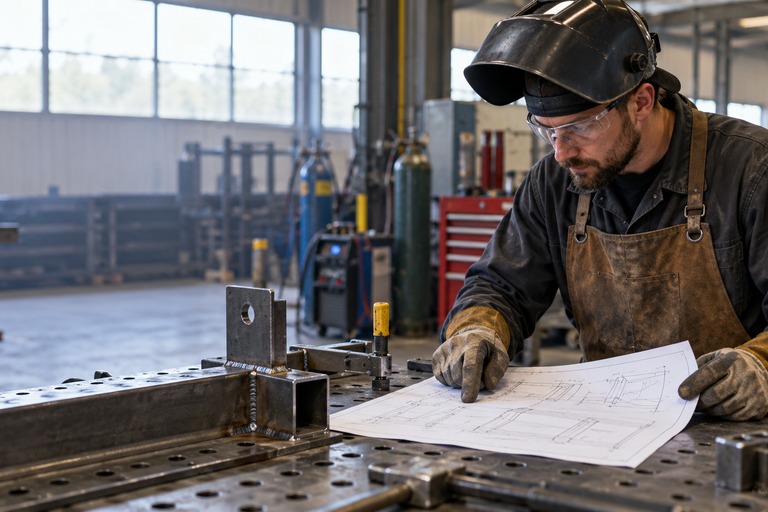
- A drawing tells you what the finished work should look like. A welding procedure supplies additional instructions about how a weld is to be made. Learn to distinguish these rather than guessing from a symbol. Try our welding symbols lab for more practice.
- Position and working conditions
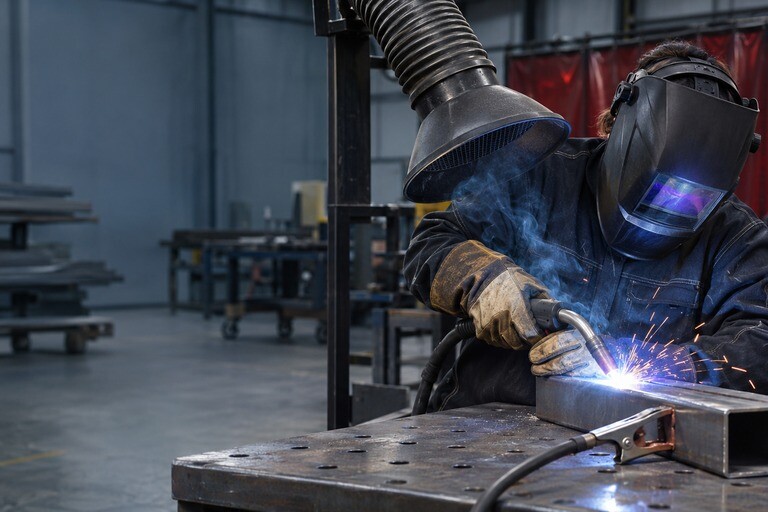
- Working around a fixed pipe or in an overhead position creates different demands than working flat at a bench. You also have to manage heat, PPE, awkward postures, and shop noise. See our welding positions guide for a visual introduction.
Is MIG, TIG, stick, or flux-cored welding easiest to learn?
There is no universally easiest process. A continuous-wire process may feel more approachable at first, while TIG often demands finer coordination. The material, joint, position, procedure, and required quality all affect the learning curve.
| Process | What you learn to manage | Examples of work |
|---|---|---|
| MIG (GMAW) | Continuous wire feed, positioning, and shielding | Production and fabrication |
| Stick (SMAW) | A consumable covered electrode and slag | Field work, repair, and structural fabrication |
| Flux-cored (FCAW) | Tubular wire, flux, and process-specific shielding | Heavy fabrication and structural work |
| TIG (GTAW) | Nonconsumable tungsten electrode and, when used, separate filler | Precision fabrication, aerospace, stainless steel, and aluminum |
These are examples, not exclusive uses. A good training program explains why a process is chosen and teaches students to follow the applicable procedure. AWS's SENSE education framework and Wallace Community College's curriculum illustrate the combination of drawing interpretation, cutting, process theory, and supervised practice.
How long does it take to get good at welding?
There is no reliable universal timeline. A student might understand a measurement lesson quickly but need repeated attempts to develop consistent physical technique. The American Welding Society notes that experienced welders may be ready for its Certified Welder test right away, while newcomers may need months of preparation. That is guidance about a particular qualification, not a guarantee of proficiency by a certain date.
When comparing schools, ask how instructors provide individual feedback, what happens when you struggle with a practical assignment, and whether there is time to practice again before an assessment. These details are more informative than a promise that welding is easy.
Free Welding School Readiness Lab
Try six short modules covering skills you may encounter in introductory training. Start with any topic. Each question explains the reasoning after you answer, so getting something wrong is part of the lesson.
Get a feel for welding school
6 modules • 24 exercises • no sign-up
Learning preview only. These are conceptual exercises, not an aptitude test, admissions assessment, welding procedure, or qualification. Do not use them to operate equipment or judge whether a real weld is safe.
Add fractional measurements
Show explanation
7 3/8 inches. Convert 3/4 to 6/8. Add 6/8 + 5/8 = 11/8, or 1 3/8. Add that to 4 + 2 = 6. The combined length is 7 3/8 inches.
Convert fractions to decimals
Show explanation
0.375 inch. Divide 3 by 8 to get 0.375. The digits in a fraction are not automatically the digits in its decimal equivalent.
Estimate a rectangular perimeter
Show explanation
74 inches. Two long sides total 49 inches; two short sides total 25 inches. Together they measure 74 inches. This is perimeter arithmetic, not a production cut list.
Understand corner geometry
Show explanation
45 degrees. An equal split of 90 degrees is 45 degrees. Actual fabrication requires the drawing, joint dimensions and instructor-approved cutting procedures.
Locate the joint
Show explanation
The drawing convention and the joint identified by the arrow. Identify the drawing convention and follow the arrow to the intended joint. Interpreting a symbol without locating the joint can put the correct weld in the wrong place.
Identify arrow-side instructions
Show explanation
The arrow side of the joint. Under the AWS convention, information below the reference line applies to the arrow side; above applies to the other side. Arrow side refers to the joint, not where you stand.
Separate length and pitch
Show explanation
2-inch weld segments spaced 6 inches center to center. The right-side pair gives length and pitch: 2 inches long, with centers 6 inches apart. The clear space would be 4 inches. The left-hand value specifies the fillet size.
Know when a procedure is needed
Show explanation
The referenced welding procedure specification (WPS). A welding procedure specification supplies the process requirements that a drawing alone may not contain. Never guess the machine settings or substitute a procedure.
Recognize a precision process
Show explanation
GTAW (TIG). TIG uses a nonconsumable tungsten electrode and is common in precision work. Other processes may also be appropriate depending on the application and approved procedure.
Understand fixed pipe
Show explanation
The workpiece cannot be rotated to keep the weld in a flat orientation. A fixed pipe requires working around a stationary joint in changing orientations. The rotating pipe allows the work to stay near the top. Gravity and access change the demands.
Recognize preparation
Show explanation
Because joint alignment and preparation affect the finished weld. Accurate preparation and fit-up help make the assigned weld possible. A poorly prepared joint cannot reliably be rescued by guessing at the machine settings.
Recognize cutting processes
Show explanation
Oxy-fuel cutting and plasma arc cutting. OFC and PAC are thermal cutting processes. Cutting and joining are different activities, each requiring approved procedures and supervised training.
Spot inconsistent fit-up
Show explanation
Ask the instructor to check the fit-up before proceeding. Pause and compare the parts with the assignment. Ask the instructor to review the mismatch. Detecting an issue early is a useful skill, not a reason to feel embarrassed.
Recognize position changes
Show explanation
Gravity acts differently relative to the joint and the learner must adapt under supervision. Gravity still points down, but the joint is now oriented differently. Do not assume the movements that worked in the flat position transfer unchanged. Ask for feedback.
Know the limits of appearance
Show explanation
No, required evaluation depends on the applicable test and acceptance criteria. Surface appearance alone does not establish internal soundness or compliance. Formal tests may require additional evaluation according to the applicable standard.
Use feedback instead of guessing
Show explanation
Ask the instructor to review the coupon and the approved procedure. Your instructor can help distinguish technique, preparation, and procedure issues. Unapproved changes make troubleshooting harder and may create safety or quality problems.
Wear compatible eye protection
Show explanation
Use suitable prescription safety eyewear or compatible over-glasses protection, with the required welding helmet. Ordinary glasses are not a substitute for appropriate eye protection. OSHA workplace rules address prescription compatibility and flying-object hazards; the school should help select suitable equipment for the task.
Select protection with the instructor
Show explanation
Ask the instructor to confirm the approved protection and filter shade before continuing. The correct protection depends on the assigned operation. Do not trade away required protection to improve visibility. Ask the instructor to verify the helmet, filter and lighting.
Recognize fumes
Show explanation
Fumes and gases may contain hazardous substances that require exposure controls. Welding fumes can contain manganese and other hazardous constituents. Ventilation and other controls are selected for the actual hazard. A welding helmet alone is not respiratory protection.
Recognize multiple hazards
Show explanation
Burns, fire, electrical shock, fumes, noise and heavy or sharp materials. Different hazards require different controls and task-appropriate PPE. Training should cover safe shop conduct, equipment, emergency procedures and supervision.
Separate credentials
Show explanation
No; AWS Certified Welder requires a qualifying performance test and AWS approval. School completion and AWS certification are separate. AWS has no formal schooling prerequisite for its Certified Welder performance test, which is administered at an Accredited Test Facility.
Choose a learning environment
Show explanation
A beginner welding school or college program with a supervised lab. A supervised school or college lab can offer structured instruction. Apprenticeships are also legitimate routes combining work and instruction. Compare availability and costs.
Separate admission and aid
Show explanation
Whether you and the exact program qualify for the funding you need. Federal student aid has separate eligibility rules. Some students without secondary credentials may qualify through an eligible career pathway and an ability-to-benefit alternative. Confirm eligibility with the aid office.
Match training to local work
Show explanation
Check local job requirements and ask schools and employers which qualifications they use. Processes, materials, positions and qualification expectations vary by employer and industry. Compare actual local requirements with the curriculum before purchasing optional training or tests.
Your learning plan
Use this to decide what to practice or ask an instructor about. Even a perfect run cannot assess practical welding technique.
Your answers stay in this browser session; no account or personal information is required. The lab does not send answers to a server. If JavaScript is unavailable, each exercise has an answer you can reveal.
Welding school requirements: what do you actually need to get in?
Some welding schools require a high school diploma or GED. Others admit students without one, depending on the program. Age rules, placement tests, and academic prerequisites differ as well. Do not confuse the requirements of a short introductory course with those of a full diploma or degree.
We checked published admissions information for eight U.S. providers on November 27, 2026. These examples show the range of policies, not a ranking or an exhaustive list. Confirm the exact program, campus, start date, and current policy before paying a deposit. Some entries describe institution-wide published guidance rather than every individual campus.
| Provider / program | High school diploma or equivalent? | Other published considerations |
|---|---|---|
| Universal Technical Institute Standard postsecondary admission | Required or accepted equivalent; application may begin before completion. | 18+, or 16+ with guardian consent; no prior trade experience, entrance exam, or minimum GPA required under its general policy. |
| Tulsa Welding School General welding admissions guidance | Diploma or GED listed in its admissions article. | Article also lists age 18+, interview and admissions test; confirm these and possible alternatives with the campus. |
| Lincoln Tech General post-high-school training guidance | Diploma or GED described in its published admissions discussion. | Interview and admissions recommendation described; verify current welding-specific requirements at your campus. |
| Missouri Welding Institute Nevada, MO; general enrollment | Recommended, not required. | Applicants under 18 need a co-signed agreement; prior welding experience is not required for most courses. |
| Central Piedmont Community College Charlotte, NC; AAS vs. short-term courses | Required for the AAS; not listed as a prerequisite for its short-term construction and welding training. | No previous welding experience needed for the AAS. Evening sections depend on the semester. |
| Palm Beach State College Lake Worth / Belle Glade, FL; Welding Technology CCP | Not required for admission. | TABE unless exempt; information session and advisor meeting. Catalog lists 1,050 hours and day/evening schedules. |
| Wallace Community College Wallace / Sparks campuses, AL; Welding Technology STC | Not required for this short certificate. | Demonstration of college and career readiness; conditional admission and essential functions. Reasonable accommodations considered. |
| Lynnes Welding Training ND / MN; Combination Welder vs. individual skills courses | Required education documentation for 480- and 640-hour combination programs; diploma/GED preferred, not required for individual skills courses. | At least 17 and must turn 18 by the last class day; interview and near-vision exam (corrective lenses permitted). |
Can you go to welding school without a GED?
Yes, some programs accept students without a high school diploma or GED. The Palm Beach State, Wallace, and Missouri Welding Institute examples are starting points for research. Lynnes and Central Piedmont also illustrate why the exact program matters. A short skills course is not necessarily equivalent to a full career-training credential.
Admission is not financial-aid eligibility. Under federal student aid rules, you generally need an accepted secondary-school credential, qualifying homeschool completion, or an applicable ability-to-benefit alternative. For most new students using ability-to-benefit, an eligible career pathway program and additional eligibility requirements apply. The program itself must be aid-eligible, too. Consult the Federal Student Aid handbook and ask the school's financial aid office for a written determination. Workforce funding, adult-education bridges, and self-pay are other options to investigate, not guaranteed funding.
Do you need to pass a math test before starting?
Not at every school. UTI's general policy does not require an entrance exam. Palm Beach State requires the TABE unless exempt, and its Welding Technology CCP requires minimum TABE scores or an exemption for completion. Other programs may have course prerequisites or separate placement policies. Ask whether a test is for admission, placement, or graduation. Those are three different things.
How much time will you actually spend welding?
Do not assume a 900-hour program means 900 hours with a torch in your hand. UTI publishes these two instructional-hour breakdowns:
Welding Technology
399 of 900 hours designated as lab (about 44%)
501 classroom / 399 lab
Welding Specialist, Canton, MI
814 of 960 hours designated as lab (about 85%)
146 theory / 814 lab
Source: UTI's published program comparison. These are different programs, not directly comparable measures of quality. Lab hours may include simulation, demonstrations, preparation, and other activities besides individual live welding.
If you are working while studying, also ask whether an evening cohort actually has space, whether shop hours fit your schedule, and whether make-up labs are possible. Compare tuition, supplies, travel and time away from work using our welding school cost guide.
Can you weld with glasses, health conditions, or physical limitations?
Wearing prescription glasses does not automatically prevent you from learning to weld. Everyday glasses are not a substitute for appropriate protective eyewear, though. Under OSHA's workplace eye and face protection rule, people who need corrective lenses must use protective eyewear incorporating the prescription or protection that fits over it without disturbing lens position. Protection must be suitable for the hazard, including side protection for flying objects.
Welding helmets are used with appropriate primary eye protection, as described in OSHA's nonmandatory PPE selection guidance. Your instructor should help you select compatible eye protection and the proper filter shade for the assigned work. Do not substitute regular glasses or a clear face shield for welding-rated protection.
Other hazards matter just as much: fumes and gases, burns, electrical shock, fire, noise, sharp metal, and heavy materials. NIOSH identifies manganese in many welding fumes as a health concern, including neurological effects. Effective ventilation and other exposure controls are central to safe training; a helmet alone does not control inhalation exposure. Ask to see how a school's lab handles ventilation, supervision, and protective equipment.
School admissions and workplace safety rules are separate. If you have asthma, a medical device, a vision condition, or a mobility limitation, speak with the school's disability services or admissions staff and an appropriate clinician about your individual needs and the actual lab environment. Some programs require vision or physical-function assessments. Do not assume a limitation disqualifies you, or that a school can accommodate every task without assessment.
Should you go to welding school, community college, or an apprenticeship?
Choose the learning environment and credential that suit your circumstances, not just the shortest advertised completion time.
| Route | Best when... | Check before committing |
|---|---|---|
| Career / trade school | You want structured shop instruction and a focused schedule. | Itemized cost, lab access, instructor feedback, qualification testing, employer connections. |
| Community college | You want to compare short certificates, diplomas, or associate degrees. | Prerequisites, course availability, general education requirements, start dates and lab schedules. |
| Registered apprenticeship or employer training | You want to earn while learning in a workplace and can meet entry requirements. | Availability, employer selection, related classes, pay progression, and the processes you will actually learn. |
Read our welding apprenticeship guide and step-by-step career guide before ruling out alternatives. School can be a good way to gain structured practice, but it is not the only way into the field.
Does graduating make you a certified welder?
Not automatically. A school certificate or diploma documents completion of that school's requirements. The AWS Certified Welder program requires a performance test at an AWS Accredited Test Facility and AWS approval. The test assesses the specified process, material, position, and applicable code or procedure. Formal welding schooling is not a prerequisite to the AWS test. Employers or jurisdictions may have additional requirements.
A school may prepare you for a qualification test or include one in tuition. Ask which one, whether retests cost extra, and what the resulting credential covers. Our welding certification guide explains the distinctions in more detail.
10 questions to ask welding schools before enrolling
Use these questions when contacting a school or touring a training shop. The answers should help you compare real learning conditions, not just marketing brochures.
- Can I start with no previous welding experience? Ask what the first few weeks look like.
- What education documents and assessments do I need? Separate admission, placement, and graduation requirements.
- How many hours involve actual individual booth practice? Distinguish classroom, simulation, demonstration, preparation, and live practice.
- What is the student-to-instructor ratio in the shop? Ask how often you receive feedback and what happens if you need extra practice.
- Which processes, metals, and positions are included? Compare them with local employer needs.
- What gear and consumables must I purchase? Get a written, campus-specific total cost.
- Can I finish on my actual work and family schedule? Check lab times, attendance policy, and make-up options.
- Which qualification tests are included? Ask about the exact credential, test location, and retest fees.
- How do you handle safety, eyewear, and accommodations? Request the applicable policy and tour the lab if possible.
- What funding and career services am I eligible for? Confirm aid separately from admission; ask about local employer expectations.
Use the general trade school admissions guide for more enrollment preparation, and our welding career guide to weigh the job's financial and physical tradeoffs.
Frequently asked questions
Can I go to welding school with no experience?
Yes. Many introductory welding programs are designed for beginners. For example, UTI and Central Piedmont's welding associate degree publish policies that do not require prior welding experience. Verify the specific program before applying.
Is welding hard if you are bad at math?
Welding uses applied math, including measurements, fractions, decimals, and geometry. You can practice these skills before school. Check whether your program has math placement, course, or completion requirements.
Can you learn welding without a GED?
Yes. Some schools and short programs accept applicants without a diploma or GED. Admission rules, financial-aid eligibility, and the credentials awarded differ by program.
Can you weld if you wear glasses?
Wearing glasses is not an automatic barrier. You need suitable protective eyewear that incorporates your prescription or fits over your glasses without affecting their position, plus appropriate welding protection. Discuss any school vision requirement with admissions.
Can you learn welding online?
Online lessons can help with theory, math, drawings, and terminology. They cannot replace supervised hands-on practice for developing physical welding technique or passing a practical qualification test.
How long does it take to learn welding?
It depends on the learner, process, application, practice, and performance standard. There is no universal mastery timeline. Compare program schedules and actual supervised lab hours instead of relying on a promised number of weeks to proficiency.
Sources and methodology
School examples were selected to illustrate policy variation, not to rank institutions or represent the entire U.S. market. We used official admissions pages, program information, and public college catalogs (checked November 27, 2026). Where campus-level detail was unavailable, we did not infer it. Some listed providers may also advertise on Trade-Schools.net; inclusion in this comparison does not indicate an endorsement or a paid ranking.
- American Welding Society: SENSE education framework
- AWS: Certified Welder program
- AWS: welding symbol conventions (May 2025)
- OSHA: 29 CFR 1910.133, eye and face protection
- OSHA: PPE selection guidance
- OSHA: welding hazards and solutions
- NIOSH: Welding Fumes and Manganese (July 2026)
- NIOSH: welding local exhaust ventilation systems
- Federal Student Aid: 2026–27 Handbook, school-determined eligibility
- Central Piedmont: Welding Technology AAS
- UTI: program hours and curricula
The readiness lab uses original educational scenarios and simplified drawings; it is not an AWS exam, approved training program, or validated aptitude assessment.
Cover: AI-generated editorial illustration, not a photograph of a real school or student.
Related training
These pages cover welding schools, the career tradeoffs, shop math, and the drawing symbols used in the lab.