HVAC vs. Electrician: Pay, Training, Work & Career Fit



HVAC vs. electrician: the quick answer
Electricians currently have slightly higher national pay, a higher upper wage range, and far more projected annual openings. HVAC/R is projected to grow faster percentage-wise and commonly offers a school-first entry route that can take months rather than years.
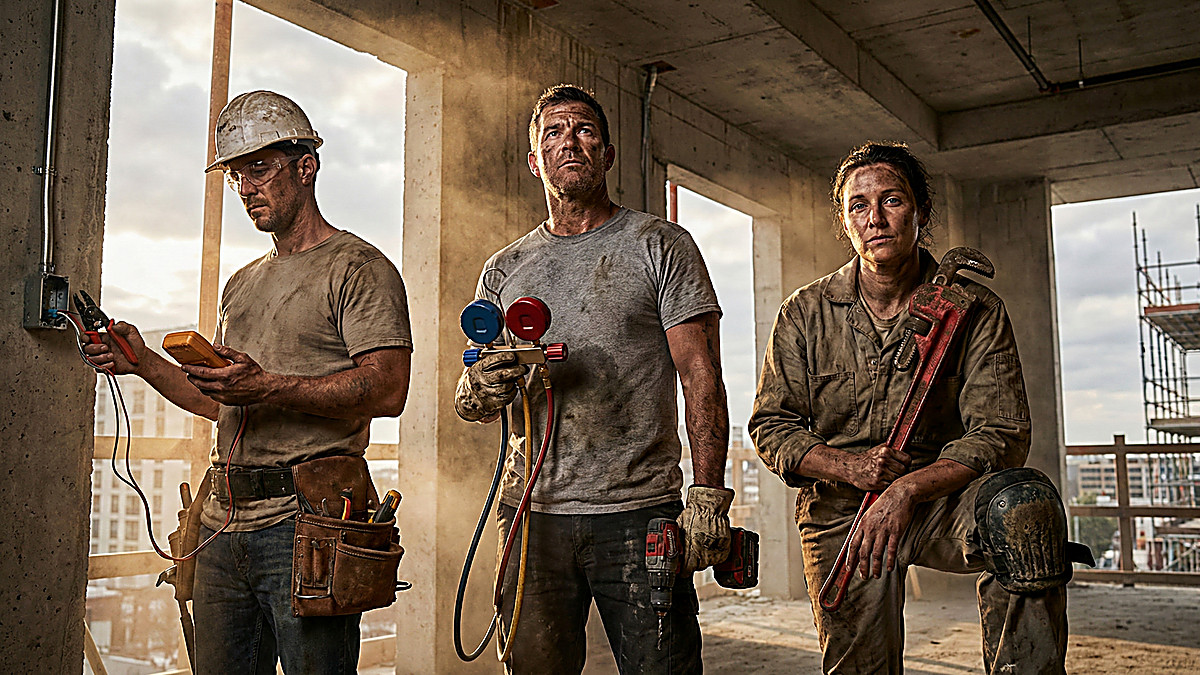
The bigger difference is how you want to learn and work. Electrical careers center on wiring, power, controls, code, construction, and a paid apprenticeship model. HVAC/R mixes electrical troubleshooting with mechanical systems, airflow, heating, cooling, refrigeration, service calls, and more direct exposure to emergency/seasonal work.
If you are deciding between the two, compare the complete path where you live: school time, time to first paycheck, time to full qualification, licensing rules, and the kind of problems you want to solve all day.
HVAC vs. electrician at a glance
| Factor | Electrician | HVAC/R technician |
|---|---|---|
| Typical entry education | High school diploma or equivalent | Postsecondary nondegree award |
| Typical post-entry training | Apprenticeship | Long-term on-the-job training |
| Common formal training | 4- or 5-year apprenticeship; technical school is optional for many entrants | 6-month to 2-year certificate/associate program is common; apprenticeships also exist |
| May 2025 median wage | $63,190 | $61,010 |
| 10th percentile wage | $42,640 | $40,050 |
| 90th percentile wage | $108,510 | $95,210 |
| 2025–35 projected growth | 9.2% | 10.9% |
| Projected annual openings | 72,700 | 40,600 |
| 2025 projected-employment base | 821,000 | 440,900 |
| Major credential issue | Licensing requirements vary by state/locality; BLS says most states require licensing | EPA Section 608 applies to covered refrigerant work; state/local licensing may also apply |
| Work pattern | Wiring, power, controls, construction, maintenance, troubleshooting | Heating/cooling/refrigeration installation, service, diagnostics, maintenance |
| Schedule reality | Full time; evenings/weekends possible; overtime common | Full time; evenings/weekends possible; emergency on-call and seasonal irregular hours can occur |
| Strong fit if you like | Electrical theory, code, wiring, structured systems, construction/industrial settings | Mechanical diagnostics, refrigeration, airflow, electrical controls, service calls, varied systems |
Data note: Wages are from BLS Occupational Employment and Wage Statistics, May 2025. Growth, openings, education, training, and the 2025 employment base are from BLS Employment Projections, 2025–35. Wage percentiles are distribution points, not experience levels.
The biggest difference is not pay. It is the training model.
A lot of comparisons say HVAC is “faster” because an HVAC certificate may take months while an electrical apprenticeship takes four or five years. That comparison is incomplete.
1. School time
How long are you in a classroom or lab before you can realistically pursue the job?
2. Time to paid work
When can you start earning in the occupation?
3. Full qualification
How long until you complete the apprenticeship, licensing, certification, or supervised experience your path requires?
For electricians, the Bureau of Labor Statistics (BLS) says most learn in a four- or five-year apprenticeship. Apprentices typically receive about 2,000 hours of paid on-the-job training each year plus technical instruction. That means the pathway is long, but much of it is paid employment. Technical school can help, and BLS says graduates usually receive some apprenticeship credit, but the amount depends on the program and sponsor.
For HVAC, BLS says postsecondary programs generally last six months to two years and may lead to a certificate or associate degree. Newly hired technicians then typically spend a lengthy period learning on the job. Some HVAC technicians instead train through paid apprenticeships that last several years.
So which is faster? If you land a solid electrical apprenticeship immediately, electrical work may get you to a paycheck sooner than spending months in HVAC school. If electrical apprenticeships are hard to enter where you live, a shorter HVAC program may provide a more predictable school-to-work route. The smart comparison is local, not theoretical.
For a deeper timeline comparison, see how long trade school takes, our apprenticeship application guide, and the dedicated HVAC apprenticeship guide.
Pay and outlook: two good careers, different strengths
Electricians lead on national pay, but not by much at the median
Electricians earned a national median of $63,190 in May 2025. HVAC/R mechanics and installers earned $61,010. That is only a $2,180 annual difference at the median.
The gap widens higher in the wage distribution. The 90th percentile was $108,510 for electricians versus $95,210 for HVAC/R technicians. At the 10th percentile, the figures were $42,640 and $40,050, respectively.
Do not turn those percentiles into “beginner” and “expert” salaries. OEWS percentiles describe the wage distribution across workers; they do not map neatly to years of experience, apprenticeship stage, union status, license level, or specialty.
Industry matters too. BLS reports a May 2025 median of $79,820 for electricians in government and $74,550 in manufacturing, compared with $61,570 for electricians working for electrical contractors. For HVAC/R, wholesale trade had a $71,190 median, while plumbing, heating, and air-conditioning contractors had a $60,030 median.
HVAC grows faster; electrical has more openings
BLS projects HVAC/R employment to grow 10.9% from 2025 to 2035, compared with 9.2% for electricians. Both are much faster than the 3% projection for all occupations.
But electricians start from a much larger employment base. BLS projects about 72,700 electrician openings per year, versus about 40,600 HVAC/R openings.
That distinction matters. A higher growth percentage does not automatically mean more jobs. HVAC is growing faster relative to its size. Electrical is the larger occupation and is projected to generate more annual openings.
BLS points to commercial construction, including data centers, residential construction, sophisticated climate-control systems, and repair/replacement work as HVAC demand drivers. For electricians, BLS cites continued building electrical work, solar and wind connections, grid expansion, and electricity demand associated with data centers and AI technologies.
Neither occupation is magically recession-proof or automation-proof. Current federal projections simply show strong expected demand through 2035.
What the work actually feels like
Electrician work
Electricians install, maintain, and repair electrical power, communications, lighting, and control systems. Depending on the job, that can mean pulling wire, installing conduit, connecting breakers and equipment, reading blueprints, troubleshooting circuits, maintaining factory equipment, or working on controls.
The trade tends to reward people who like structured systems, precise rules, diagrams, electrical theory, and code-based work. Electrical mistakes can be dangerous, so careful procedure is not optional.
BLS says electricians work indoors and outdoors at homes, businesses, factories, and construction sites. They may work in cramped spaces, at heights, around dust or fumes, and in hot or cold weather.
HVAC/R work
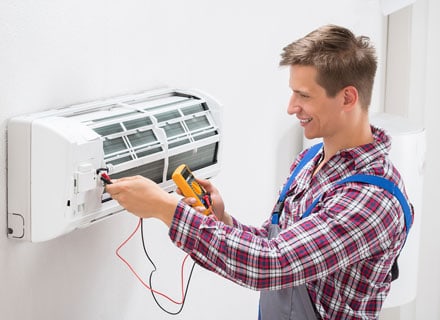
HVAC/R technicians install, maintain, test, and repair heating, cooling, ventilation, and refrigeration systems. They may install electrical components and wiring, troubleshoot controls, diagnose airflow or temperature problems, repair failed parts, handle refrigerants, and explain system problems to customers.
The trade tends to reward people who enjoy multi-system troubleshooting. A single problem may involve electrical controls, airflow, mechanical components, combustion, refrigeration, or some combination of them.
BLS says HVAC technicians often travel between service calls and may work outdoors, in cramped spaces, or in buildings that are uncomfortable because the heating or cooling system is broken.
Which trade is harder?
Neither one wins a universal misery trophy.
Electrical work is hard in a precision-and-code sense. You need to understand electrical theory, read diagrams, perform calculations, follow code, and work safely around hazards that can be fatal. BLS specifically lists mathematics, blueprint reading, electrical code requirements, and safety among apprenticeship instruction topics.
HVAC is hard in a systems-diagnosis sense. You may need to reason across electrical components, mechanical equipment, airflow, load requirements, refrigerant circuits, and controls. BLS highlights math, mechanical, problem-solving, and technology skills for HVAC technicians.
If you enjoy deep electrical systems and rules, electrical may feel more natural. If you enjoy chasing a fault through several interacting systems, HVAC may be more satisfying.
Which is harder on your body?
Both can beat you up if you ignore ergonomics and safety, just in different ways.
Electricians may spend long periods standing, kneeling, working overhead, climbing, or moving heavy components. They can also work at heights and in cramped spaces. Common hazards include shock, falls, and burns.
HVAC technicians may work in cramped or uncomfortable spaces, outdoors in bad weather, and around heavy equipment. BLS says HVAC/R technicians have one of the highest rates of injuries and illnesses of all occupations; listed hazards include burns, chemicals, and muscle strains or sprains from handling heavy equipment.
That does not mean every HVAC job is brutal or every electrical job is clean and comfortable. Residential service, commercial construction, industrial maintenance, refrigeration, controls, and building automation can feel like different careers inside the same occupational label.
Schedule and work-life reality
Almost all electricians work full time. BLS says evenings and weekends may be required and overtime is common, especially around construction and scheduled maintenance.
HVAC technicians also mostly work full time, but BLS explicitly notes evening and weekend shifts, emergency on-call work, and overtime or irregular schedules during peak heating and cooling seasons.
That makes schedule tolerance a real differentiator. If you strongly dislike emergency calls when everyone else's air conditioner dies during the same heat wave, consider that before choosing residential HVAC service. If you dislike early construction schedules, travel between worksites, or project-driven overtime, electrical work has its own lifestyle costs.
Specialty matters more than the stereotype. Commercial controls, facilities maintenance, new construction, residential service, refrigeration, and industrial electrical maintenance can each have very different schedules.
Licensing and certification: two very different systems
Electrician licensing
BLS says most states require electricians to be licensed, but requirements vary by state. Most electricians learn through apprenticeship, and BLS says those programs typically last four or five years. After completing apprenticeship, workers are considered journey workers, subject to state or local licensing requirements.
That is why electrician school and becoming a licensed electrician are not synonyms. Technical school can build fundamentals and may earn apprenticeship credit, but you still need to verify the rules where you intend to work and the requirements of the apprenticeship sponsor you are targeting. Our electrician career roadmap explains the broader sequence.
HVAC certification and licensing
HVAC has an additional federal rule that causes endless confusion: EPA Section 608.
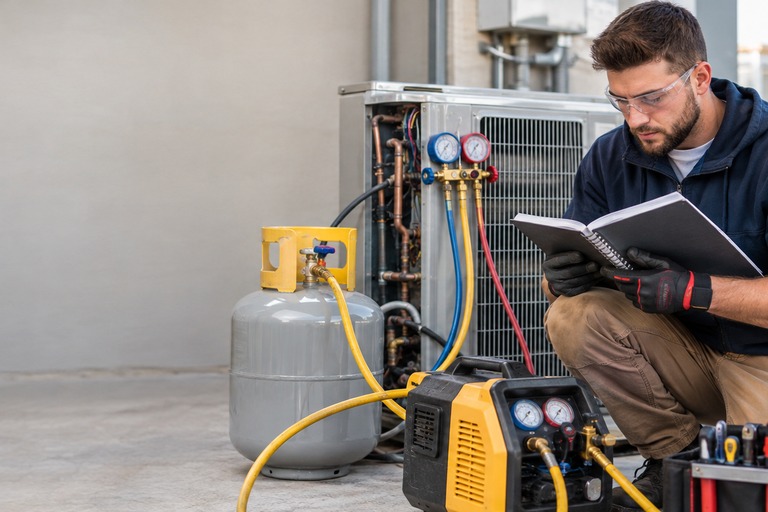
The EPA requires certification for technicians who maintain, service, repair, or dispose of equipment in ways that could release regulated refrigerants. EPA offers Type I, Type II, Type III, and Universal credentials, and Section 608 technician certification does not expire. Closely and continually supervised apprentices are exempt from the certification requirement while working under a certified technician.
EPA 608 is not a general national HVAC occupational license. BLS notes that some states and localities also require HVAC technicians to be licensed. Those are separate systems.
If you are preparing for the federal refrigerant credential, TSNET also has an independent EPA 608 practice test.
Math and technical learning
You do not need to be a math prodigy for either career. You do need to be willing to use applied math correctly.
Electrician apprenticeship instruction commonly includes mathematics alongside electrical theory, blueprint reading, code, and safety. Real electrical work can involve load calculations, voltage, current, resistance, measurements, and layout.
HVAC technicians use math for tasks such as determining load requirements and interpreting system measurements. Their technical learning also spans mechanical systems, electrical components, airflow, controls, and refrigerant handling.
The useful question is not “Which trade has less math?” It is “Which kind of technical problem would I rather solve repeatedly?”
Career growth and specialization
Both trades are broader than their entry-level stereotypes.
Electricians can move into commercial and industrial work, controls, manufacturing maintenance, renewable-energy connections, supervision, project management, and, where licensing rules allow, contracting.
HVAC/R technicians can specialize in commercial service, refrigeration, controls, testing and balancing, larger institutional systems, installation, maintenance, service management, or contracting.
BLS Employment Projections estimates that self-employed workers make up about 7.1% of electricians and 6.3% of HVAC/R mechanics and installers. That is useful context, not proof that one trade is automatically the better business opportunity.
If ownership is your goal, investigate contractor-license rules, insurance, capital needs, pricing, and demand in your state instead of choosing a trade from a generic “best business” list.
Which trade fits you better?
Electrician may fit you better if...
- You like wiring, circuits, diagrams, and electrical systems.
- You are comfortable with code-heavy, rule-driven work.
- A multi-year paid apprenticeship sounds better than paying for a longer school-first path.
- You want access to a large occupation with many projected openings.
- Construction, industrial, maintenance, or controls work sounds appealing.
- You can tolerate standing, kneeling, climbing, heights, and occasional cramped spaces.
HVAC may fit you better if...
- You like diagnosing machines that combine mechanical and electrical systems.
- Airflow, heating, cooling, refrigeration, and controls sound interesting.
- A six-month-to-two-year school program feels like a useful structured entry route.
- You are comfortable interacting with customers and moving between service calls.
- You can tolerate cramped spaces, outdoor work, and uncomfortable temperatures.
- You can live with the possibility of emergency on-call work and seasonal schedule spikes.
Either one can fit if...
- You like hands-on technical work.
- You want a career where learning continues after school.
- You are willing to follow safety procedures every day, even when the job is annoying.
- You care more about becoming genuinely competent than collecting the shortest credential possible.
HVAC or electrician fit checker
This is a transparent gut check, not a scientific career assessment. Each answer adds one point to the trade it favors. A tie means your local apprenticeship availability, school costs, and preferred specialty should probably make the decision.
Can you switch from HVAC to electrical or vice versa?
Yes, but skills transfer more easily than credentials.
HVAC technicians often develop useful electrical troubleshooting experience because HVAC systems contain wiring, motors, relays, controls, and electrical components. That experience can make electrical concepts feel less alien, but it does not automatically satisfy state or local electrician licensing requirements.
Electricians bring valuable skills to HVAC controls and electrical diagnosis, but an electrical license does not replace EPA Section 608 certification for covered refrigerant work.
If you think you may switch later, assume you will need to satisfy the new trade's credential and supervised-training rules rather than expecting a one-for-one transfer.
Questions to ask before choosing a program or apprenticeship
Ask an electrical apprenticeship sponsor
- Is this a registered apprenticeship, and who registers it?
- How long is the program and how are paid on-the-job hours structured?
- What is the wage progression?
- How much related technical instruction is included?
- What work types will I actually experience: residential, commercial, industrial, maintenance, controls?
- Does completing the program satisfy or support the licensing path in this state/locality?
- If I attend technical school first, exactly how much credit will this sponsor grant?
Ask an HVAC school or apprenticeship sponsor
- How much hands-on lab time is included?
- Is EPA Section 608 preparation and testing included, and which certification types are covered?
- Does the program train on electrical controls as well as heating, cooling, airflow, and refrigeration fundamentals?
- What additional on-the-job learning should I expect after graduation?
- Does this program satisfy any state/local education requirement or count toward an apprenticeship?
- What are the total costs beyond tuition, including tools, books, testing, and fees?
- Which employers or apprenticeship sponsors regularly hire graduates?
HVAC vs. electrician FAQ
Who makes more, HVAC technicians or electricians?
Electricians have the higher national median and upper wage percentile in the latest BLS data. In May 2025, electricians had a median annual wage of $63,190 versus $61,010 for HVAC/R mechanics and installers. The 90th percentiles were $108,510 and $95,210, respectively. Actual earnings vary widely by location, employer, specialty, overtime, and other factors.
Which career is faster to enter, HVAC or electrician?
It depends on what you mean by “enter.” HVAC school programs generally last six months to two years, but students may spend that time in school before starting field work. Electrical apprenticeships typically last four or five years, but apprentices are paid while receiving on-the-job training. A person accepted directly into an electrical apprenticeship may therefore start earning sooner than someone attending HVAC school first.
Do you have to go to trade school to become an electrician?
Not necessarily. BLS says most electricians learn through apprenticeship, while some start at technical school. Technical-school graduates usually receive some credit toward apprenticeship, but the amount varies. Licensing requirements also vary by state and locality.
Do HVAC technicians need EPA Section 608 certification?
EPA requires Section 608 certification for technicians who maintain, service, repair, or dispose of equipment in ways that could release regulated refrigerants. The credential has Type I, II, III, and Universal categories and does not expire. Apprentices may work under a certified technician when closely and continually supervised. State/local HVAC licensing may apply separately.
Which trade has more job openings?
Electricians. BLS projects about 72,700 electrician openings per year from 2025 to 2035, compared with about 40,600 for HVAC/R mechanics and installers. HVAC is projected to grow faster percentage-wise, 10.9% versus 9.2%.
Is HVAC more physically demanding than electrical work?
There is no universal winner. BLS describes electricians working at heights, standing and kneeling for long periods, and facing shock, fall, and burn hazards. HVAC technicians often work in cramped or uncomfortable spaces, handle heavy equipment, and face burn, chemical, and strain/sprain hazards. The specialty and employer can change the physical reality substantially.
Which trade uses more math?
Both use applied math. Electrician training commonly covers mathematics, electrical theory, blueprint reading, and code. HVAC technicians use math for load requirements and combine it with mechanical, electrical, airflow, and refrigeration troubleshooting. Choose based on which technical problems you prefer, not on trying to avoid math entirely.
Can an electrician work on HVAC systems?
Electricians may work on electrical power and controls associated with HVAC equipment when allowed by their scope and local rules. But an electrical license does not substitute for EPA Section 608 certification when work on covered equipment could release regulated refrigerants. Mechanical/HVAC licensing can also apply depending on the jurisdiction.
Bottom line
Choose electrician if you are drawn to electrical systems, code, wiring, construction or industrial work, and a structured apprenticeship path. Choose HVAC/R if you prefer broad mechanical diagnosis, refrigeration and climate-control systems, service work, and a school-first route that can be shorter before entry-level employment.
Do not choose either trade because somebody on Reddit said one is “cleaner,” “easier,” or guaranteed to make six figures.
Compare the full path where you live: apprenticeship access, school cost, licensing rules, local employers, schedule, and the kind of technical problems you actually want to solve for years.
If you want to add plumbing to the comparison, see our broader electrician vs. HVAC vs. plumber showdown.
Sources and methodology
Fact-checked October 5, 2026. Wage figures are May 2025 BLS Occupational Employment and Wage Statistics data. Employment projections are BLS 2025–35 projections released August 27, 2026. Regulatory statements use current EPA guidance. We keep wage distributions separate from experience levels and avoid treating state/local licensing as nationally uniform.
- U.S. Bureau of Labor Statistics, Occupational Outlook Handbook: Electricians — BLS source
- U.S. Bureau of Labor Statistics, Occupational Outlook Handbook: Heating, Air Conditioning, and Refrigeration Mechanics and Installers — BLS source
- U.S. Bureau of Labor Statistics, Occupational Projections and Worker Characteristics — BLS projections table
- U.S. Environmental Protection Agency, Section 608 Technician Certification Requirements — EPA source
- U.S. Department of Labor, Registered Apprenticeship — Apprenticeship.gov
Explore training options
Once you know which trade fits better, compare the actual training route rather than the marketing headline. Start with electrician training or HVAC training, then verify the licensing and apprenticeship rules where you plan to work.