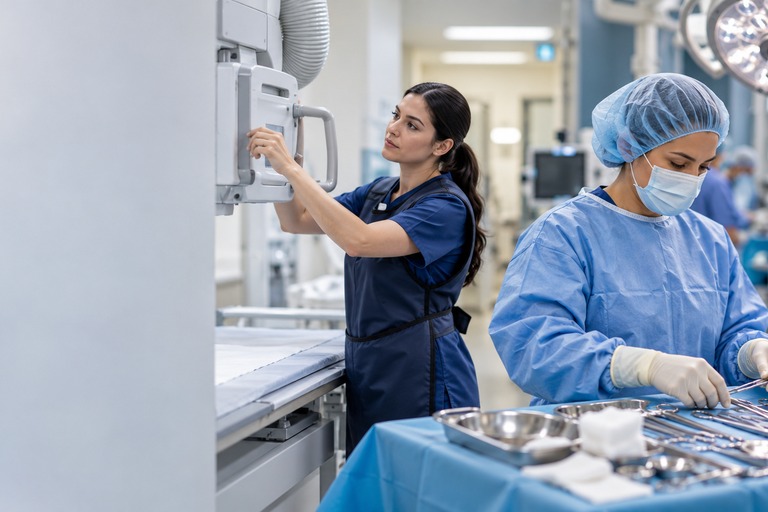
Anesthesia Technician vs. Surgical Technologist: Which OR Career Fits You?



Two operating-room careers, two very different sides of the drape. Compare what the jobs actually involve before you spend money on training.
The fast decision
Surgical technology is the clearer, more standardized route if you want to work inside the sterile surgical workflow. Anesthesia technology is a more variable, equipment-heavy route with scarcer accredited programs and more employer-specific entry paths.
The biggest data warning: surgical technologists have a dedicated BLS occupation. Anesthesia technicians and technologists do not, so neat national anesthesia-tech salary and growth figures often rely on mismatched occupations or opaque estimates.
Table of Contents
If you want to work in an operating room without becoming a nurse, surgeon, or anesthesia provider, anesthesia technology and surgical technology can both put you close to the action. But they put you on very different sides of it.
A surgical technologist works primarily with the sterile surgical field, instruments, supplies, and the surgical team. An anesthesia technician or technologist supports the anesthesia team, equipment, airway supplies, monitoring systems, and room readiness. One path has a much more standardized education and labor-data trail. The other is more fragmented, more employer-dependent, and surprisingly easy to research badly.
That last point matters. There is a clean federal occupation code for surgical technologists. There is not a comparable standalone BLS occupation for anesthesia technicians or technologists. So if a website shows you a tidy national anesthesia-tech salary and growth rate without explaining where the number came from, inspect the source before trusting it.
Quick answer
Choose surgical technology if you want to be scrubbed into procedures, handle sterile instruments, anticipate the surgeon's needs, and follow a comparatively clear training-and-certification path.
Choose anesthesia technology if you are more interested in anesthesia equipment, airway and monitoring supplies, technical troubleshooting, room readiness, and supporting anesthesia providers. The catch is that formal accredited programs are scarce, job requirements vary more by hospital, and national pay/outlook data are much less clean.
Neither job is a shortcut to becoming a nurse, anesthesiologist, CRNA, or certified anesthesiologist assistant. Those are separate professions with their own education, licensing, and clinical scopes.
Anesthesia tech vs. surgical tech at a glance
| Factor | Anesthesia technician / technologist | Surgical technologist |
|---|---|---|
| Primary team | Anesthesia team | Surgical team |
| Typical OR position | Near the anesthesia workstation and head of the table; may move between rooms or procedure areas | At or near the sterile field and instrument tables |
| Main focus | Equipment, airway and monitoring supplies, room readiness, troubleshooting, provider support | Sterile field, instruments, supplies, counts, anticipating surgical needs |
| Sterile role | Usually works outside the sterile field | Frequently scrubbed into the sterile field |
| Formal national occupation data | No dedicated BLS OEWS/EP series | Yes: SOC 29-2055 |
| Typical training structure | Employer training varies; formal CAAHEP programs exist but are scarce | Formal accredited certificate/associate pathways are widely established |
| Main current credential | Cer.A.T.T. from ASATT | CST from NBSTSA |
| Legacy credential | Cer.A.T. remains recognized for existing holders; ASATT no longer offers the technician exam | N/A |
| National pay number | No defensible standalone BLS median | $64,650 median annual wage, May 2025 |
| Federal outlook | No standalone federal projection | 5% growth, 2025-2035; about 7,100 openings per year |
| Good fit for | Equipment-minded troubleshooters who like technical support and varied room readiness | Detail-focused people who want direct involvement in the sterile surgical workflow |
Want to see the training paths?
Explore the anesthesia technician career and training landscape, or dig into the step-by-step surgical-tech route before comparing schools.
Explore anesthesia technician training How to become a surgical tech
Data note: Surgical-technologist wage and outlook figures above are from the latest BLS OEWS and Employment Projections available as of October 2026. Anesthesia-tech figures are intentionally not forced into a national average because no equivalent standalone federal series exists.
First, untangle the job titles
This comparison gets messy fast because similar-sounding anesthesia titles are not interchangeable.
Anesthesia technician
Hospitals commonly use anesthesia technician for technical support staff who prepare, clean, stock, test, transport, and troubleshoot anesthesia-related equipment and supplies. Exact duties and hiring requirements vary by employer.
Some current hospital postings accept a high school diploma or GED plus basic life support and relevant healthcare experience. Others require ASATT certification or more specialized experience. That variation is part of the career's reality, not a footnote.
Certified Anesthesia Technician (Cer.A.T.)
Cer.A.T. is a legacy ASATT credential. ASATT still recognizes people who already hold it, but it no longer offers the technician-level certification exam to new candidates.
If you see a school or article promising that a beginner can simply take the Cer.A.T. exam after a short course, that information is outdated.
Certified Anesthesia Technologist (Cer.A.T.T.)
Cer.A.T.T. is ASATT's active technologist credential. New entrants can qualify by completing a CAAHEP-accredited, CoA-ATE-approved anesthesia technology program and passing the technologist examination. Experienced uncertified anesthesia technicians may qualify through ASATT's Practical Experience Pathway, and active legacy Cer.A.T. holders have an Advancement Program route.
Certified anesthesiologist assistant (CAA)
A CAA is not an anesthesia technician or technologist. CAAs are graduate-educated anesthesia professionals who provide anesthesia care under anesthesiologist supervision. Do not use CAA salaries, education requirements, or occupational data to estimate anesthesia-tech outcomes.
One especially nasty data trap: ONET currently includes titles such as "Anesthesia Technician" and "Cer.A.T.T." among reported titles attached to its Anesthesiologist Assistants occupation. That does not make the occupations equivalent. The task profile for that ONET occupation includes administering anesthetics and controlling anesthesia levels, which are not duties you should automatically assign to technical anesthesia-support staff.
Surgical technologist
A surgical technologist is the formal occupation represented by federal SOC 29-2055. "Surgical tech," "scrub tech," and "operating room tech" are common job-title variations.
Certified Surgical Technologist (CST)
CST is the credential awarded by the National Board of Surgical Technology and Surgical Assisting (NBSTSA). Current NBSTSA eligibility includes graduates of CAAHEP- or ABHES-accredited surgical technology programs, with a separate eligibility category for qualifying military program graduates.
The easiest way to picture the difference: where you work in the OR
Imagine the operating room divided into two overlapping work zones.
Surgical technologist: the sterile-field side
The surgical technologist is focused on the sterile environment and the tools used to perform the operation. O*NET lists core tasks such as maintaining the sterile field, counting sponges and instruments, passing instruments and supplies, helping the team gown and glove, preparing the patient, and restocking the OR.
During a procedure, a scrubbed surgical technologist may spend long stretches at the sterile field, monitoring what is needed next and protecting aseptic technique. The work rewards precision. A missed count, contaminated item, or wrong instrument can matter immediately.
Anesthesia tech: the equipment-and-support side
Anesthesia technicians and technologists work in support of anesthesia providers. ASATT describes the profession around preparing, acquiring, applying, and maintaining equipment and supplies used in anesthesia care.
Depending on the facility and credential level, that can include preparing anesthesia workstations, airway equipment, monitors, invasive-line supplies, infusion equipment, and other specialized devices; cleaning and restocking after cases; and responding when the anesthesia team needs equipment or technical help.
The key distinction is support. Anesthesia technicians do not become independent anesthesia providers because they can prepare the equipment. Administering anesthesia and directing the anesthetic plan are separate licensed clinical responsibilities.
One surgery, two different workflows
Exact workflows vary by hospital, procedure, and staffing model, but a typical case shows the contrast clearly.
Before the patient enters
Surgical technologist: Opens and organizes sterile supplies, prepares the sterile field, checks instruments and supplies, and gets the room ready for the surgical team's sterile work.
Anesthesia tech: Helps ensure anesthesia equipment, circuits, airway supplies, monitors, carts, and related devices are clean, stocked, tested, and ready for the anesthesia provider.
During patient setup
Surgical technologist: Helps protect the sterile setup and may assist with positioning, skin preparation, draping, and final room readiness within the role allowed by the facility.
Anesthesia tech: May help stage monitoring and airway equipment, bring specialized equipment into the room, and assist the anesthesia provider with technical setup. Patient-contact duties vary substantially by employer.
During the operation
Surgical technologist: Passes instruments and supplies, tracks counts, watches the sterile field, and anticipates the next step of the procedure.
Anesthesia tech: Remains available for anesthesia-equipment or supply needs and may support multiple rooms or procedural areas depending on staffing and facility design.
After the case
Surgical technologist: Participates in final counts, breaks down the sterile field safely, manages contaminated instruments and supplies according to protocol, and helps reset the room.
Anesthesia tech: Cleans and resets anesthesia equipment and work areas, replaces disposable supplies, restocks carts, and prepares the anesthesia setup for the next case.
If the part of surgery that fascinates you is the instrument sequence and sterile procedure itself, surgical technology is probably closer to what you are imagining. If you are pulled toward the machines, airway gear, monitors, troubleshooting, and anesthesia logistics, anesthesia technology deserves a closer look.
Training: surgical technology has the clearer road map
This is one of the biggest differences between the careers.
Surgical technology training
BLS says surgical technologists typically need a postsecondary nondegree award, while accredited programs may award a certificate or associate degree. Current ARC/STSA standards require students in accredited surgical technology programs to complete at least 120 surgical cases as part of clinical education.
For students who want the CST credential, accreditation matters. NBSTSA currently requires graduation from a CAAHEP- or ABHES-accredited surgical technology program to qualify through the standard graduate pathway. Military graduates have a separate eligibility category.
That gives the occupation a relatively straightforward sequence:
- Complete an accredited surgical technology program.
- Complete supervised clinical requirements.
- Establish CST exam eligibility.
- Pass the NBSTSA exam.
- Meet employer and state requirements where you plan to work.
Anesthesia technology training
Formal anesthesia technology education exists, but access is dramatically narrower.
As of October 2, 2026, ASATT's approved-schools directory lists 10 CAAHEP-accredited anesthesia technology programs in the United States. Graduates of these programs are eligible for ASATT's National Certification Examination for the Cer.A.T.T. credential.
That means a prospective student may face a practical question before anything else: Is there an accredited program you can realistically attend?
If not, some hospitals still hire entry-level anesthesia technicians and train them internally. Current Johns Hopkins postings, for example, show anesthesia-technician jobs requiring a high school diploma/GED plus BLS or CPR-related requirements, with experience or other healthcare credentials varying by position.
But getting hired into an uncertified technician job is not the same thing as immediately qualifying for Cer.A.T.T.
The anesthesia-tech certification path is easy to misunderstand
ASATT currently recognizes three routes toward the active Cer.A.T.T. credential:
1. Accredited-program route
For someone beginning the career through formal education, the route is a CAAHEP-accredited / CoA-ATE-approved anesthesia technology program, followed by the technologist exam.
2. Practical Experience Pathway (PEP)
Experienced, uncertified anesthesia technicians may qualify through ASATT's Practical Experience Pathway. Current requirements include:
- Five years of anesthesia-tech experience at a Level 1 or Level 2 facility, or seven years at a tertiary or outpatient facility
- At least 40 specified continuing-education credits
- Current ACLS and BLS credentials from the American Heart Association or American Red Cross
- Verified anesthesia-technology employment history
ASATT notes that anatomy and physiology I/II and general chemistry are now recommended rather than mandatory PEP prerequisites.
This is a real alternate route, but it is not a "take a quick online course and challenge the exam" shortcut. It is a multi-year experience pathway.
3. Advancement Program
Active Cer.A.T. holders in good standing may use ASATT's Advancement Program to pursue Cer.A.T.T. The important word is existing: new entrants cannot earn Cer.A.T. because the technician exam is no longer offered.
Recertification
ASATT currently requires 30 continuing-education credits during each two-year certification period for Cer.A.T.T. holders, including valid ACLS. Legacy Cer.A.T. holders need 20 CEs during their two-year period.
Pay: only one of these careers has a clean national number
This is where bad comparisons become dangerously easy.
Surgical technologist pay
BLS May 2025 OEWS data reports:
- Median annual wage: $64,650
- Median hourly wage: $31.08
- 10th percentile annual wage: $45,940
- 90th percentile annual wage: $96,940
BLS also reports a mean annual wage of $68,710. Do not interpret the 10th and 90th percentiles as automatic "beginner" and "experienced" salaries; wages vary with geography, employer, specialty, schedules, bargaining agreements, and other factors.
Anesthesia technician pay
There is no equivalent standalone BLS national wage series for anesthesia technicians or technologists. That means a single national median would require a different source and methodology, and different websites often mix incompatible titles.
A safer way to see the market is to inspect real employer postings while remembering that each posting is local and role-specific.
Current examples checked October 2, 2026 include:
| Employer / role | Location | Posted pay range | Selected requirements |
|---|---|---|---|
| Johns Hopkins All Children's Hospital - Anesthesia Technician | St. Petersburg, FL | $19.02-$30.44/hour | HS/GED; BLS within 3 months; healthcare education/credentials preferred |
| Johns Hopkins Suburban Hospital - Certified Anesthesia Tech | Bethesda, MD | $19.85-$32.76/hour | HS/GED; CPR plus ASATT/Cer.A.T.T.; related experience preferred |
| Johns Hopkins Howard County - Anesthesia Tech Lead | Columbia, MD | $21.88-$36.13/hour | HS/GED; Cer.A.T.T. or legacy Cer.A.T.; at least 5 years of experience |
Those are examples, not a national salary survey. They do show why title, certification, experience, geography, call requirements, and employer matter so much in this field.
If you are comparing offers, look at the actual hospital pay range and requirements in the city where you plan to work rather than relying on a national anesthesia-tech "average" with murky occupational mapping.
Job outlook: surgical tech has federal projections; anesthesia tech does not
BLS projects employment of surgical technologists to rise from 118,400 jobs in 2025 to 124,300 in 2035, an increase of 5,900 jobs or 5%. It projects about 7,100 surgical-technologist openings per year on average over that decade.
BLS also reports that 71% of surgical technologists worked in hospitals in 2025, with physician offices and outpatient care centers among the other major employers.
There is no comparable federal anesthesia-technician projection series at the same occupation level. It is reasonable to observe that anesthesia services depend on technical equipment and supplies, but it is not responsible to convert that observation into a made-up national growth percentage.
For anesthesia technology, evaluate demand locally: search hospital systems in your region, check how often anesthesia-tech jobs appear, note whether employers want Cer.A.T.T., and see whether the jobs are concentrated at large academic or trauma centers.
Certification and state rules: surgical tech varies more by state
Surgical technology has a patchwork of state laws rather than one nationwide licensing rule.
As of October 2026, AST's live legislative overview lists 18 states with laws related to surgical-technologist education, certification, and/or registration. The requirements are not identical. Some address education or certification standards; others focus on registration. Employers may impose additional credentialing standards regardless of state law.
So before enrolling, check the current law and major employer requirements in the state where you expect to work.
Anesthesia technology does not have the same clean state-law framework in the sources reviewed for this article. ASATT certification is a professional credential, and hospitals define substantial parts of job qualification and day-to-day scope. That makes local employer research especially important.
Work environment: both can be intense, just in different ways
Surgical technology: static focus and sterile discipline
BLS says surgical technologists spend much of their time on their feet. Hospital jobs may include nights, weekends, holidays, on-call work, and shifts longer than eight hours.
The distinctive stress is staying locked into the sterile workflow. You are handling instruments, watching counts, following the procedure, and protecting the sterile field while the operation unfolds in front of you.
You also need to be comfortable with surgical sights, bodily fluids, sharp instruments, protective equipment, and physically demanding work.
Anesthesia technology: equipment readiness and fast technical response
Anesthesia-tech work can involve moving equipment and supplies, cleaning and resetting workstations, troubleshooting devices, responding to the anesthesia team's requests, and supporting multiple anesthetizing locations. Some positions include call, weekends, or nights; others are more predictable.
Current employer postings demonstrate that variation. One Johns Hopkins anesthesia-technician posting requires call and weekends, while a lead posting at another Hopkins facility lists no call or weekends.
In other words: do not choose anesthesia technology because someone told you it is automatically the "easier schedule." Read actual postings where you live.
Which career fits you better?
Surgical technology may fit you better if you:
- Want to be directly involved in the sterile surgical workflow
- Like instruments, anatomy, procedure sequencing, and hands-on precision
- Can stay focused in one high-stakes environment for long stretches
- Are comfortable with blood, open surgical sites, sharps, and strict sterile technique
- Prefer a career with a clearer accredited-school-to-credential pathway
- Want national wage and outlook data that is easier to evaluate
Anesthesia technology may fit you better if you:
- Are fascinated by anesthesia machines, airway equipment, monitors, circuits, and technical systems
- Like troubleshooting and making sure equipment is ready before it becomes an emergency
- Prefer supporting the anesthesia side rather than working inside the sterile surgical field
- Are comfortable with employer-specific job descriptions and training expectations
- Have access to one of the limited accredited programs or can realistically enter through an employer route
- Are willing to research local job requirements instead of assuming one national pathway applies everywhere
Think twice about surgical technology if you:
- Strongly dislike prolonged standing
- Are uncomfortable around open surgery or sharps
- Hate rigid procedural rules and constant attention to sterile technique
- Want a job where you can casually step away in the middle of a procedure
Think twice about anesthesia technology if you:
- Need a widely available accredited program close to home
- Want a career with a simple national salary/outlook dashboard
- Dislike equipment troubleshooting or supply/readiness work
- Assume a short certificate automatically qualifies you for Cer.A.T.T.
Can an anesthesia tech become a surgical tech, or vice versa?
Yes, people can change paths, but neither credential simply converts into the other.
An anesthesia technician who wants to become a surgical technologist would normally need to meet surgical-technology education, clinical, certification, employer, and state requirements. Prior hospital experience may make the environment familiar, but it does not replace the formal competencies required for the sterile surgical role.
A surgical technologist moving toward anesthesia technology would likewise need to meet the hiring or education requirements of the anesthesia department and, if pursuing Cer.A.T.T., satisfy an ASATT eligibility route.
Your existing skills may help. They are not an automatic bridge credential.
Career growth: what can each path lead to?
Surgical technologists may move toward lead roles, education, management, or additional healthcare education. One direct surgical-care advancement option is surgical first assisting, which requires additional training and its own credentialing path. BLS also notes that advancement to nursing or other healthcare occupations generally requires additional education, training, and/or licensing.
Anesthesia technicians and technologists may progress to senior or lead technical roles, equipment/supply coordination, education, or department supervision. A Cer.A.T.T. can strengthen a technologist's professional standing, but it does not turn the holder into an anesthesia provider.
Moving into professions such as nursing, CRNA practice, perfusion, physician assistant practice, or certified anesthesiologist assistant practice requires the separate prerequisite and degree path for that profession.
Questions to ask before choosing a program
For surgical technology, ask:
- Is the program currently accredited by CAAHEP or ABHES?
- Will graduation make me eligible for the NBSTSA CST exam?
- How are the 120 required clinical cases arranged and tracked?
- Which hospitals host clinical rotations?
- What do employers in my state require beyond graduation?
- Does my state have education, certification, or registration rules for surgical technologists?
For anesthesia technology, ask:
- Is the program listed by ASATT as a CAAHEP-accredited anesthesia technology program?
- Does graduation make me eligible for the Cer.A.T.T. exam?
- What degree or certificate will I earn?
- Where are clinical experiences completed?
- How many local employers actually hire anesthesia technicians or technologists?
- Do those employers require Cer.A.T.T., accept uncertified technicians, or train new hires internally?
If there is no accredited anesthesia technology program near you, do not assume a random "anesthesia technician certificate" online creates ASATT exam eligibility. Check ASATT first.
Bottom line
These careers share an operating room, not a career path.
Surgical technology is the more standardized choice. The occupation has a dedicated federal SOC code, current BLS wage and outlook data, widely established accredited training, a clear CST pathway, and state rules you can research before enrolling.
Anesthesia technology is the more variable choice. It can be an appealing route for people who like equipment, systems, troubleshooting, and the anesthesia side of perioperative care, but accredited programs are scarce and employer expectations vary widely. The active national credential is Cer.A.T.T., not a new-entry Cer.A.T., and there is no standalone BLS salary or projection series that lets you compare the job with surgical technology using one neat national number.
That is not a reason to avoid anesthesia technology. It is a reason to research your local market before spending money on training.
If you can picture yourself happiest with a sterile instrument table, a scrubbed surgical team, and the rhythm of a procedure, look harder at surgical technology. If you keep looking past the drape at the anesthesia workstation, airway equipment, monitors, and devices and thinking, "I want to know how all of that works," anesthesia technology may be the better rabbit hole.
Frequently asked questions
Is an anesthesia technician the same as an anesthesia technologist?
Not necessarily. Employers use titles inconsistently, but ASATT distinguishes its active Certified Anesthesia Technologist (Cer.A.T.T.) credential from the legacy Certified Anesthesia Technician (Cer.A.T.) credential. ASATT no longer offers the technician certification exam to new candidates.
Which pays more: anesthesia tech or surgical tech?
There is no clean national apples-to-apples answer. Surgical technologists had a BLS median annual wage of $64,650 in May 2025. Anesthesia technicians and technologists do not have a standalone BLS wage series, so compare current employer pay ranges in the market where you plan to work rather than treating third-party national estimates as equivalent federal data.
How long does it take to become a surgical technologist?
Program length varies, but surgical technologists typically complete a postsecondary certificate or associate-degree program. Accredited programs include supervised clinical education, and current ARC/STSA standards require at least 120 surgical cases. Check a specific program's published length rather than assuming every path takes the same number of months.
Can you become a certified anesthesia technologist without attending an accredited program?
Experienced anesthesia technicians may qualify through ASATT's Practical Experience Pathway. It currently requires five years of relevant experience at a Level 1 or 2 facility or seven years at a tertiary/outpatient facility, plus specified continuing education, ACLS, BLS, and verified work history. That is a long-experience route, not a quick substitute for formal training.
Do surgical technologists have to be certified?
Requirements vary. AST's current legislative overview lists 18 states with laws related to surgical-technologist education, certification, and/or registration, and employer rules may be stricter than state law. Check both your state's current requirements and the hiring standards of major employers where you plan to work.
Sources
- U.S. Bureau of Labor Statistics, Surgical Assistants and Technologists: https://www.bls.gov/ooh/healthcare/surgical-technologists.htm
- U.S. Bureau of Labor Statistics, 2025-2035 Employment Projections: https://www.bls.gov/emp/tables/occupational-projections-and-characteristics.htm
- O*NET OnLine, Surgical Technologists (29-2055.00): https://www.onetonline.org/link/details/29-2055.00
- NBSTSA, CST Eligibility: https://www.nbstsa.org/cst-eligibility
- ARC/STSA, Standards and Guidelines for Surgical Technology Programs: https://arcstsa.org/wp-content/uploads/2023/06/2023-SurgicalTechnologyStandards-w-AppB-update-approved061523.pdf
- Association of Surgical Technologists, Legislative Overview: https://www.ast.org/Advocacy/Legislative_Overview/
- ASATT, About Certification: https://www.asatt.org/about-certification
- ASATT, Practical Experience Pathway: https://www.asatt.org/practical-experience-pathway
- ASATT, Approved Schools: https://www.asatt.org/approved-schools
- ASATT, Scope of Practice: https://www.asatt.org/assets/docs/23_ASATT_Scope_of_Practice.pdf
- Johns Hopkins Medicine, current anesthesia-technician job postings reviewed October 2, 2026: https://jobs.hopkinsmedicine.org/