Surgical Tech vs. Sterile Processing Tech: Pay, Training & Career Fit



If you want to work around surgery without becoming a nurse or spending years in medical school, surgical technology and sterile processing can look deceptively similar. Both careers revolve around sterile technique, surgical instruments, and keeping procedures safe. But the jobs happen in different parts of the surgical system and demand different kinds of training, pressure tolerance, and day-to-day interaction.
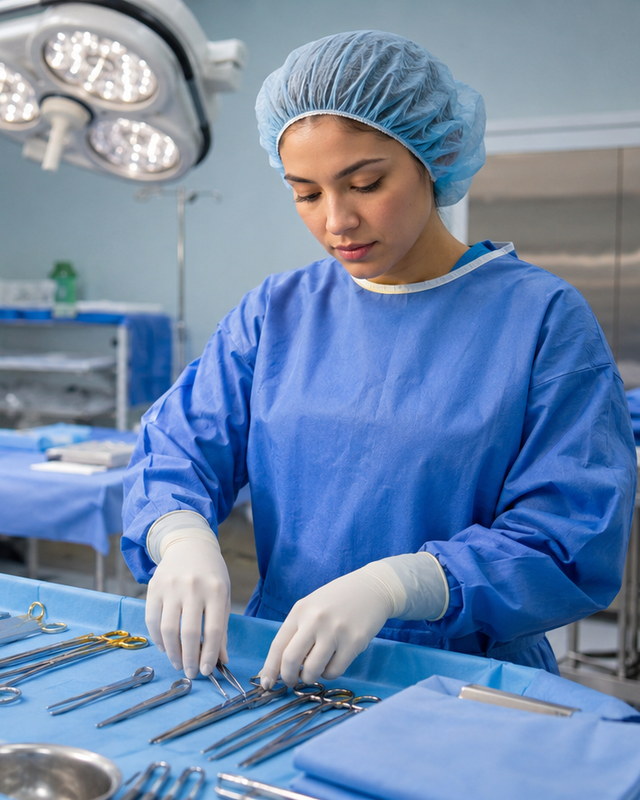
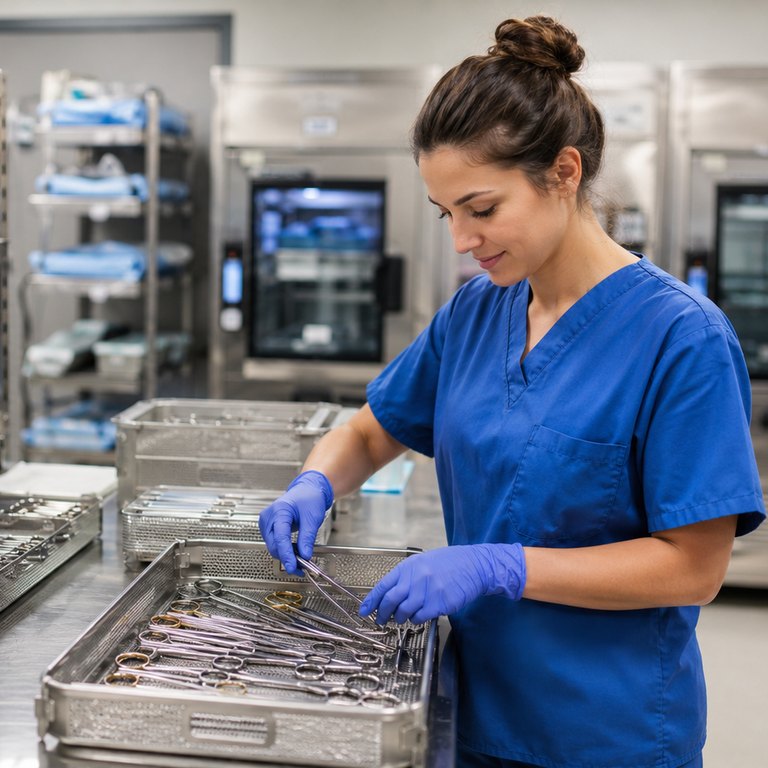
The shortest version: Surgical technologists work in the operating room during procedures. Sterile processing technicians work behind the scenes cleaning, inspecting, assembling, sterilizing, and distributing reusable instruments and equipment.
Surgical technology usually requires a more structured postsecondary program and clinical experience, while sterile processing can have a lower formal education barrier. Surgical technologists also earn more nationally according to the latest federal wage data.
Neither job is the universally better choice. The better fit depends on whether you want to be inside the OR, how quickly you want to enter healthcare, how much direct patient contact you want, and which kind of pressure you would rather deal with.
Surgical Tech vs. Sterile Processing Tech: Quick Comparison
| Factor | Surgical technologist | Sterile processing technician |
|---|---|---|
| Main job | Supports live surgical procedures and maintains the sterile field | Reprocesses, inspects, assembles, sterilizes, stores, and distributes instruments |
| Typical work area | Operating rooms and surgical suites | Sterile processing/central service departments |
| Patient contact | Direct contact is part of the job | Usually little or no direct patient care |
| Typical entry education in federal projections | Postsecondary nondegree award | High school diploma or equivalent for the broader Medical Equipment Preparers category |
| Common credentials | CST or TS-C | CRCST or CSPDT |
| National median annual pay | $64,650 | $47,700 for Medical Equipment Preparers, the broader BLS proxy |
| 2025–35 projected growth | 5.0% | 10.8% for Medical Equipment Preparers proxy |
| Average annual openings | 7,100 | 10,700 for Medical Equipment Preparers proxy |
| Main pressure | Live procedures, sterile-field decisions, rapid teamwork | Throughput, instrument accuracy, decontamination quality, turnaround deadlines |
| Online-only path? | No. Clinical and hands-on training are essential | Coursework may be online, but CRCST still requires 400 hands-on hours in an SPD |
Fast fit check: Surgical technology makes more sense if you want to be part of the live surgical team and are willing to complete a structured clinical training path. Sterile processing may fit better if you prefer technical work behind the scenes, want a lower formal education barrier, or want to enter the hospital environment without direct patient care as the center of your job.
Same Instruments, Different Jobs
The easiest way to understand these careers is to follow the instruments.
A surgical technologist is at the procedure end of the cycle. O*NET lists core duties such as maintaining the sterile field, arranging instruments and supplies, counting sponges and instruments, preparing patients, passing instruments to surgeons, and providing technical assistance during operations. The job happens in real time. If the surgeon needs a particular clamp, the surgical tech cannot put it on tomorrow's to-do list.
A sterile processing technician works on the reprocessing side. The closest federal occupation is Medical Equipment Preparers (SOC 31-9093), which is broader than sterile processing alone. Its O*NET duties include cleaning instruments for sterilization, inspecting equipment, assembling surgical instrument trays, operating steam autoclaves, recording sterilizer results, maintaining inventory, and checking sterile supplies.
The Instrument Journey: Where Each Career Takes Over
Facilities differ, but a reusable surgical tray generally moves through a cycle like this:
- Used during surgery: The surgical technologist manages instruments on the sterile field, passes them during the procedure, and participates in counts.
- Point-of-use handling: After the procedure, gross soil is kept from drying and instruments are prepared for safe contained transport according to facility policy and device instructions.
- Decontamination: The sterile processing team receives contaminated instruments, disassembles items when required, and performs manual and/or mechanical cleaning.
- Inspection and assembly: Clean instruments are inspected for damage or residual soil and assembled into the correct sets or trays.
- Packaging and sterilization: Sets are packaged or placed in validated containers, processed using the appropriate sterilization method, and monitored according to applicable instructions and standards.
- Quality checks and storage: Sterilization records and indicators are reviewed, packages are protected from damage, and sterile items are stored or staged for upcoming cases.
- Case preparation and delivery: Instruments move back toward the surgical suite in preparation for the next procedure.
- OR setup: The surgical technologist verifies and organizes the sterile setup for the operation, and the cycle starts again.
They are not two versions of the same job. They are two handoff points in the same patient-safety system. One role prepares and safeguards instruments between procedures; the other manages them in the sterile field while surgery is happening.
Training: Which Path Takes Longer?
Surgical technology has the more structured training path
The BLS Occupational Outlook Handbook says surgical technologists typically need a certificate or associate degree. Training combines classroom study with supervised clinical experience.
For students targeting the Certified Surgical Technologist (CST) credential, program accreditation is not decorative alphabet soup. NBSTSA's current eligibility rules require graduation from a surgical technology program accredited by CAAHEP or ABHES for the standard graduate route to the CST exam.
Accredited surgical technology programs also have substantial clinical requirements. Current ARC/STSA standards require students to complete at least 120 surgical cases, including 30 general-surgery cases and 90 specialty cases, with minimum first-scrub requirements within those totals.
That is why a legitimate surgical-tech program cannot be purely online. Some academic material can be delivered online, but instrument skills, lab competencies, sterile-field practice, and live clinical cases have to happen in person.
Sterile processing can have a lower formal education barrier, but hands-on experience still matters
For the broader BLS occupation of Medical Equipment Preparers, the 2025–35 projections list a high school diploma or equivalent as typical entry education and moderate-term on-the-job training as typical.
People also enter sterile processing through certificate courses or employer training. But a course-completion certificate is not the same thing as professional certification.
For example, HSPA's Certified Registered Central Service Technician (CRCST) credential requires both an exam and 400 hours of hands-on sterile processing experience. Those hours may be completed before the exam or, under provisional certification, within six months after passing it.
HSPA's current 400-hour breakdown is:
- 120 hours in decontamination
- 120 hours in preparing and packaging instruments
- 120 hours in sterilization and disinfection
- 24 hours in storage and distribution
- 16 hours in quality assurance processes
And there is a catch worth knowing before paying for an online course: HSPA does not place candidates into departments to complete those hours. You are responsible for finding an authorized sterile processing department where you can get the experience.
That placement question is arguably more important than whether an online course has slick videos and a shiny student portal.
Certification: CST, TS-C, CRCST, and CSPDT Are Not Interchangeable
The credential abbreviations get messy fast, so here is the clean version.
Surgical technology credentials
CST (Certified Surgical Technologist): Administered by NBSTSA. The standard graduate eligibility route requires completion of a CAAHEP- or ABHES-accredited surgical technology program. Military eligibility pathways also exist.
TS-C (Tech in Surgery - Certified): Administered by NCCT. NCCT offers several eligibility routes. Its experience route requires actual work as a Tech in Surgery, not sterile processing experience. The current experience pathway calls for three years, or 6,240 hours, of full-time-equivalent Tech in Surgery experience within the past five years under appropriate clinical supervision.
Sterile processing credentials
CRCST (Certified Registered Central Service Technician): Administered by HSPA. Full certification requires 400 documented hands-on hours plus the exam. Candidates may test provisionally before completing the hours, but they must submit the 400 hours within six months of passing. HSPA says a one-time two-month extension may be available only when the candidate has already begun working or volunteering in an SPD and the department requests the extension before provisional status expires.
If the required hours are not submitted in time, the provisional certification is forfeited and the candidate has to reapply and retest.
CSPDT (Certified Sterile Processing and Distribution Technician): Administered by CBSPD. CBSPD's current eligibility rules allow several routes. A candidate can qualify through 12 months of SPD employment, completion of an SPD training course with a passing grade of at least 70, a combined allied-health/SPD experience route, or qualifying healthcare product sales/service experience. The credential is valid for five years.
Does the law require certification?
There is no single national rule covering every surgical technologist or sterile processing technician. State laws and employer requirements vary. Some states regulate surgical technologists, some impose sterile-processing credential rules, and hospitals can maintain hiring standards beyond state minimums.
Before choosing a program, check two things separately:
- What your state legally requires.
- What the hospitals and surgery centers where you actually want to work require or strongly prefer.
Those are related questions, but they are not the same question.
Pay: Surgical Techs Earn More Nationally
The latest national wage data are the May 2025 BLS Occupational Employment and Wage Statistics, released May 15, 2026.
| Wage measure | Surgical technologists | Medical Equipment Preparers (sterile-processing proxy) |
|---|---|---|
| Employment estimate | 117,460 | 77,420 |
| 10th percentile | $45,940 | $36,410 |
| 25th percentile | $54,690 | $39,800 |
| Median | $64,650 | $47,700 |
| 75th percentile | $79,750 | $58,570 |
| 90th percentile | $96,940 | $69,950 |
| Mean annual wage | $68,710 | $50,510 |
At the national median, the difference is $16,950 per year in favor of surgical technologists.
Do not read the percentile rows as a career ladder. The 10th percentile does not mean "beginner pay," and the 90th percentile does not mean "senior pay." Geography, shift differentials, employer type, overtime, union status, specialty, and other factors all influence where a worker falls in the distribution.
Source: U.S. Bureau of Labor Statistics, May 2025 OEWS. See Surgical Technologists (29-2055) and Medical Equipment Preparers (31-9093).
Job Outlook: Both Have Openings, but the Data Are at Different Occupational Grains
The newest BLS Employment Projections cover 2025 through 2035.
| Outlook measure | Surgical technologists | Medical Equipment Preparers proxy |
|---|---|---|
| Employment, 2025 | 118,400 | 79,900 |
| Projected employment, 2035 | 124,300 | 88,600 |
| Numeric change | +5,900 | +8,700 |
| Percentage change | 5.0% | 10.8% |
| Average annual openings | 7,100 | 10,700 |
These are national projections, not promises about a particular city or hospital. They also come from the BLS Employment Projections program, whereas the wage table above comes from OEWS. Slightly different employment counts between federal datasets are normal because they are produced for different purposes.
For sterile processing in particular, remember that the 10.8% projection applies to the broader Medical Equipment Preparers occupation, not a sterile-processing-only series.
Source: U.S. Bureau of Labor Statistics, 2025–35 Employment Projections.
What the Work Actually Feels Like
The pressure is different, but neither job is a spa day with stainless-steel props.
Surgical tech pressure is live and procedural
A surgical technologist works in extremely close physical proximity to other members of the surgical team and has to respond to what is happening right now. O*NET identifies maintaining the sterile field, monitoring OR conditions, preparing patients, counting instruments, and passing supplies as core tasks.
The job also involves long periods on your feet. O*NET rates standing as a major part of the work context for surgical technologists, and BLS notes that surgical technologists spend much of their time standing. Hospital schedules can also include nights, weekends, holidays, or on-call periods, depending on the facility.
If you dislike blood, close teamwork, sudden changes, or being corrected immediately when something is wrong, the OR can be a rough place to discover that about yourself.
Sterile processing pressure is technical and throughput-driven
Sterile processing is more removed from the patient, but that does not mean low pressure. Medical Equipment Preparers also score highly in O*NET for time pressure, standing, contact with others, and exposure to hazardous conditions.
The difference is where the pressure comes from. Instead of a surgeon waiting for an instrument in your hand, you may have multiple trays waiting for decontamination, an incomplete set needed for a case, a failed quality check, or a sterilization turnaround that affects tomorrow's schedule.
The work can involve contaminated instruments, repetitive manual tasks, protective equipment, lifting trays, detailed inspection, recordkeeping, and strict adherence to device instructions and facility procedures.
Patient contact is a major divider
Surgical technologists have direct involvement with patients as part of the perioperative team. O*NET includes preparing and positioning patients among their core tasks.
Sterile processing is generally a behind-the-scenes department. The job may involve frequent interaction with coworkers and clinical departments, but direct patient care is usually not central to the role. Exact workflows vary by facility, so "never sees a patient" is too absolute.
Can Sterile Processing Be a Stepping Stone to Surgical Tech?
Sterile processing can teach you instrument names, assembly logic, decontamination concepts, sterilization basics, and how surgical services operate. You may also build hospital relationships and learn whether you enjoy the environment before committing to a longer program.
But CRCST experience does not substitute for CST-qualifying surgical technology education or the clinical surgical cases required within an accredited surgical-tech program. Likewise, NCCT's experience route for the TS-C requires actual Tech in Surgery work experience, not time spent in sterile processing.
Individual colleges may evaluate prior college coursework according to their own transfer policies, but working in SPD should not be sold as a magic bridge that lets you skip the surgical-tech clinical sequence.
Think of it as relevant experience, not advanced standing.
Which Career Fits You Better?
Use this as a decision filter rather than a scoreboard.
| If this matters most... | The path to investigate first | Why |
|---|---|---|
| Being in the operating room | Surgical tech | The job is built around live procedures and the sterile field |
| Lower formal education barrier | Sterile processing | Federal projections list high school as typical entry education for the broader proxy occupation |
| Higher national median pay | Surgical tech | May 2025 OEWS median is $64,650 vs. $47,700 for the proxy |
| Minimal direct patient care | Sterile processing | Work is typically centered in reprocessing departments rather than bedside care |
| Fast-moving procedural teamwork | Surgical tech | Continuous coordination happens during surgery |
| Instrument systems and process control | Sterile processing | Cleaning, inspection, assembly, sterilization, tracking, and distribution are the core workflow |
| A structured credentialed education path | Surgical tech | CST eligibility strongly ties the graduate route to programmatic accreditation |
| Flexible entry routes | Sterile processing | Employer training and multiple certification pathways exist, although CRCST still requires hands-on hours |
| Avoiding on-call surgical cases | Sterile processing may fit better | Many departments operate staffed shifts rather than OR call, but schedules vary by facility |
| Avoiding contaminated instruments | Neither | Both careers involve infection-control hazards, just at different stages of the cycle |
Surgical technology may fit you if...
- You specifically want to be inside the operating room.
- You enjoy precise teamwork under live time pressure.
- You can tolerate blood, tissue, sharps, and surgery itself.
- You are comfortable with prolonged standing and close physical proximity to coworkers.
- You are willing to complete structured clinical training before entering the field.
- Higher national wage potential matters enough to justify the longer training runway.
Sterile processing may fit you if...
- You prefer technical healthcare work without direct patient care as the main task.
- You like instruments, systems, quality control, and repeatable processes.
- You want to investigate a lower formal education barrier.
- You would rather deal with workflow deadlines than live surgical procedures.
- You are comfortable handling contaminated equipment in protective gear.
- You can secure the hands-on experience needed for the credential you want.
Who Should Think Twice?
Think twice about surgical technology if...
You cannot tolerate the sight of surgery, struggle with close team dynamics, strongly dislike being on your feet for long stretches, or need a job that reliably ends at the same time every day. Hospital surgical schedules can be unpredictable, and the consequences of sterile-field mistakes are immediate.
Also reconsider any program that cannot clearly explain its accreditation status and clinical placement structure. A cheap program becomes expensive very quickly if it does not qualify you for the credential or employment pathway you expected.
Think twice about sterile processing if...
You are choosing it because someone promised it is an easy, calm hospital job. Sterile processing is detail-heavy work with contamination hazards, time pressure, documentation requirements, repetitive tasks, and potentially heavy instrument sets.
Be especially cautious with programs that prepare you for a CRCST exam but provide no realistic route to the required 400 hands-on hours. Passing the test provisionally without a place to complete the experience can leave you racing a six-month clock.
Questions to Ask Before You Enroll
For surgical technology programs
- Is this surgical technology program currently accredited by CAAHEP or ABHES?
- Which certification exam will I be eligible to take after graduation?
- Who arranges clinical placements?
- How does the program ensure students can complete the required surgical cases and first-scrub experiences?
- What happens if a clinical site becomes unavailable or my required cases are delayed?
- Which costs are not included in tuition, such as uniforms, background checks, health requirements, CPR/BLS, exam fees, or transportation to clinical sites?
- What certification do employers in this region usually request?
For sterile processing programs
- Does this course prepare students for CRCST, CSPDT, or both?
- If I want CRCST certification, how will I obtain the required 400 hands-on hours?
- Does the school arrange an externship, help secure one, or leave placement entirely to the student?
- Are local hospitals willing to hire candidates before full certification and provide experience on the job?
- If the course is online, what hands-on practice is included before I enter a real department?
- Are exam fees included in tuition?
- What credentials do nearby employers actually list in current job postings?
That last question is underrated. National rules tell you what is possible. Local employers tell you what will get you hired.
Bottom Line
Surgical technology and sterile processing are tightly connected careers, but they are not interchangeable.
Surgical tech offers direct participation in surgery, a more structured training and credential pathway, and a higher national median wage. It also brings longer formal preparation, direct patient involvement, close surgical-team dynamics, and live procedural pressure.
Sterile processing offers a lower formal education barrier in federal occupational data and a behind-the-scenes route into surgical services. But it still demands serious technical accuracy, physical work, contamination control, and hands-on experience for credentials such as CRCST.
If you are deciding between them, do not start with the job title. Start with the work environment you actually want: inside the OR during the case, or behind the scenes making sure every instrument is safe and ready before it gets there.
Ready to explore training? Compare surgical technologist schools and programs or sterile processing training options. For step-by-step career routes, see how to become a surgical tech and how to become a sterile processing technician.
Frequently Asked Questions
Is sterile processing the same as surgical technology?
No. Surgical technologists work as part of the operative team during procedures and maintain the sterile field. Sterile processing technicians clean, inspect, assemble, sterilize, store, and distribute reusable instruments and equipment between uses.
Which pays more: surgical tech or sterile processing?
Nationally, surgical technologists have the higher median wage. May 2025 BLS OEWS data show a $64,650 median for Surgical Technologists versus $47,700 for Medical Equipment Preparers, the broader federal occupation used as a proxy for sterile processing. Local wages can differ substantially.
Can a sterile processing technician become a surgical technologist?
Yes, but sterile processing is not a formal shortcut to CST eligibility. SPD experience can provide useful instrument and sterilization knowledge, but CST eligibility through the standard graduate route still requires qualifying surgical technology education and clinical experience.
Can either career be trained for completely online?
Surgical technology cannot be completed entirely online because hands-on lab and clinical surgical experience are essential. Sterile processing theory may be offered online, but HSPA's CRCST requires 400 hands-on hours in a sterile processing department.
Do surgical techs and sterile processing techs have to be certified?
There is no single national certification law covering every worker in either occupation. Requirements vary by state and employer. Before enrolling, verify both the law where you plan to work and the hiring requirements of local hospitals or surgical facilities.
Sources and Methodology
Wage figures use the U.S. Bureau of Labor Statistics May 2025 Occupational Employment and Wage Statistics, released May 15, 2026. Outlook figures use the BLS 2025–35 Employment Projections, released August 27, 2026. Surgical technologist data use SOC 29-2055. Sterile-processing national comparisons use SOC 31-9093, Medical Equipment Preparers, explicitly as a broader proxy because BLS does not publish a sterile-processing-only national occupation series.
Occupational duties and work-context comparisons were checked against current O*NET data. Credential requirements were checked against current official guidance from NBSTSA, ARC/STSA, HSPA, NCCT, and CBSPD as of September 20, 2026.
- U.S. Bureau of Labor Statistics: Surgical Technologists, May 2025 OEWS
- U.S. Bureau of Labor Statistics: Medical Equipment Preparers, May 2025 OEWS
- U.S. Bureau of Labor Statistics: 2025–35 Occupational Projections
- BLS Occupational Outlook Handbook: Surgical Assistants and Technologists
- O*NET OnLine: Surgical Technologists and Medical Equipment Preparers
- NBSTSA: CST Eligibility
- ARC/STSA: Surgical Technology Standards and Clinical Case Requirements
- HSPA: CRCST Certification Requirements
- NCCT: Tech in Surgery - Certified
- CBSPD: CSPDT Certification