Surgical Tech vs. Radiology Tech: Pay, Training, Stress & Career Fit



One career revolves around diagnostic imaging and patient positioning. The other puts you inside the sterile field of an operating room. Here’s how to decide which kind of clinical day fits you better.
The quick answer
Nationally, radiologic technologists currently earn more: the May 2025 median was $80,110, compared with $64,650 for surgical technologists. Both occupations are projected to grow 5% from 2025 to 2035, but radiologic technology has more projected annual openings: about 13,000 versus 7,100.
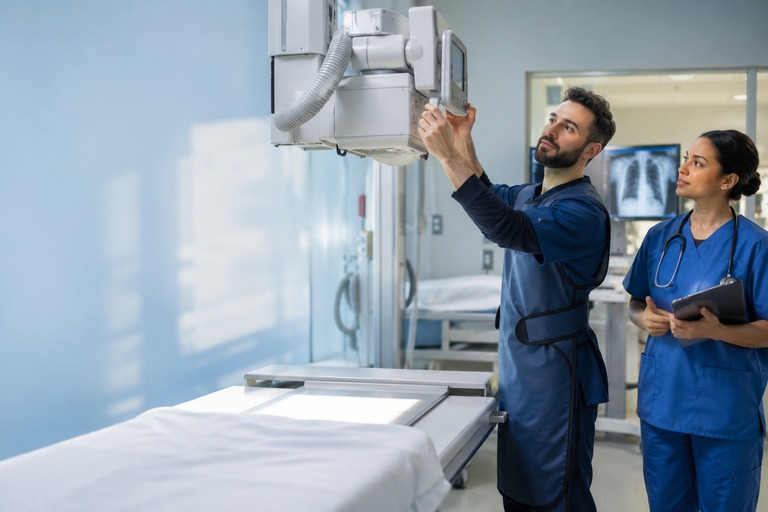
The bigger difference is the work. Radiologic technologists move through imaging exams, position patients, operate X-ray equipment, and manage radiation safety. Surgical technologists build and protect the sterile field, manage instruments and supplies, and stay locked into procedures with the OR team. Pick the environment you can actually see yourself working in on an ordinary Tuesday.
Surgical Tech vs. Radiology Tech at a Glance
| Factor | Radiologic Technologist | Surgical Technologist |
|---|---|---|
| BLS occupation | Radiologic Technologists and Technicians (29-2034) | Surgical Technologists (29-2055) |
| May 2025 median pay | $80,110 | $64,650 |
| 10th–90th percentile range | $55,980–$118,660 | $45,940–$96,940 |
| 2025–35 growth | 5% | 5% |
| Projected annual openings | 13,000 | 7,100 |
| Typical entry education (BLS) | Associate degree | Postsecondary nondegree award |
| Core work | Patient positioning, X-ray imaging, image quality, radiation safety | Sterile field, instruments, counts, supplies, intraoperative support |
| Main work rhythm | Repeated individual imaging exams | Longer procedures with the same OR team |
| Regulatory reality | State licensing is common and separate from ARRT | State rules vary widely; certification and registration laws are not uniform |
| Natural next steps | CT, MRI, mammography and other imaging credentials | Surgical specialties, leadership, or additional training toward first assisting |
Wage percentiles are distribution points, not experience levels. Pay varies by location, employer, schedule, specialty, and other factors.
What Each Job Actually Feels Like
Radiologic technology: many patient encounters, precise positioning, imaging equipment
Radiologic technologists produce diagnostic images ordered by clinicians. The job combines patient care with technical execution: you confirm the correct patient and exam, position anatomy, operate imaging equipment, evaluate whether the image is technically usable, and follow radiation-safety procedures.
That means you are not hiding in a dark room pressing a button. You are often moving between patients, helping people who may be injured or frightened, adjusting positioning when someone cannot move normally, and making technical decisions within the scope of your role. BLS notes that radiologic technologists are often on their feet for long periods and may need to lift or turn patients.
Radiologic technologists do not diagnose what is on the image. Image interpretation belongs to physicians such as radiologists. The technologist’s job is to obtain diagnostic-quality images safely and accurately.
Surgical technology: sterile-field discipline, instruments, anticipation, OR teamwork
Surgical technologists prepare operating rooms, organize sterile instruments and supplies, help maintain the sterile field, and pass instruments and other items during procedures. They work close to surgeons, nurses, anesthesia staff, and the patient for the duration of the operation.
The job rewards people who like precise routines under pressure. Sterility is not a vibe; it is a system. Counts matter. Instrument knowledge matters. Noticing a break in sterile technique matters. The work can also involve blood, body fluids, unpleasant sights and odors, and long periods on your feet. BLS specifically notes that surgical technologists may help move patients or lift heavy trays and may work shifts longer than eight hours.
If the operating room fascinates you, that intensity can be part of the appeal. If exposed anatomy makes you queasy, clinical training is a lousy place to discover that you were hoping “surgical” was mostly metaphorical.
For another close OR comparison, see surgical tech vs. sterile processing tech.
Pay and Outlook: Radiologic Technology Has the Current National Edge
Current May 2025 BLS OEWS data shows a clear national pay gap.
| Pay measure | Radiologic Technologists | Surgical Technologists |
|---|---|---|
| 10th percentile | $55,980 | $45,940 |
| Median | $80,110 | $64,650 |
| 90th percentile | $118,660 | $96,940 |
The median difference is $15,460 per year, or about 24% relative to the surgical-technologist median. That does not mean every rad tech earns more than every surgical tech. Geography, overtime, call, shift differentials, specialty skills, and employer type can move an individual’s pay considerably.
It also does not make the 10th percentile “entry-level” or the 90th percentile “experienced.” BLS wage percentiles describe the distribution of wages, not a career ladder.
Same projected growth rate, different market size
BLS Employment Projections for 2025–2035 put both occupations at 5% growth.
- Radiologic technologists and technicians: 234,200 jobs in 2025, projected to 246,000 in 2035; about 13,000 openings per year.
- Surgical technologists: 118,400 jobs in 2025, projected to 124,300 in 2035; about 7,100 openings per year.
Annual openings include more than brand-new jobs. They also reflect workers leaving an occupation or the labor force. For a prospective student, that is usually more useful than staring only at the growth percentage.
Training: This Is Where the Paths Split Fast
Radiologic technologist training
BLS lists an associate degree as the typical entry education for radiologic technologists. ARRT’s primary pathway requires candidates to:
- Earn an associate degree or higher from an institution accredited by an agency ARRT recognizes.
- Complete an ARRT-approved educational program in the discipline.
- Meet ARRT ethics requirements.
- Pass the ARRT examination.
One useful nuance: ARRT says the associate degree does not have to be in radiologic sciences. In practice, many students complete an associate-level radiography program that handles both the degree and professional education together, but the rule itself is broader than that.
Also, do not assume “not JRCERT-accredited” automatically means “not ARRT-eligible.” JRCERT is the major programmatic accreditor for radiography and gives students useful program-outcome transparency, but ARRT recognizes multiple accreditation mechanisms. Ask the school to show you exactly how its graduates satisfy ARRT educational eligibility and your state’s requirements.
Surgical technologist training
BLS lists a postsecondary nondegree award as the typical entry education for surgical technologists. Programs may lead to a certificate, diploma, or associate degree depending on the institution and pathway.
If your goal is the Certified Surgical Technologist (CST) credential from NBSTSA, accreditation is not a footnote. NBSTSA states that graduates seeking CST eligibility through the accredited-program route must graduate from a CAAHEP- or ABHES-accredited surgical technology program.
Current surgical-technology curriculum standards also require substantial in-person clinical experience. ARC/STSA’s surgical rotation requirements call for at least 120 surgical cases, including at least 80 in the First Scrub role.
So, yes, some theory can be delivered online or in hybrid formats. No, you cannot become competent at either job entirely from your couch. Both paths require hands-on labs and clinical education.
Important 2027 radiography update: ARRT has approved changes to radiography clinical competency requirements effective March 1, 2027. If your program or exam timeline crosses that date, use ARRT’s current competency document rather than relying on an old procedure-count checklist.
Credentials and State Rules: Certification Is Not the Same as Licensure
Radiologic technology
ARRT certification and registration is a professional credential. A state license is government permission to practice in a jurisdiction. They are related, but they are not the same thing.
ARRT says more than 75% of states have licensing laws covering radiologic technology. Some states use ARRT exam scores or credentials in their licensing process; some have additional requirements. An ARRT credential by itself does not guarantee that you can immediately work in every state.
Before enrolling, check the state where you expect to work—not just the state where the school is located.
Surgical technology
Surgical technology has a more fragmented state-law landscape. Current state rules can involve education standards, national certification requirements, registration, or no profession-specific state requirement at all. The Association of Surgical Technologists maintains a state-law overview, but the details differ enough that a national one-sentence rule is misleading.
The practical move is simple: verify your state’s current rule and ask major local employers which credential they expect.
Which Job Is More Stressful?
There is no honest universal answer. The stress is different.
Radiologic-tech stress: pace, positioning, and patient variability
You may move quickly between scheduled exams, emergency patients, portable studies, and people who cannot easily hold the required position. You are responsible for technical image quality while limiting unnecessary radiation exposure. BLS also notes exposure to infectious disease and the need to monitor radiation exposure.
Surgical-tech stress: vigilance, sterile technique, and the OR team
A surgical technologist may spend long stretches standing within the sterile field, anticipating instrument needs and reacting quickly when a procedure changes direction. O*NET’s work-context data also reflects the high consequence attached to errors in surgical technology.
O*NET survey dates differ between these occupations and work-context items, so this guide uses those responses to understand the type of work pressure rather than manufacture a neat numerical “stress score.”
Ask yourself which kind of pressure bothers you less: rapid turnover with many patients, or sustained procedural intensity with the same team.
Physical Demands and Schedule: Different Flavors of Tired
Both careers are physical.
Radiologic technologists may need to help injured or mobility-limited patients turn, transfer, or hold a position. They also spend long periods standing and may move portable imaging equipment.
Surgical technologists spend long periods on their feet, often without being able to wander away from the sterile field. They may help position patients and lift trays or supplies. The work can also involve protective equipment and awkward positioning depending on the case.
If you already have significant back, foot, shoulder, or joint problems, ask programs how clinical accommodations work and—more importantly—observe the actual job before assuming either path is “light duty.”
Work schedules and lifestyle
BLS notes that radiologic technologists may work evenings, weekends, or overnight because imaging is needed in emergencies. Outpatient imaging and physician-office jobs can offer more predictable daytime schedules, although availability varies by market and employer.
For surgical technologists, BLS says hospital workers may work or be on call during nights, weekends, and holidays, and shifts may last longer than eight hours. Ambulatory surgery centers can provide more elective, daytime-heavy schedules, but they are not every job.
If schedule predictability matters a lot to you, compare work settings, not just occupations.
Advancement: Radiology Has the More Structured Credential Ladder
Radiologic technology has a particularly clear path for adding modalities. Depending on your supporting credential and pathway, ARRT offers postprimary credentials that include areas such as:
- Computed tomography (CT)
- Magnetic resonance imaging (MRI)
- Mammography
- Bone densitometry
- Cardiac interventional radiography
- Vascular interventional radiography
Each credential has its own structured-education, clinical-experience, ethics, and examination requirements. It is not an automatic upgrade, but it gives radiologic technologists a standardized way to broaden their technical scope.
Surgical technologists can deepen expertise in areas such as orthopedics, cardiovascular surgery, neurosurgery, robotics, or other service lines. Moving into surgical first assisting is a separate step that requires additional preparation and credentialing; it should not be presented as an automatic promotion from surgical tech.
Which Career Fits You Better?
Radiologic technology may fit better if you like:
- Combining patient interaction with equipment and anatomy
- Shorter, repeated clinical encounters rather than one long procedure
- Positioning problems and technical image-quality decisions
- A formal path to add imaging modalities later
- A career where the current national median pay is above $80,000
Surgical technology may fit better if you like:
- The operating room specifically—not just healthcare in general
- Instruments, anatomy, sterile technique, and procedural sequence
- Deep concentration on one case for an extended period
- Tight, highly coordinated team environments
- A training path that may be available through a nondegree award
Think twice about radiologic technology if:
- Frequent patient handling or positioning sounds miserable
- You have no interest in imaging equipment, anatomy, or radiation-safety rules
- You want long, continuous involvement with one patient
Think twice about surgical technology if:
- Blood, open surgery, tissue, odors, or sharps make you strongly uncomfortable
- Long periods standing in one work zone are a bad physical fit
- You hate strict procedural rules or real-time correction from a close clinical team
Quick Work-Environment Matcher
This is not a personality test. It is six forced-choice questions about the work itself. Pick the answer that sounds less annoying on a tired day, not the one that sounds cooler in a brochure.
Questions to Ask Schools Before You Pay a Deposit
For radiologic technology programs
- How does this program satisfy ARRT primary-pathway educational requirements? Ask for the exact route, not just “our graduates are eligible.”
- What accreditation does the institution and program hold? If the program is not JRCERT-accredited, ask how ARRT approval and state eligibility are established.
- How are clinical placements arranged? Ask whether the school secures them, how far students may travel, and what happens if a site becomes unavailable.
- What are the current credential-exam pass, completion, and job-placement outcomes? JRCERT-accredited programs publish effectiveness data.
- What will I need after graduation in the state where I intend to work? Certification and state licensure are separate questions.
Explore radiologic technology and X-ray training options.
For surgical technology programs
- Is the surgical technology program CAAHEP- or ABHES-accredited? If CST eligibility matters to you, verify it yourself.
- Which certification exam are graduates eligible to take? Do not accept “nationally certified” as a complete answer.
- How are the required surgical cases and clinical rotations scheduled and documented? Ask what happens if case volume is low.
- Which hospitals and surgery centers host students? Clinical access is a huge part of the value of the program.
- What does my state require, and what do local employers usually require? Those are two different questions.
If the OR still sounds like your place after reading the ugly parts as well as the fun ones, explore surgical technologist training options.
A Better Way to Decide Before You Enroll
- Shadow or observe if you can. An hour in an imaging department or OR-adjacent setting can teach you things no salary table can.
- Check the credential path backward from the job. Start with the state and employers where you want to work, then verify the credential, then verify the program makes you eligible for it.
- Compare the actual clinical commitment. Ask when clinicals start, how placements work, how far you may travel, and whether you can realistically keep your current job while completing them.
That sequence prevents a common mistake: falling in love with a school first and only later discovering that its program does not fit the credential, schedule, or workplace you wanted.
If neither role feels quite right, browse other healthcare training and career paths.
Frequently Asked Questions
Who makes more money, a surgical tech or a radiology tech?
Radiologic technologists currently have the higher national median. May 2025 BLS data puts the median at $80,110 for radiologic technologists and technicians versus $64,650 for surgical technologists. Individual pay still varies substantially by location, employer, shift, and specialty.
Which is harder: surgical tech school or radiology tech school?
They are hard in different ways. Radiologic technology typically involves associate-level coursework plus imaging science, positioning, radiation safety, and clinical competencies. Surgical technology compresses anatomy, instrumentation, sterile technique, and supervised OR performance into its training. The better question is which type of learning you handle better.
Can you become a surgical tech or radiology tech with a certificate?
A postsecondary nondegree award is the BLS typical-entry classification for surgical technologists, and certificate or diploma routes exist. For ARRT’s radiography primary pathway, however, candidates need an associate degree or higher in addition to completing an ARRT-approved educational program.
Is surgical technology more stressful than radiologic technology?
Not universally. Surgical technology tends to concentrate stress around sterile technique, long procedures, close-team coordination, and high consequences of error. Radiologic technology often concentrates stress around patient flow, difficult positioning, emergency imaging, image quality, and radiation safety.
Do surgical techs or radiology techs work nights and weekends?
Both can. BLS notes evening, weekend, and overnight work for some radiologic technologists because imaging may be needed in emergencies. Hospital surgical technologists may work or be on call nights, weekends, and holidays, and some shifts last longer than eight hours. Outpatient settings can be more predictable in both fields.
Can a surgical tech become a radiology tech later, or vice versa?
Yes, but it is generally a new education and credential path, not a simple cross-certification. The clinical skills overlap in broad healthcare basics, but the professional education, competencies, and credentialing requirements are different.
Sources and Methodology
Labor-market figures were independently rebuilt from the BLS May 2025 Occupational Employment and Wage Statistics release (published May 15, 2026) and BLS Employment Projections 2025–2035 (released August 27, 2026). Wage and projection datasets are kept separate because they are different BLS programs.
Work-environment guidance was checked against BLS Occupational Outlook Handbook and O*NET. O*NET survey dates differ by occupation and work-context item, so this guide uses those responses to describe work patterns rather than pretending they create a synchronized “stress score.”
Credentialing and regulatory guidance was checked against ARRT, NBSTSA, ARC/STSA, and the Association of Surgical Technologists as of September 24, 2026. State rules can change; verify the jurisdiction where you plan to work.
- BLS: Radiologic and MRI Technologists
- BLS: Surgical Assistants and Technologists
- ARRT: Primary Eligibility Requirements
- ARRT: State Licensing
- ARRT: Didactic and Clinical Competency Requirements
- NBSTSA: CST Eligibility
- ARC/STSA: Standards and Curricula
- Association of Surgical Technologists: State Law Overview
- O*NET: Radiologic Technologists and Technicians
- O*NET: Surgical Technologists
Explore Training Options
Once you know which work environment fits better, compare programs based on credential eligibility, clinical placement, schedule, and outcomes—not just which school has the shiniest brochure.