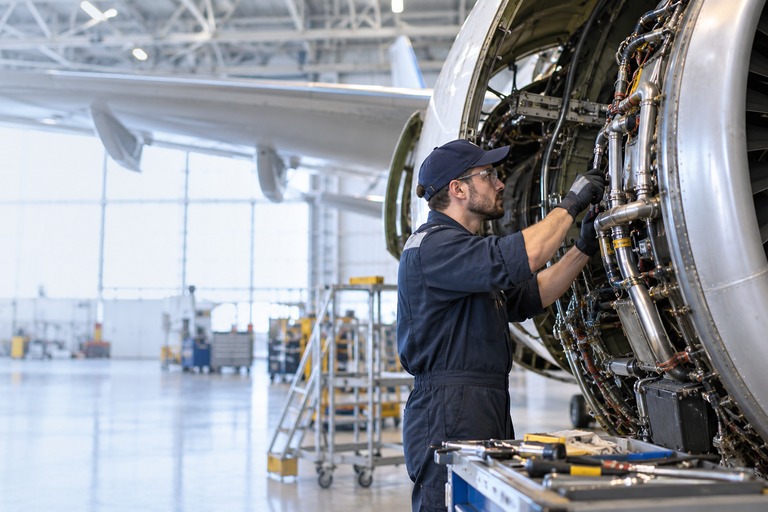
Aircraft Mechanic Apprenticeships: Get Paid to Train and Know What Counts Toward an FAA A&P


Yes, you can become eligible for FAA aircraft mechanic tests through paid, supervised work instead of graduating from an A&P school. But a job labeled aircraft mechanic apprenticeship is not a promise of an Airframe and Powerplant (A&P) certificate. Some employers teach both ratings. Others train for one rating, an employer-specific Repairman certificate, or an aircraft structures job. Some require you to enroll in a technical college first.
The distinction matters. Under 14 CFR 65.77, the experience route requires at least 18 months of appropriate practical experience for an Airframe or Powerplant rating, or at least 30 months of concurrent practical experience for both ratings. You still need FAA testing authorization and must pass the required exams. An employer's apprenticeship completion document does not replace those steps.
This guide explains how to find real programs, compare their promises, check whether your work can qualify, and start documenting your maintenance experience before the first bolt comes off.
Quick navigation: The four routes | Eight employer programs | FAA rules | Find an apprenticeship | Verification worksheet and log | School versus apprenticeship | FAQs
Start here: Which training route actually fits?
| Your situation | Investigate first | The catch |
|---|---|---|
| You need wages while learning and can relocate. | Employer-sponsored A&P apprenticeship, such as Kalitta Air's published program. | Limited locations, competitive cohorts, and sometimes employment commitments. |
| You have a local maintenance shop willing to train you. | Supervised civilian on-the-job training (OJT). | You must prove enough appropriate, hands-on work for the intended FAA rating. |
| You want structured classes and a predictable school-based testing route. | FAA-certificated Part 147 aviation maintenance technician school. | Tuition, tools, exams, and living expenses need a real budget. |
| You have relevant military aircraft maintenance experience. | FAA evaluation of your military records or a qualifying JSAMTCC Certificate of Eligibility. | Military service alone does not automatically grant an FAA A&P certificate. |
Before accepting any offer: Ask, "At the end of this exact program, which FAA rating can I be eligible to test for, and how will you help me document the required experience?" If the recruiter cannot answer, that is a much bigger problem than the starting wage.
What does an aircraft mechanic apprenticeship actually mean?
Unlike a single standardized degree, the word apprenticeship covers several arrangements:
- Registered paid apprenticeship: Structured wages, mentoring, instruction, and employer training under U.S. Department of Labor (DOL) or state apprenticeship rules. Registration addresses labor standards. It does not mean the FAA has pre-approved every graduate to take A&P exams.
- Paid civilian OJT: Working under lawful supervision at an airline, repair station, or general aviation shop, sometimes without a formally registered apprenticeship. It can be a legitimate FAA experience path if your duties and evidence qualify.
- Mechanic helper or trainee: An entry job that may lead to broader maintenance work. Washing aircraft, moving equipment, or working in a parts room is not a substitute for actual airframe or powerplant maintenance experience.
- School-plus-work apprenticeship or cadet program: A paid job paired with a required Part 147 school. You still need to investigate tuition, financial aid, the school's FAA certificate, and work schedules.
- Specialized structures, interiors, avionics, or Repairman training: Valuable jobs that may not deliver the full breadth needed for both A&P ratings.
The credential terms matter more than the marketing label. The FAA issues a Mechanic Certificate with Airframe, Powerplant, or both ratings. It also issues job-specific Repairman certificates in qualifying circumstances. A DOL journeyworker completion certificate, a state apprenticeship credential, and an FAA A&P certificate are not interchangeable. Read the FAA's mechanic FAQ and practical experience guidance before signing a training agreement.
Eight real employer pathways, with the fine print
Research checked October 29, 2026. These are employer-published program descriptions, not a list of guaranteed current vacancies. Always check the live career portal, your eligibility, current pay, available seats, and written training agreement. Locations and terms can change.
| Employer / location | What the published program actually offers | School required? | What to verify before applying |
|---|---|---|---|
| Kalitta Air, Oscoda, MI | DOL-registered, roughly 2.5-year paid A&P apprenticeship; published $17/hour first-year wage and employer-paid FAA exam fees. | No external school stated. | Next cohort, full A&P task coverage, tools and relocation. |
| Republic Airways, Indianapolis and bases | Paid AMT OJT with a published 30-month commitment and conditional post-completion certified-AMT job offer after passing A&P exams. Separate military and cadet tracks have different prerequisites. | Depends on track. | Whether a civilian beginner intake is open. The $16/hour military transition posting is not beginner-pay evidence. |
| Duncan Aviation, Lincoln, NE / Battle Creek, MI | Paid two-year structured training, no tuition, exam support; FAA Airframe or Powerplant rating path. | No external college stated. | Internal employee and manager-approval requirements, next cohort, post-training commitments. |
| Aviation Technical Services, Everett, WA and some other facilities | Paid 18-24-month MRO pathway; its FAQ describes possible Repairman, then Airframe eligibility. | No external school stated. | Do not assume Powerplant/full A&P eligibility; ask about required personal tools. |
| Textron Aviation, Wichita/Independence, KS | Paid three-year school-plus-work model, including two days a week at technical college during the skills phase; distinct A&P and avionics tracks. | Yes, partner-college enrollment. | Exact net tuition/assistance, FAA outcome of the selected track, available openings. |
| Delta TechOps, nationwide partner-school network | Apprenticeship access for eligible students at partner A&P schools, plus separate employee pathways. | Yes for TechOps apprenticeship. | Partner enrollment, program availability, and school cost; not a standalone free A&P training program. |
| AAR Airframe, Greensboro, NC / Lake City, FL | Greensboro paid 16-week trainee program; Lake City 18-month structures/interiors apprenticeship; school-linked helper and military pathways. | Depends on track. | Which track applies, whether it builds FAA A&P eligibility, and partner-school enrollment. |
| Jet MX, Goodyear, AZ | Published 36-month full-time aircraft mechanic apprenticeship framework, plus military SkillBridge. | Not stated. | Active beginner vacancies, exact scope and FAA outcome; its current listed job is for an experienced A&P. |
Three especially important examples
Kalitta Air: a published route toward both A&P ratings. The company describes a 5,360-hour, approximately 2.5-year registered apprenticeship rotating through maintenance departments, including engines, structures, and avionics. It says apprentices start at $17 an hour for the first year, receive milestone increases, and have exam fees covered. The company's published minimum wage after obtaining A&P certification is $26 an hour. Those are Kalitta's stated terms, not national apprentice wage averages or a guaranteed offer to every applicant. Relocating to Oscoda may be necessary. Read Kalitta's program.
Duncan Aviation: useful training, but watch the rating. Duncan describes a two-year employer-paid program in Lincoln and Battle Creek, with employer-provided materials and testing support. Its stated credential outcome is Airframe or Powerplant. An older official Duncan article describes a minimum 90 days of prior full-time employment in good standing before joining; confirm whether that rule still applies to your cohort. Duncan explicitly says the apprenticeship is not offered in Provo, Utah. See Duncan's current program.
ATS: a clear illustration of the Repairman distinction. ATS describes a paid program with roughly three competency levels and an initial two-week training period. Its FAQ says participants may become eligible for an employer-specific FAA Repairman certificate after the requisite experience and may later pursue an Airframe mechanic rating. It does not promise full A&P eligibility after 18 months. That is not necessarily a bad job. It is simply a different qualification outcome. Read the ATS FAQ.
Other examples underline the same lesson. Textron's paid apprenticeship includes required technical-college enrollment and education assistance. Delta requires applicants to its TechOps apprenticeship to be at least 18 and enrolled in a partner A&P school. At AAR, an 18-month structures-and-interiors apprenticeship is not the same as its college-linked helper or short trainee programs. Jet MX publishes a 36-month apprenticeship framework, but it cautions that openings exist only when posted; on the verification date its listing was for an experienced mechanic. None of these differences is obvious if you search only for the word apprentice.
FAA rules: What experience actually qualifies?
For people using experience rather than graduation from an FAA-certificated Part 147 school, 14 CFR 65.77(b) calls for documentary evidence acceptable to the FAA of:
- At least 18 months of appropriate practical experience for the Airframe or Powerplant rating being sought; or
- At least 30 months of practical experience concurrently performing duties suitable for both Airframe and Powerplant ratings.
Practical experience means doing relevant aircraft maintenance, construction, or alteration work, not just watching a mechanic, sitting in class, or holding a general airport job. A documented year spent exclusively on cabin interiors does not by itself show the Powerplant experience required for an A&P certificate. FAA inspectors evaluate the evidence, including whether the scope of work adequately represents the rating sought.
Why overtime does not make a one-year A&P apprenticeship
The FAA answers this explicitly: even 3,120 hours worked in a single year does not substitute for the minimum 18 calendar months required for one rating or 30 calendar months for both. FAA FAQ. The FAA's Advisory Circular 65-30B, Change 1 describes a month of practical experience as averaging 160 hours based on a 40-hour workweek. Those are experience-evaluation guidelines, not an hours-only shortcut around the calendar and work-scope requirements.
Likewise, time in classroom instruction is not the hands-on experience required by the OJT route. An employer can offer excellent classroom instruction while still needing to supply sufficient actual maintenance experience. Keep training-class hours and practical-work hours separate in your records.
Supervision and the limits of an uncertificated apprentice
An uncertificated apprentice must work under the applicable FAA-authorized supervision or maintenance-organization authority. A beginner cannot simply sign off their own repairs or approve an aircraft for return to service. Ask the shop exactly who supervises your work, what authority the work falls under, who validates your records, and how you will gain experience in the appropriate systems. For civilian OJT applicants the FAA specifically describes supervision by a certificated Airframe and/or Powerplant mechanic. FAA experience guidance.
DOL registration and FAA authorization are separate
A DOL-registered apprenticeship can establish a structured paid training relationship and produce a completion credential. It does not itself certify someone as an FAA mechanic. For experience-based mechanic applicants, the FAA separately reviews evidence and authorizes testing. A state-registered avionics program or a repair-station Repairman qualification is not a shortcut to the full A&P certificate.
Document your work from the first day
The FAA does not prescribe one mandatory OJT logbook template. It recommends recording what maintenance you performed, time spent, and validation by a certificated mechanic. Strong supporting records make it easier for an FAA Aviation Safety Inspector (ASI) to evaluate your experience. FAA experience guidance.
Use a personal, portable log alongside any employer training system. For each task, record:
- Date and hands-on time. Separate shop maintenance from classroom, observation, and unrelated duties.
- Aircraft details. Include make/model and registration (N-number) when applicable and appropriate; component shops should record the relevant traceable work order or component identifier instead.
- What you physically did. Describe the work, affected system, relevant maintenance documentation, and tools or procedures used. Never invent task details.
- Rating relevance. Tag the task as Airframe, Powerplant, or General as an organizational aid, not as an FAA-issued classification.
- Supervisor validation. Obtain the supervising qualified person's name, appropriate certificate or organization details, and confirmation of the work, following shop record and privacy policies.
- Supporting documents. Keep employer statements, training records, and any additional paperwork that can establish dates and breadth of work.
Good log description: "Assisted with removal and inspection of a landing-gear brake assembly under supervision; used the current aircraft maintenance manual and recorded the work order." Add truthful time, aircraft and supervisor details.
Not useful: "Worked in hangar all week." It tells an FAA inspector almost nothing about what you actually maintained.
Do not put protected customer details, proprietary maintenance instructions, or sensitive operational information into a publicly shared spreadsheet. An apprentice's personal notes should not replace the employer's required aircraft maintenance records.
How you move from OJT to an FAA mechanic certificate
- Build eligible experience. Keep task-level documentation and ask supervisors for periodic review. Check your intended rating and experience categories with the local FAA Flight Standards District Office early, especially if you work in a narrow specialty shop.
- Obtain an FAA Tracking Number (FTN). Register through the FAA IACRA system before knowledge testing.
- Request experience evaluation. Experience-based applicants arrange a meeting with an airworthiness ASI through an FSDO or IFO. Bring documentary evidence and two completed FAA Form 8610-2 applications. Check the current FAA form and instructions before attending.
- Get the FAA's authorization to test. If the ASI is satisfied with your experience and eligibility, the FAA endorses the necessary applications. A DOL completion certificate alone does not replace this evaluation.
- Pass the applicable FAA exams. Depending on the rating, complete General and Airframe and/or Powerplant knowledge testing, followed by oral and practical testing with a Designated Mechanic Examiner. The prescribed tests must be completed within the applicable 24-month period. For a detailed exam breakdown, see our A&P certification guide.
Graduates with authenticated documents from FAA-certificated Part 147 schools and certain military applicants with qualifying JSAMTCC certificates follow different authorization procedures. A military job title by itself is not FAA approval. Check the FAA's experience requirements.
Find a legitimate apprenticeship without wasting months
Step 1: Search the official apprenticeship system. Start at the Apprenticeship.gov Job Finder. Search aircraft mechanic, airframe and powerplant, and occupation 49-3011.00. Avionics searches may use 49-2091.00, but those results need separate credential checks. Do not mistake aircraft manufacturing assembler roles for qualifying maintenance OJT.
Step 2: Watch employers directly. Search the employer links in the table above for apprentice mechanic, maintenance trainee, mechanic helper, and aircraft support mechanic. A company having a program page online does not mean today's cohort is hiring. Some roles are restricted to veterans, existing employees, or enrolled A&P students.
Step 3: Work the local-airport route. Find nearby aircraft maintenance shops, fixed-base operators (FBOs), and FAA-certificated repair stations. Ask about actual maintenance-helper work, not just ramp service. The FAA experience page specifically discusses the possibility of civilian OJT through aviation maintenance facilities and flying/aero clubs. Be professional and specific: explain the FAA rating you're pursuing and ask whether their work mix can support it.
Step 4: Make the recruiter answer the important questions in writing. Ask for the exact credential goal; paid hours and starting wage; school-enrollment requirements; tool and exam bills; full-time maintenance duties; supervision; personal OJT-log validation; commitment and repayment terms; and whether external beginner applications are open. Use the worksheet below.
Step 5: Compare a realistic school alternative. If no employer will provide appropriately broad, supervised maintenance experience, look at a nearby FAA-certificated Part 147 school rather than assuming that an unrelated airport job will somehow accumulate A&P credit. Our aircraft mechanic school directory is for exploring school-based training, not a directory of free apprenticeships.
Red flags that deserve a second conversation
- The recruiter promises a "full A&P license" from 12 months of any hangar work.
- The advertised apprenticeship is actually a college-enrollment-required internship, but tuition is hidden in the sales pitch.
- The position involves only cleaning, moving aircraft, inventory, or one repetitive component, and nobody can explain how experience will qualify.
- An employer says a DOL journeyworker credential automatically replaces FAA exams.
- The company refuses to describe supervision or provide verifiable records of the maintenance tasks performed.
- A post-training agreement includes fees or repayment obligations you have not been given in writing.
- The job listing is for prior military mechanics or certificated A&P holders, but is advertised to beginners as an open apprenticeship.
Interactive and printable: Apprenticeship offer verifier + FAA experience log
Use the checklist to compare job offers before signing, then start a maintenance-experience log with fields the FAA recommends. You can print the worksheet and export entered experience rows to CSV. The form runs entirely in your browser; it does not submit entries to Trade-Schools.net or the FAA. Save your CSV before leaving the page.
Free browser-only planning tool
Check the offer. Log the work. Keep the evidence.
Use this before enrolling or signing an employment agreement. Choose a response for each question, and write down what the employer actually said. Print your worksheet or export your task log as a CSV for your personal records.
Important regulatory notice: This is a self-organization and employer-comparison tool, not an official FAA form or an eligibility determination. Completing it does not guarantee permission to take FAA exams. The FAA evaluates experience-based applications; graduates of FAA-certificated Part 147 schools follow the separate authenticated-graduation route. Contact an FAA FSDO for your specific circumstances.
FAA experience log starter
Record real work only. Never put invented dates, aircraft identifiers, or supervisor signatures in your maintenance records. This worksheet does not replace the employer's legally required maintenance logs.
| Date | Aircraft / work order | Rating area | Actual hands-on task | Hours | Supervisor validation / reference | Remove |
|---|---|---|---|---|---|---|
Entries stay on this page unless you print or export them. The browser does not save them automatically.
Apprenticeship versus school: The trade-offs
| Factor | Paid employer apprenticeship | Unregistered civilian OJT | FAA Part 147 school |
|---|---|---|---|
| Pay while learning | Employer wages if hired; published rates vary. | Depends on the job agreement; volunteer arrangements may exist. | Typically no wage for class time; some school-plus-work partnerships pay students. |
| Tuition and fees | Sometimes employer-covered; check college requirements, tools, exams, and payback clauses. | No school tuition required for the experience route, but prep and tests cost money. | Tuition and fees vary widely; check net price, tools, aid, and completion outcomes. |
| FAA experience eligibility | Only if the actual work or partner-school route meets FAA requirements. | Based on acceptable work, supervision, scope, and records, not job title. | Authenticated graduation from an FAA-certificated school is a recognized path to testing eligibility. |
| Calendar constraints | Experience-based A&P generally requires 30 months of concurrent work; structured programs may take longer. | Same regulatory minimum; sparse or narrow work can delay eligibility. | FAA notes many Part 147 programs take about 18-24 months, depending on ratings and schedule. |
| Main risk | Misreading the advertised credential or being unable to relocate. | Accumulating time the FAA cannot credit. | Paying too much or assuming graduation itself grants the mechanic certificate. |
A paid apprenticeship can be financially attractive if you're already supporting yourself. But don't compare a verified $17/hour apprentice wage with an $79,870 national mechanic median as if that median were what you'll earn the morning you finish. The Bureau of Labor Statistics reported a $79,870 median annual wage for aircraft mechanics and service technicians (SOC 49-3011) in May 2025 and projects 5.4% employment growth and about 11,400 annual openings for that occupation during 2025-2035. Those figures describe the broader occupation, not apprentice pay, A&P-specific salaries, or guaranteed openings at a particular employer. More information belongs on our aircraft mechanic salary guide.
The math you actually need is local: wages during training minus relocation, tools, commuting, exam costs, lost income, and any school tuition, weighed against the likelihood of completing the credential you want. If you're considering college, compare published net prices and see our aircraft mechanic school cost guide.
Financial aid and GI Bill benefits
Employer apprenticeships, FAA mechanic certification, and college financial aid each use different approval systems. The VA explains that registered apprenticeships can be deemed approved for veterans' training while employers still need to work with the relevant State Approving Agency for VA listing and benefit administration. VA approval does not mean the FAA has certified the worker. Check the VA's program-approval guidance and your specific benefit eligibility. FAFSA-based federal student aid generally depends on enrollment in an eligible school program; a standalone workplace apprenticeship is not automatically a college financial-aid program.
What about avionics apprenticeships?
Avionics technicians work with aircraft electronics, wiring, navigation, communications, and related systems. That's a valuable specialty, but there is no separate FAA "Avionics Mechanic" rating alongside Airframe and Powerplant. Some avionics roles operate under a repair station's authority or require job-specific credentials, and some technicians hold an Airframe rating or full A&P. Textron, for example, publishes a distinct avionics apprenticeship. Ask whether its completion credential is a state apprenticeship credential, a school award, an FAA Mechanic rating, or something else. An electronics-focused apprenticeship does not automatically cover the breadth of experience needed for both A&P ratings. Read the FAA mechanic FAQ.
Frequently asked questions
Can I become an A&P mechanic without attending aviation maintenance school?
Yes. Under 14 CFR 65.77, qualified applicants can use documented practical experience instead of an authenticated graduation document from an FAA-certificated Part 147 school. The experience must meet the applicable 18-month single-rating or 30-month concurrent A&P rule, be acceptable to the FAA, and be followed by the required tests. The job title apprentice doesn't guarantee eligibility.
Is an aircraft mechanic apprenticeship always paid and tuition-free?
No. A specific employer program may pay full-time wages and cover training, but some programs require technical college enrollment, and expenses for tools or exams may still apply. Verify the real net cost in writing before accepting an offer. An informal volunteer OJT arrangement also is not a paid apprenticeship.
Does a 30-month apprenticeship automatically give me an A&P certificate?
No. The FAA evaluates the qualifying practical experience or applicable school documents, and the applicant must pass the required written, oral, and practical tests. Thirty calendar months in a job with only one narrow type of maintenance work may be insufficient for both ratings.
Can I finish the FAA experience requirement faster by working 60 hours a week?
No. The FAA specifically says that accumulating 3,120 hours in one year doesn't replace the required minimum calendar experience. The relevant work also must cover the appropriate practical duties; hours alone aren't enough.
Do I need to buy a special FAA logbook?
No official mandatory OJT logbook template exists. The FAA recommends a log that records the maintenance performed, time spent on each task, and validation by a certificated mechanic. Consistent, verifiable records help an inspector assess your experience.
Is an FAA Repairman certificate the same as an A&P certificate?
No. A Repairman certificate is issued for a specific job with a qualifying employer under different Part 65 provisions. Its privileges are tied to that employer and duties. A Mechanic certificate with the appropriate Airframe and/or Powerplant ratings is a different, more portable credential.
What if there are no apprenticeships near me?
Try civilian maintenance-helper OJT with qualified local shops, but confirm that the actual duties and supervision support your intended rating. If that isn't realistic, compare FAA-certificated Part 147 schools and their net costs. A local school may be the more reliable option than moving across the country for a program with an uncertain credential outcome.
Sources and verification approach
Verified for this article October 29, 2026. Employer policy pages may change. Government sources below explain the legal requirements; employer links explain their own published program terms, not independently verified graduation or hiring outcomes.
- 14 CFR 65.77: mechanic practical-experience requirements; FAA mechanic FAQ; FAA experience guidance.
- FAA Advisory Circular 65-30B, Change 1; FAA Form 8610-2 information; FAA testing requirements.
- U.S. DOL Apprenticeship Job Finder; VA School and Program Approval.
- Employer-published programs: Kalitta Air, Republic Airways, Duncan Aviation, ATS, Textron Aviation, Delta TechOps, AAR Airframe, and Jet MX.
- BLS Occupational Outlook Handbook: Aircraft and Avionics Equipment Mechanics and Technicians, May 2025 wages and 2025-2035 Employment Projections. Detailed mechanics SOC 49-3011 kept separate from avionics SOC 49-2091.
Bottom line: Find out which FAA rating the actual work supports, get the program terms in writing, and document the maintenance you perform. Earning wages while you learn is a real path. Spending 30 months hoping your job title will somehow turn into an A&P is not.
Explore FAA-certificated school options if an apprenticeship isn't workable
If paid OJT isn't available locally or won't cover enough practical maintenance, compare schools that offer the FAA Part 147 training route. School-based options may charge tuition and aren't the same as the paid employer programs listed above. Start with the aircraft mechanic training directory, then ask each school about FAA certification, total net cost, tools, exam expenses, course schedule, and program outcomes.
Related training
These pages cover the school, certification, and pay questions mentioned above. They are related training choices, not a list of open apprenticeships.