Aircraft Mechanic Salary: A&P Pay by State, Industry, and Career Path



What aircraft mechanics actually earn, where the strongest pay markets are, and what the numbers do (and do not) tell you about A&P careers.
How Much Do Aircraft Mechanics Make?
Aircraft mechanics and service technicians earned a median annual wage of $79,870, or $38.40 per hour, in the latest U.S. Bureau of Labor Statistics (BLS) Occupational Employment and Wage Statistics data for May 2025. Pay is spread widely: the 10th percentile was $48,780, the 75th percentile was $99,130, and the 90th percentile was $128,890.
That makes a six-figure income realistic for part of the field, but there is no single national "A&P mechanic salary" or "starting salary." A&P is an FAA credential, not a separate BLS occupation, and pay changes sharply by employer type, location, shift, and experience.
Data timing: Wage figures are from BLS May 2025 OEWS, released May 15, 2026. Outlook figures are from the BLS 2025–35 Employment Projections, released August 27, 2026. Those are different statistical programs, so their employment counts should not be treated as interchangeable.
In This Guide
- National wage distribution
- What "A&P mechanic salary" means
- Aircraft mechanic salary by state
- Pay by industry and employer type
- Starting-pay reality
- Overtime, shifts, and premium pay
- Aircraft mechanic vs. avionics technician
- Job outlook and annual openings
- Work environment and schedule
- A&P training routes
- Is becoming an aircraft mechanic worth it?
- Questions to ask schools
- FAQ
Aircraft Mechanic Wage Distribution
BLS estimated 138,090 aircraft mechanics and service technicians (SOC 49-3011) in its May 2025 OEWS survey. Here is the national wage distribution:
| Percentile | Hourly wage | Annual wage | What it means |
|---|---|---|---|
| 10th | $23.45 | $48,780 | 10% earned less and 90% earned more |
| 25th | $30.11 | $62,630 | 25% earned less and 75% earned more |
| Median | $38.40 | $79,870 | Half earned less and half earned more |
| 75th | $47.66 | $99,130 | 25% earned more |
| 90th | $61.97 | $128,890 | 10% earned more |
BLS defines OEWS wages as straight-time gross pay. The estimates exclude overtime pay, shift differentials, nonproduction bonuses, and employer benefit costs. So a mechanic's total annual compensation can be higher than the published wage estimate, but the amount depends on the employer and schedule rather than on a universal aviation formula.
What Does "A&P Mechanic Salary" Actually Mean?
The FAA issues one Aviation Mechanic certificate with an Airframe (A) rating, a Powerplant (P) rating, or both. Holding both is commonly called an A&P certificate.
BLS does not publish a separate national wage series for A&P certificate holders. It publishes wages for Aircraft Mechanics and Service Technicians, SOC 49-3011. That group does not isolate the wage effect of holding both FAA ratings.
So it would be misleading to claim that an A&P automatically adds a specific national dollar amount to a mechanic's wage. The credential instead expands the certificated work a mechanic may be qualified to perform, and employers can make A&P certification a condition of particular jobs.
If you are still sorting out the credential itself, use our FAA A&P certification guide. For the full path from training to testing and employment, see how to become an aircraft mechanic.
Aircraft Mechanic Salary by State
Location matters a lot. In May 2025 BLS state estimates, the median ranged from $45,470 in West Virginia to $105,370 in New Jersey among the 50 states.
10 highest-paying states
| Rank | State | Median annual wage | Estimated employment |
|---|---|---|---|
| 1 | New Jersey | $105,370 | 1,900 |
| 2 | New York | $102,800 | 4,300 |
| 3 | Maryland | $100,500 | 1,070 |
| 4 | Washington | $98,980 | 4,480 |
| 5 | Connecticut | $96,830 | 1,430 |
| 6 | Nevada | $94,890 | 2,570 |
| 7 | Massachusetts | $93,040 | 1,410 |
| 8 | Alaska | $91,150 | 1,470 |
| 9 | Hawaii | $90,830 | 1,150 |
| 10 | California | $86,100 | 12,590 |
High pay is not the same thing as the largest job market. The states with the most estimated aircraft mechanic employment were Texas (16,850), Florida (14,850), California (12,590), Oklahoma (8,550), and Georgia (6,720).
Complete state table
| State | Median annual wage | Employment |
|---|---|---|
| Alabama | $82,260 | 4,310 |
| Alaska | $91,150 | 1,470 |
| Arizona | $75,300 | 5,670 |
| Arkansas | $65,420 | 720 |
| California | $86,100 | 12,590 |
| Colorado | $82,080 | 2,690 |
| Connecticut | $96,830 | 1,430 |
| Delaware | $83,550 | 240 |
| Florida | $76,940 | 14,850 |
| Georgia | $75,640 | 6,720 |
| Hawaii | $90,830 | 1,150 |
| Idaho | $61,250 | 600 |
| Illinois | $81,680 | 3,370 |
| Indiana | $63,400 | 1,500 |
| Iowa | $69,890 | 330 |
| Kansas | $80,270 | 1,440 |
| Kentucky | $67,920 | 1,680 |
| Louisiana | $79,780 | 1,150 |
| Maine | $67,890 | 190 |
| Maryland | $100,500 | 1,070 |
| Massachusetts | $93,040 | 1,410 |
| Michigan | $74,900 | 3,380 |
| Minnesota | $81,980 | 2,390 |
| Mississippi | $74,880 | 1,360 |
| Missouri | $71,470 | 1,700 |
| Montana | $64,170 | 310 |
| Nebraska | $64,020 | 410 |
| Nevada | $94,890 | 2,570 |
| New Hampshire | $79,610 | 190 |
| New Jersey | $105,370 | 1,900 |
| New Mexico | $84,440 | 860 |
| New York | $102,800 | 4,300 |
| North Carolina | $76,980 | 4,700 |
| North Dakota | $77,740 | 200 |
| Ohio | $80,570 | 2,840 |
| Oklahoma | $74,390 | 8,550 |
| Oregon | $82,850 | 1,080 |
| Pennsylvania | $78,000 | 2,080 |
| Rhode Island | $70,720 | 120 |
| South Carolina | $75,160 | 1,660 |
| South Dakota | $75,750 | 150 |
| Tennessee | $81,040 | 4,670 |
| Texas | $84,440 | 16,850 |
| Utah | $70,160 | 2,080 |
| Vermont | $76,370 | 160 |
| Virginia | $82,200 | 2,260 |
| Washington | $98,980 | 4,480 |
| West Virginia | $45,470 | 590 |
| Wisconsin | $73,930 | 1,270 |
| Wyoming | $56,680 | 340 |
How to use the table: treat the state median as a market benchmark, not a promised offer. These figures are not adjusted for local living costs, and a state's aviation jobs may be concentrated around only a few airports, military installations, manufacturers, or maintenance bases.
Which Aircraft Mechanic Industries Pay the Most?
Employer type can move pay almost as much as geography. BLS reports the following May 2025 medians among major industries employing aircraft mechanics:
| Industry | Share of employment | Median annual wage |
|---|---|---|
| Air transportation | 26% | $96,170 |
| Couriers and express delivery services | 3% | $90,190 |
| Aerospace product and parts manufacturing | 18% | $82,720 |
| Federal government | 9% | $76,210 |
| Support activities for air transportation | 30% | $72,910 |
The difference between the air transportation and support-activities medians is more than $23,000 a year. That helps explain why two people with the same broad occupational title can have very different paychecks.
But do not read the $96,170 air-transportation median as a guaranteed "airline mechanic salary." It is an industry-wide median, not a pay scale for a specific airline, station, union agreement, or experience level.
How Much Do Aircraft Mechanics Make Starting Out?
There is no official national starting salary for aircraft mechanics.
BLS does not publish OEWS wages by years of experience, and the $48,780 10th-percentile figure should not be relabeled as entry-level pay. A newly certificated mechanic can encounter very different base rates depending on whether the first job is with a general aviation shop, repair station, manufacturer, regional carrier, major airline, cargo operation, or federal employer.
A better way to judge a starting offer is to compare five items:
- Base hourly rate. Start here before adding anything else.
- Required credentials. Check whether the job requires one FAA rating, both A&P ratings, or employer-specific qualifications.
- Premiums. Separate shift, line, license, location, or specialty premiums from base pay.
- Overtime rules. Ask when overtime starts, whether it is voluntary or scheduled, and what rate applies.
- Progression. If the employer uses a step scale or collective bargaining agreement, compare the starting step, top step, and time required to progress.
That gives you a much cleaner comparison than a crowdsourced "average starting salary" that mixes employers and locations.
Aircraft Mechanic vs. Avionics Technician Salary
Aircraft mechanics and avionics technicians work around the same aircraft, but BLS tracks them as different occupations.
| Measure | Aircraft mechanics | Avionics technicians |
|---|---|---|
| SOC | 49-3011 | 49-2091 |
| May 2025 employment (OEWS) | 138,090 | 18,830 |
| Median annual wage | $79,870 | $82,280 |
| Median hourly wage | $38.40 | $39.56 |
| 2025 employment (projections) | 140,000 | 19,800 |
| Projected 2035 employment | 147,600 | 21,600 |
| Projected growth, 2025–35 | 5.4% | 9.4% |
| Average annual openings | 11,400 | 1,700 |
Avionics has the slightly higher median wage and faster projected percentage growth. Aircraft mechanics, however, have a much larger employment base and many more projected openings each year.
The work is different too. Aircraft mechanics focus broadly on mechanical and structural systems such as engines, brakes, landing gear, hydraulics, and airframes. Avionics technicians concentrate on electronic systems, communications, navigation, instrumentation, and related equipment.
If you like both sides of the aircraft, look at actual curricula and employer requirements rather than choosing on a $2,410 difference in national median pay. The broader aviation training hub can help you compare paths.
Aircraft Mechanic Job Outlook: 2025–2035
BLS projects employment of aircraft mechanics and service technicians to grow from 140,000 in 2025 to 147,600 in 2035, an increase of 5.4%.
It also projects 11,400 openings per year on average. The separations data help explain that number: about 4,300 annual openings are associated with workers leaving the labor force and 6,300 with workers transferring to other occupations. In other words, most openings are expected to come from replacement needs rather than from 7,500 net new jobs appearing all at once.
BLS points to increasing passenger travel and goods transportation, a growing number of aircraft, greater system complexity, and the growing space industry as factors that may support demand.
What the Work Is Actually Like
The pay is attractive, but this is not a clean-shirt remote job with an airplane-themed Slack channel.
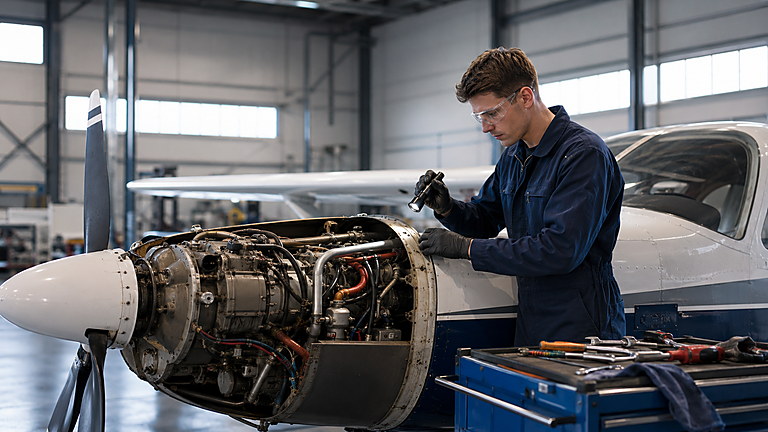
BLS describes work in hangars, repair stations, and on airfields. Mechanics may work outdoors, crouch or lie in uncomfortable positions, reach overhead for extended periods, climb ladders or scaffolds, and work around engine noise and vibration. Strict safety standards and deadlines can add stress.
Schedules can also be a deal-breaker. Nights, weekends, holidays, and longer 8- or 10-hour shifts are part of the occupation for some workers.
That reality is worth considering before you choose a school. If a training program sells only the aircraft and the paycheck but barely discusses schedules, documentation, safety standards, and physical working conditions, keep asking questions.
How Long Does A&P Training Take?
The FAA describes two main civilian routes for gaining the training and experience needed for an Aviation Mechanic certificate.
FAA-certificated Aviation Maintenance Technician School
An FAA-certificated AMTS, often called a Part 147 school, provides approved training. The FAA says estimated completion time at most Part 147 schools is 18 to 24 months, depending on the rating or ratings pursued. Graduates of the applicable curriculum can become eligible to take the relevant FAA tests if they meet the other eligibility requirements.
You can explore aircraft mechanic schools and A&P training when you are ready to compare programs.
On-the-job practical experience
For the experience route, FAA rules require at least 18 months of appropriate practical experience for one rating or 30 months of concurrent experience for both Airframe and Powerplant ratings. The FAA stresses that this must be actual maintenance experience and must be documented.
Military personnel may also qualify through relevant experience or the Joint Service Aviation Maintenance Technician Certification Council pathway.
For testing and credential details, see the aircraft mechanic certification guide and FAA A&P practice test.
Is Becoming an Aircraft Mechanic Worth It?
For the right person, the economics are compelling: the national median is nearly $80,000, a quarter of the occupation earns above roughly $99,000, and the field does not typically require a bachelor's degree.
The decision gets weaker if you take on unnecessary training debt, cannot tolerate shift work, or live far from the aviation employers you actually want.
The career may be a strong fit if you:
- Want hands-on technical work with a high level of responsibility.
- Are comfortable following precise procedures and documenting work.
- Can handle noisy, physical, sometimes awkward working conditions.
- Are open to nights, weekends, or relocation if the best early opportunities require them.
- Can reach FAA eligibility through a reasonably priced school, military experience, or documented OJT.
- Like the idea of building expertise in a regulated field where mistakes matter.
Think harder before committing if you:
- Need a predictable Monday-to-Friday daytime schedule immediately.
- Strongly prefer remote or desk-based work.
- Dislike detailed inspections, recordkeeping, or procedural compliance.
- Would need to finance a high-cost program without comparing lower-cost AMTS options or the OJT route.
- Are choosing the occupation only because you saw a top-end salary number.
Before borrowing for school, use our aircraft mechanic school cost guide and calculator. Compare total program charges, tools, testing, financing, completion time, and the jobs graduates actually pursue, not just the advertised tuition number.
Questions to Ask an Aircraft Mechanic School Before Enrolling
A good school comparison should answer more than "How fast can I start?"
- Is the school currently FAA-certificated under Part 147 for the Airframe, Powerplant, or combined A&P curriculum I want?
- What is the total expected cost, including required tools, books, supplies, fees, and testing expenses?
- How long do students typically take to complete the exact curriculum?
- What percentage of students complete the program?
- What employer relationships exist, and what kinds of employers actually hire recent graduates?
- Does the school publish verifiable placement information, and how does it define "placed"?
- What equipment and aircraft systems will I work on during training?
- How does the program prepare students for the knowledge, oral, and practical tests?
- What happens financially if I withdraw or need extra time?
- Are there lower-cost public, military, employer-sponsored, or OJT routes that could get me to the same FAA eligibility?
If you are still comparing education paths more broadly, see trade school vs. certificates vs. apprenticeships and our guide to trade school costs.
Frequently Asked Questions
How much do aircraft mechanics make?
The May 2025 BLS OEWS median was $79,870 per year, or $38.40 per hour. The 25th percentile was $62,630 and the 75th percentile was $99,130.
How much do A&P mechanics make?
There is no separate official BLS "A&P mechanic salary." A&P refers to holding both FAA Airframe and Powerplant ratings. BLS includes aircraft mechanics under SOC 49-3011, which had a $79,870 national median in May 2025.
Can aircraft mechanics make $100,000 or more?
Yes. The 75th percentile was $99,130 and the 90th percentile was $128,890 in May 2025. Those are straight-time wage estimates, not guarantees for a particular experience level or employer.
What state pays aircraft mechanics the most?
New Jersey had the highest published median among the 50 states in May 2025 at $105,370. New York was next at $102,800, followed by Maryland at $100,500.
Do airline aircraft mechanics make more?
Air transportation had a $96,170 median for aircraft mechanics in May 2025, compared with the $79,870 national median and $72,910 in support activities for air transportation. That is an industry comparison, not a guaranteed rate at any specific airline.
How much do aircraft mechanics make starting out?
BLS does not publish a national starting salary. The 10th percentile was $48,780, but it should not be treated as an entry-level rate because the BLS wage distribution is not organized by experience.
Do aircraft mechanics get overtime?
Some employers offer overtime and shift premiums, particularly in round-the-clock operations. BLS OEWS wage estimates exclude overtime and shift differentials, so you need the employer's current pay rules to estimate total compensation.
Is A&P school worth it?
It can be, especially when the training cost is reasonable relative to likely employment options. Compare FAA certification status, total program cost, completion time, financing, and realistic local jobs before deciding. An expensive program is not automatically better than a public AMTS or documented OJT route.
How long does A&P training take?
The FAA says most Part 147 schools have an estimated completion time of 18 to 24 months, depending on the rating or ratings. The practical-experience route requires at least 18 months for one rating or 30 months concurrently for both.
Sources and Methodology
Data checked October 5, 2026.
- U.S. Bureau of Labor Statistics: Aircraft and Avionics Equipment Mechanics and Technicians, Occupational Outlook Handbook (updated August 27, 2026).
- BLS OEWS: May 2025 State Occupational Employment and Wage Estimates (released May 15, 2026).
- BLS OEWS: May 2025 Technical Notes, including the wage definition and exclusions.
- BLS Employment Projections: 2025–35 Occupational Projections and Worker Characteristics (released August 27, 2026).
- BLS Employment Projections: 2025–35 Occupational Separations and Openings.
- Federal Aviation Administration: Become an Aviation Mechanic.
- Federal Aviation Administration: Experience Requirements to Become an Aircraft Mechanic (updated July 16, 2026).
- Federal Aviation Administration: Become a Mechanic FAQ.
Method: We keep BLS OEWS wage/employment estimates separate from BLS Employment Projections. We do not map wage percentiles to experience, infer a national A&P wage premium, or convert employer-specific overtime and shift rules into a universal salary estimate.
Explore Aircraft Mechanic Training
If the pay, work environment, and FAA pathway make sense for you, compare aircraft mechanic schools and aviation maintenance training. You can also explore the broader aviation training hub before choosing a program.