
Outdoor Jobs That Pay Well: 12 Careers Beyond the Desk



What this guide does: compares 12 non-bachelor's outdoor careers using May 2025 BLS pay data, 2025–2035 projections, and current O*NET work-context responses.
Our cutoff: median pay above $50,980 and at least 70% of O*NET respondents saying all-weather outdoor work is required every day.
If you want a career that gets you outside, the usual internet lists are not very helpful. A job does not become an "outdoor career" because somebody visits a construction site twice a month, and "no four-year degree" does not mean "no training."
This guide uses a stricter test. Every career in the main list has a May 2025 national median wage above $50,980, the median for all U.S. occupations, and at least 70 percent of O*NET respondents said their job requires working outdoors, exposed to all weather conditions, every day. We also prioritized careers that typically do not require a bachelor's degree.
That leaves a useful group of trades and technical occupations rather than a grab bag of dog walkers, landscape architects, biologists, and office-based engineers.
Important: The O*NET percentage is the share of surveyed workers who chose "Every day" for the outdoor-weather question. It is not the percentage of a shift spent outside. A crane operator, for example, may spend much of the day in an enclosed cab while still working at an outdoor site every day.
The Fast Answer
- Highest median pay in this comparison: Electrical power-line installers and repairers — $95,320.
- Fastest projected growth: Solar photovoltaic installers — 37% from 2025 to 2035.
- Another fast-growing technical path: Wind turbine service technicians — 30% growth.
- Strong option if you like heavy machinery more than ladders: Operating engineers and other construction equipment operators — $59,850 median pay.
- Fixed-site infrastructure option: Water and wastewater treatment operators — $60,020 median pay, although rotating shifts are common.
- Most accessible formal education requirement: Roofers typically have no formal educational credential requirement; most learn on the job, and apprenticeships are another route.
12 Outdoor Jobs That Pay Well
| Career | 2025 median pay | O*NET: "outdoors every day" | 2025–35 outlook | Typical entry/training |
|---|---|---|---|---|
| Electrical power-line installer/repairer | $95,320 | 100% | +10% | High school + technical instruction/OJT; apprenticeships common |
| Telecommunications line installer/repairer | $74,330 | 95% | -3% | High school + long-term OJT |
| Pile driver operator | $73,300 | 98% | -6% | High school + moderate OJT; apprenticeship possible |
| Rail-track laying/maintenance equipment operator | $70,070 | 84% | +2% | High school + moderate OJT |
| Crane and tower operator | $68,080 | 98% | +4% | High school + related experience + moderate OJT; federal qualification rules apply |
| Wind turbine service technician | $64,120 | 79% | +30% | Postsecondary nondegree award + long-term OJT |
| Brickmason/blockmason | $62,120 | 97% | +1% | High school + apprenticeship |
| Water/wastewater treatment operator | $60,020 | 70% | -6% | High school + long-term OJT; state license usually required |
| Operating engineer/construction equipment operator | $59,850 | 100% | +5% | High school + moderate OJT; apprenticeship/vocational routes available |
| Service unit operator, oil and gas | $58,160 | 100% | +1% | No formal credential typical; related experience + moderate OJT |
| Roofer | $55,440 | 97% | +5% | No formal credential + moderate OJT; apprenticeship possible |
| Solar photovoltaic installer | $53,140 | 70% | +37% | High school + moderate OJT; technical training can help |
Data notes: Median wages are national May 2025 BLS figures. Outlook is the BLS 2025–2035 national projection for the detailed occupation, rounded to the nearest whole percent. O*NET percentages show the share of respondents who answered "Every day" to "How often does this job require working outdoors, exposed to all weather conditions?" Median pay is not starting pay, and local wages can differ substantially.
How We Chose These Careers
We used three filters:
- Pay above the U.S. median. The May 2025 median annual wage for all occupations was $50,980. That gives "pays well" an objective baseline instead of whatever number makes a headline sound impressive.
- Outdoor work is routine, not incidental. At least 70 percent of O*NET respondents for the occupation reported that all-weather outdoor work is required every day.
- A bachelor's degree is not the normal entry requirement. Some jobs still demand serious preparation: apprenticeships, technical awards, employer training, experience, licenses, or safety qualifications.
This is a comparison set, not a claim that these are the 12 highest-paying outdoor careers in America. The point is to identify solid non-bachelor's pathways with unusually strong outdoor exposure and useful federal labor data.
Power and Communications Infrastructure
1. Electrical Power-Line Installers and Repairers
Median pay: $95,320
Outdoor every day: 100%
Projected growth: 10%
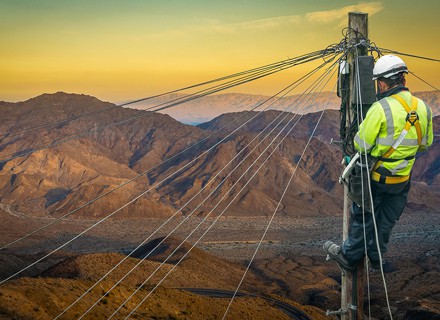
Linework has the highest median wage in this comparison by a wide margin. Power-line installers build and repair electrical distribution and transmission systems, often using bucket trucks, climbing equipment, and specialized tools. BLS says a high school diploma is the typical entry-level education, but becoming proficient requires technical instruction and substantial on-the-job training; apprenticeships are common.
The trade-off is not subtle. O*NET reports daily exposure to weather for every surveyed worker, and the job also involves heights, hazardous conditions, physical demands, and emergency restoration work. BLS notes that storms and natural disasters can mean travel and long hours for several days in a row.
Good fit if: You want high earning potential, structured technical work, and you are comfortable with heights, weather, and strict safety procedures.
Think twice if: You want predictable hours or dislike emergency callouts and high-consequence work.
Explore the training side separately in our lineworker training guide.
2. Telecommunications Line Installers and Repairers
Median pay: $74,330
Outdoor every day: 95%
Projected growth: -3%
Telecom line installers build and maintain the physical cabling that carries phone, television, and internet service. The line specialty matters here: other telecommunications technicians may work largely indoors, while O*NET shows that 95 percent of line installers report outdoor weather exposure every day.
The national median is strong, but the outlook is a caution flag. BLS projects employment of telecom line installers to decline 3 percent from 2025 to 2035 as recent network buildouts mature and newer infrastructure needs less maintenance. That does not mean zero hiring; replacement openings will still exist as workers leave the occupation.
Good fit if: You like utility-style field work and communications infrastructure.
Think twice if: You want a field with strong net employment growth rather than replacement-driven openings.
Heavy Construction, Lifting, and Rail
3. Pile Driver Operators
Median pay: $73,300
Outdoor every day: 98%
Projected growth: -6%
Pile driver operators run specialized equipment that drives steel, concrete, or timber piles for bridges, piers, retaining walls, and foundations. The pay is excellent for a high-school-entry occupation, and the work is about as genuinely outdoors as it gets.
The catch is scale: this is a small specialty, with only about 2,300 jobs in 2025, and BLS projects a 6 percent decline by 2035. Treat it as a specialized heavy-construction path, not a huge national hiring market.
Good fit if: You want specialized heavy equipment and civil construction.
Think twice if: You need a large, geographically broad occupation with lots of openings.
4. Rail-Track Laying and Maintenance Equipment Operators
Median pay: $70,070
Outdoor every day: 84%
Projected growth: +2%
Rail-track maintenance operators lay, repair, and maintain track and operate equipment used for ballast cleaning, tamping, and other track work. BLS lists a high school diploma plus moderate-term on-the-job training as the typical path.
This can be a strong option for someone who wants infrastructure work without making rooftops, towers, or utility poles the center of the job. The trade-off is that rail maintenance can involve irregular hours, travel, noisy equipment, and work around active rail operations.
Good fit if: You like infrastructure, machinery, and field crews.
Think twice if: You need a conventional Monday-to-Friday daytime schedule.
5. Crane and Tower Operators
Median pay: $68,080
Outdoor every day: 98%
Projected growth: +4%
Crane and tower operators move heavy materials and equipment on construction and industrial sites. O*NET shows that 98 percent report outdoor all-weather work every day, even though many operators spend substantial time inside an enclosed cab.
This is also one of the careers where "no bachelor's degree" can be badly misunderstood. BLS lists a high school diploma, related work experience, and moderate-term on-the-job training as typical. For cranes covered by OSHA's construction standard, employers must ensure operators meet applicable training, certification or licensing, and evaluation requirements. State and local licensing rules can add another layer.
Good fit if: You have excellent spatial judgment, patience, and comfort carrying high responsibility.
Think twice if: You want a quick, no-qualification path into heavy equipment.
6. Operating Engineers and Other Construction Equipment Operators
Median pay: $59,850
Outdoor every day: 100%
Projected growth: +5%
Operating engineers run excavators, bulldozers, loaders, graders, and other construction equipment. O*NET's result is striking: 100 percent of surveyed workers said the job requires outdoor weather exposure every day. At the same time, much of the actual shift may be spent in a machine cab.
BLS says many operators learn after high school through on-the-job training; others enter through apprenticeships or vocational schools. This makes the occupation one of the most direct bridges between technical training and outdoor infrastructure work.
Good fit if: You want outdoor job sites but would rather operate machinery than spend all day climbing.
Think twice if: Whole-body vibration, irregular construction schedules, or seasonal slowdowns would wear you down.
See heavy equipment training options for the education side of the decision.
Clean Energy and Field Energy Work
7. Wind Turbine Service Technicians
Median pay: $64,120
Outdoor every day: 79%
Projected growth: +30%
Wind turbine technicians are the clean-energy standout for people who like troubleshooting as much as being outside. They inspect, maintain, and repair electrical, mechanical, and hydraulic systems in and around wind turbines.
BLS projects 30 percent employment growth from 2025 to 2035, far faster than the 3 percent average for all occupations. Entry typically requires a postsecondary nondegree award followed by long-term on-the-job training.
The job is not simply "outside in a field." BLS describes work outdoors, in confined spaces, and often at great heights. Evening or weekend on-call work may also be part of the deal.
Good fit if: You want a technical renewable-energy job and are genuinely comfortable at height.
Think twice if: Heights, confined spaces, or remote wind-farm locations are hard no's.
Explore wind turbine technician training.
8. Solar Photovoltaic Installers
Median pay: $53,140
Outdoor every day: 70%
Projected growth: +37%
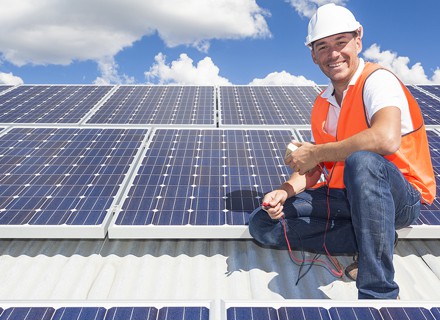
Solar PV installers assemble and mount photovoltaic systems on roofs and other structures. It has the lowest median pay in our main list, but it also has the fastest BLS growth projection: 37 percent from 2025 to 2035.
BLS says a high school diploma is the typical entry-level education and moderate-term on-the-job training is common. Some workers take technical courses or programs before entering the field. O*NET also shows high-place exposure is common, so rooftop comfort matters.
Good fit if: You want a relatively accessible route into fast-growing renewable-energy work.
Think twice if: You dislike roofs, sun exposure, lifting, or regionally variable construction activity.
See solar energy training options.
9. Service Unit Operators, Oil and Gas
Median pay: $58,160
Outdoor every day: 100%
Projected growth: +1%
Service unit operators run equipment used to service producing oil and gas wells, restore flow, or remove obstructions. BLS classifies the detailed occupation as one in which a formal educational credential is not typically required, but related work experience and moderate-term on-the-job training are typical.
The lifestyle is a bigger filter than the education requirement. BLS notes that oil and gas crews may travel to remote areas, work in all weather, put in long shifts, and sometimes spend weeks away from home. The industry can also expand or contract with energy markets and productivity changes.
Good fit if: You value field work and can tolerate travel, long shifts, and industry volatility.
Think twice if: You need geographic stability and a conventional weekly schedule.
Building and Municipal Infrastructure
10. Brickmasons and Blockmasons
Median pay: $62,120
Outdoor every day: 97%
Projected growth: +1%
Brickmasons and blockmasons build walls, partitions, arches, foundations, and other structures from brick and block. BLS says masons typically need a high school diploma and learn through apprenticeship or on-the-job training.
The work is physically demanding and weather-sensitive. O*NET reports 97 percent daily outdoor weather exposure, and BLS notes that inclement weather can affect schedules.
Good fit if: You like precise, visible craft work and apprenticeship-style learning.
Think twice if: Repetitive lifting, kneeling, bending, or weather-driven schedule changes are deal breakers.
For broader options, see construction trade schools.
11. Water and Wastewater Treatment Plant and System Operators
Median pay: $60,020
Outdoor every day: 70%
Projected growth: -6%
This is the oddball on the list, in a good way. Water and wastewater operators split time among treatment equipment, control systems, tanks, basins, and field areas. O*NET shows both outdoor and indoor work are routine, making it a better fit for someone who wants substantial outdoor exposure without spending every minute on an open construction site.
BLS lists a high school diploma and long-term on-the-job training as typical. A state license is usually required, although entry-level workers often complete licensing requirements while training. Employment is projected to decline as plants automate, but BLS still projects about 10,000 openings per year on average, all from replacement needs.
The work is essential and relatively fixed-location, but the schedule can be weird: treatment plants run around the clock, so nights, weekends, rotating shifts, and on-call duties are common.
Good fit if: You want public-infrastructure work, systems troubleshooting, and a mix of indoor/outdoor duties.
Think twice if: Rotating shifts are worse to you than bad weather.
12. Roofers
Median pay: $55,440
Outdoor every day: 97%
Projected growth: +5%
Roofing is one of the clearest direct-entry outdoor trades. BLS says there are typically no formal education requirements. Most roofers learn on the job, while some enter through apprenticeships.
It is also one of the hardest jobs here physically. Roofers climb, bend, kneel, lift, and work in temperature extremes. BLS reports unusually high injury and fatality rates for the occupation, and northern-state work can be limited in winter. Busy summers may mean overtime.
Good fit if: You want a straightforward path into hands-on construction and do not mind hard physical work.
Think twice if: Heights, heat, repetitive strain, or seasonal work are major concerns.
Which Outdoor Career Fits You Best?
If pay is your first filter
Start with electrical linework. Its $95,320 median is more than $20,000 above the next job in this comparison. Just do not confuse median pay with apprentice pay or assume the work is easy to enter. The earnings come with extensive training and serious safety responsibility.
If job growth matters most
Look hardest at solar PV installation (+37%) and wind turbine service (+30%). Those are the two clear growth outliers in the group.
If you want to stay closer to the ground
Operating engineers, rail-track maintenance operators, and water/wastewater operators are better starting points than linework, wind, roofing, or tower-crane paths. That does not make them low-risk jobs; it just reduces how central climbing and elevated work are to the occupation.
If you want an earn-while-you-learn route
Look for registered apprenticeships in linework, masonry, roofing, and heavy equipment. Registered Apprenticeship is a paid job with structured on-the-job learning, related instruction, progressive wage increases, and a recognized credential. The exact application rules, wage schedule, tuition arrangements, and benefits depend on the sponsor, so inspect the actual program rather than assuming every apprenticeship has identical terms.
If you want a fixed workplace instead of constantly changing jobsites
Water and wastewater treatment deserves a closer look. The plant does not move every three weeks. The compromise is shift work rather than travel.
If you want outdoor work but not necessarily every day
Consider surveying and mapping technician as a hybrid alternative. Its May 2025 median wage was $54,240 and BLS projects 6 percent growth, but only 44 percent of O*NET respondents reported all-weather outdoor work every day. It belongs in the conversation, just not in a list built around consistently daily outdoor exposure.
What "No 4-Year Degree" Actually Means
None of the main careers has a bachelor's degree as its typical BLS entry requirement. That is not the same as showing up Monday morning with work boots and vibes.
Depending on the occupation, preparation may include:
- A multi-year apprenticeship
- A postsecondary technical certificate or other nondegree award
- Moderate- or long-term employer training
- Prior related work experience
- State licensing
- Equipment-specific qualification
- Employer safety training
For example, wind turbine technicians typically need a postsecondary nondegree award. Water and wastewater operators usually need state licensing. And for cranes covered by OSHA's construction rule, employers must ensure operators satisfy applicable training, certification or licensing, and evaluation requirements.
If apprenticeship is your preferred route, Apprenticeship.gov is the federal starting point for understanding Registered Apprenticeship and finding participating programs.
Outdoor Jobs We Deliberately Left Out
A useful list needs exclusions as much as inclusions.
Arborists and tree workers
Tree work is unquestionably outdoors, and specialized arborists can build strong careers. But the federal wage category that cleanly captures tree trimmers and pruners has a May 2025 median below our $50,980 cutoff. Federal data also cannot neatly isolate every higher-skilled arborist specialty, so ranking "arborist pay" with false precision would be misleading.
Wildland firefighters
Wildland firefighting is one of the most outdoor jobs imaginable, but it is a classification and compensation minefield. Generic BLS firefighter wages do not cleanly represent federal wildland fire positions, seasonal schedules, overtime, hazard pay, and federal pay systems. Rather than paste the wrong firefighter salary into a neat table, we left it out of the ranking.
Highway maintenance workers and septic service workers
Both easily pass the outdoor-work test, but their May 2025 national median wages — $50,260 for highway maintenance workers and $49,880 for septic tank servicers and sewer pipe cleaners — fall below the $50,980 all-occupations benchmark used for this guide.
Sheet metal workers
Sheet metal work pays well nationally, but the broad occupation includes substantial fabrication and indoor work. Current O*NET responses do not show the consistent all-weather outdoor exposure we required for the main list. Architectural sheet-metal installers may spend much more time outside than the occupation as a whole, but the national data cannot cleanly separate that specialty for our comparison.
Surveying and mapping technicians
The pay qualifies, and field surveying is genuinely outdoor work. But O*NET reports that 44 percent work outdoors in all weather every day. We treat it as a strong hybrid field/office option, not one of the 12 consistently outdoor careers.
Before You Choose an Outdoor Career
Ask yourself five less-glamorous questions before focusing on salary:
- How much weather can I realistically tolerate? Daily outdoor work in July and January is different from liking hiking in October.
- How do I feel about heights? Linework, roofing, wind, and some crane work can make this an immediate yes-or-no filter.
- Do I want apprenticeship, school, or employer training? The learning model changes the timeline, cash flow, and application process.
- Can I handle irregular hours or travel? Utility restoration, rail work, oilfield service, and 24/7 treatment plants can all disrupt a normal weekly schedule in different ways.
- Is the job growing locally? National data is a baseline. Before training, check your state or metro employment data and actual employers in your region.
If the bigger question is simply whether you want physical or non-office work, compare this guide with our articles on hands-on jobs, active jobs, and high-paying jobs without a degree.
Frequently Asked Questions
What is the highest-paying outdoor job without a four-year degree?
Among the 12 occupations in this comparison, electrical power-line installers and repairers have the highest May 2025 national median wage at $95,320. BLS lists a high school diploma as the typical entry-level education, but technical instruction and extensive on-the-job training are required, and apprenticeships are common.
What outdoor jobs are growing the fastest?
Among this comparison set, BLS projects solar photovoltaic installers to grow 37 percent from 2025 to 2035 and wind turbine service technicians to grow 30 percent. Both are much faster than the 3 percent average projected for all occupations.
Can I get a good outdoor job without college?
Yes, if by "college" you mean a four-year bachelor's degree. Many outdoor trades use apprenticeships or employer training instead. Others, such as wind turbine service technician, typically require a postsecondary nondegree award. The specific credential and training route matters more than the simple college/no-college label.
Which outdoor jobs do not require much work at heights?
Operating engineers and construction equipment operators, rail-track maintenance operators, and water/wastewater treatment operators are stronger places to start if you want outdoor work without making climbing a core duty. Jobsite hazards still exist, and duties vary by employer.
How does O*NET measure whether a job is outdoors?
O*NET asks workers how often the job requires working outdoors while exposed to all weather conditions. Responses range from "Never" to "Every day." In this guide, the outdoor percentage is the share of respondents who selected "Every day." It does not mean that same percentage of every shift is spent outside.
Do outdoor jobs slow down in winter?
Some do. BLS specifically notes that roofing can be limited in northern states during winter, and construction work can have weather-dependent schedules. Other outdoor careers have a different problem: lineworkers may work longer hours during severe-weather emergencies, while water-treatment facilities operate around the clock regardless of season.
Explore Training Options
Outdoor careers span several training models. If one of these paths fits, compare the training requirements before choosing a school or program:



Related Articles



Sources and Methodology
Data checked September 10, 2026.
Primary sources:
- U.S. Bureau of Labor Statistics, Occupational Employment and Wage Statistics, May 2025: https://www.bls.gov/news.release/ocwage.t01.htm
- BLS Occupational Projections and Worker Characteristics, 2025–2035: https://www.bls.gov/emp/tables/occupational-projections-and-characteristics.htm
- BLS: Electrical Power-Line Installers and Repairers: https://www.bls.gov/ooh/installation-maintenance-and-repair/line-installers-and-repairers.htm
- BLS: Telecommunications Technicians: https://www.bls.gov/ooh/installation-maintenance-and-repair/telecommunications-equipment-installers-and-repairers-except-line-installers.htm
- BLS: Construction Equipment Operators: https://www.bls.gov/ooh/construction-and-extraction/construction-equipment-operators.htm
- BLS: Material Moving Machine Operators: https://www.bls.gov/ooh/transportation-and-material-moving/material-moving-machine-operators.htm
- BLS: Wind Turbine Technicians: https://www.bls.gov/ooh/installation-maintenance-and-repair/wind-turbine-technicians.htm
- BLS: Masonry Workers: https://www.bls.gov/ooh/construction-and-extraction/brickmasons-blockmasons-and-stonemasons.htm
- BLS: Water and Wastewater Treatment Plant and System Operators: https://www.bls.gov/ooh/production/water-and-wastewater-treatment-plant-and-system-operators.htm
- BLS: Oil and Gas Workers: https://www.bls.gov/ooh/construction-and-extraction/oil-and-gas-workers.htm
- BLS: Roofers: https://www.bls.gov/ooh/construction-and-extraction/roofers.htm
- BLS: Solar Photovoltaic Installers: https://www.bls.gov/ooh/construction-and-extraction/solar-photovoltaic-installers.htm
- BLS: Data for Occupations Not Covered in Detail (rail-track maintenance and other occupations): https://www.bls.gov/ooh/about/data-for-occupations-not-covered-in-detail.htm
- O*NET: Outdoors, Exposed to All Weather Conditions: https://www.onetonline.org/find/descriptor/result/4.C.2.a.1.c
- ONET occupation work-context pages for SOC/ONET codes 49-9051.00, 49-9052.00, 47-2072.00, 47-4061.00, 53-7021.00, 49-9081.00, 47-2021.00, 51-8031.00, 47-2073.00, 47-5013.00, 47-2181.00, and 47-2231.00: https://www.onetonline.org/
- U.S. Department of Labor, Registered Apprenticeship: https://www.apprenticeship.gov/employers/registered-apprenticeship-program
- OSHA, 29 CFR 1926.1427 — crane operator training, certification, and evaluation: https://www.osha.gov/laws-regs/regulations/standardnumber/1926/1926.1427
Find Training for an Outdoor Career
If one of these paths fits, use the finder below to compare relevant vocational and technical training options near you.