MRI Tech vs. Ultrasound Tech: Pay, Training, Physical Demands, and Career Fit


Choosing between MRI technology and diagnostic medical sonography is not really a salary decision. In May 2025, U.S. diagnostic medical sonographers earned a median $96,590 a year, compared with $95,480 for MRI technologists. That is a difference of only $1,110. Yet the work feels very different: sonographers search for diagnostic information in real time while manipulating an ultrasound probe, whereas MRI technologists coordinate complex scanning protocols, patient positioning, and stringent magnetic-field safety.
The short answer: Consider ultrasound if you enjoy hands-on, close-contact patient care and making imaging decisions while the examination unfolds. Consider MRI if you prefer cross-sectional anatomy, equipment and imaging physics, and a safety-critical workflow built around magnetic resonance. Neither career is a low-effort desk job. Your strongest choice also depends on whether a qualifying clinical program exists near you, the credentials employers accept locally, and your physical tolerance for the work.
This is a comparison of diagnostic medical sonographers (SOC 29-2032) and magnetic resonance imaging technologists (SOC 29-2035). Radiologic technologists who operate X-ray and CT equipment belong to a different occupation. Treating them as interchangeable with MRI technologists leads to bad salary comparisons and sometimes bad school choices.
MRI vs. ultrasound tech at a glance
| Category | Diagnostic medical sonographer | MRI technologist |
|---|---|---|
| Main imaging method | High-frequency sound waves; live, operator-controlled imaging | Strong magnetic field and radio waves; protocol-driven image acquisition |
| May 2025 U.S. median annual pay | $96,590 | $95,480 |
| Lowest 10% of wages | Below $67,820 | Below $68,890 |
| Highest 10% of wages | Above $129,370 | Above $127,670 |
| 2025 U.S. employment, BLS projections baseline | 92,200 | 43,900 |
| Projected employment growth, 2025-2035 | 13.9% | 7.7% |
| Average annual openings, 2025-2035 | About 6,000 | About 2,300 |
| BLS typical education for entry | Associate degree | Associate degree |
| Common credential routes | ARDMS (RDMS/RDCS/RVT), CCI, or ARRT(S) as appropriate | ARRT(MR) primary or postprimary, or ARMRIT |
| Main recurring physical demands | Sustained transducer pressure, repetitive hand motion, shoulder/neck posture | Patient transfers and positioning, moving coils, prolonged standing |
| Distinctive safety responsibility | Safe acoustic exposure, infection control, patient positioning | Metal and implant screening, magnetic-field access controls, radiofrequency and other MR hazards |
Wages are from the BLS May 2025 Occupational Employment and Wage Statistics (OEWS); jobs, openings, education, and growth are from the separate BLS 2025-2035 Employment Projections (EP). The 10th and 90th wage percentiles are not starting and senior salaries. Sources: BLS sonographer profile, BLS radiologic and MRI profile, and BLS occupational projections.
What the daily work actually feels like
Sonography: Finding the images yourself, in real time
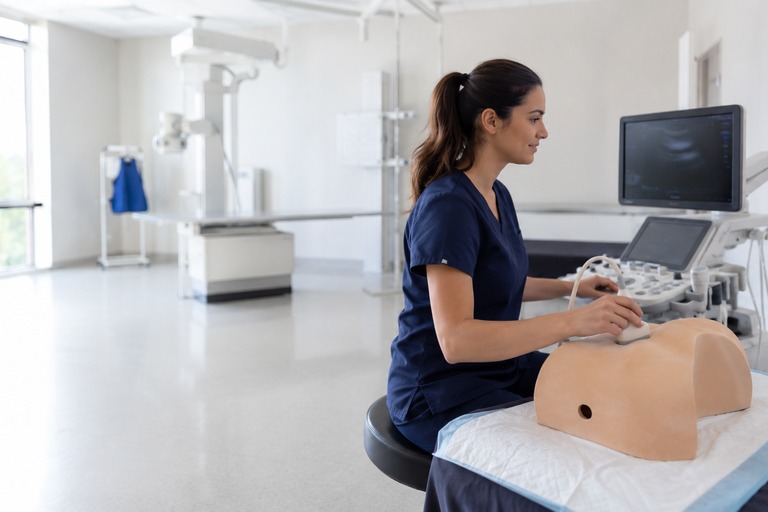
Imagine being assigned an abdominal ultrasound. You review the order, explain the examination, position the patient, select a transducer, and begin scanning. The image changes immediately as you angle and press the probe. Your other hand adjusts depth, gain, focus, or Doppler settings. You must recognize anatomy as it appears, identify views that need closer examination, and capture enough useful images and measurements for the interpreting clinician.
That mix of fine motor skills and real-time judgment is the attraction. It is also the pressure. If a needed view is missed, the interpreter cannot simply reconstruct every missing angle afterward. Sonographers routinely adapt their technique for limited mobility, pain, body habitus, and urgent clinical questions. The job calls for concentration and an ability to stay calm when patients are nervous or when findings are concerning. The interpreting physician or other authorized clinician, not the sonographer, makes the final diagnosis.
Sonography is not all prenatal imaging. General sonographers evaluate abdominal organs and many other structures; vascular specialists assess blood vessels; cardiac sonographers work with heart imaging. These specialties may involve different workplaces, exams, credentials, and physical demands. For a fuller look at the specialty landscape, read our diagnostic medical sonographer career guide.
MRI: Planning protocols, screening hazards, and helping people through the scanner
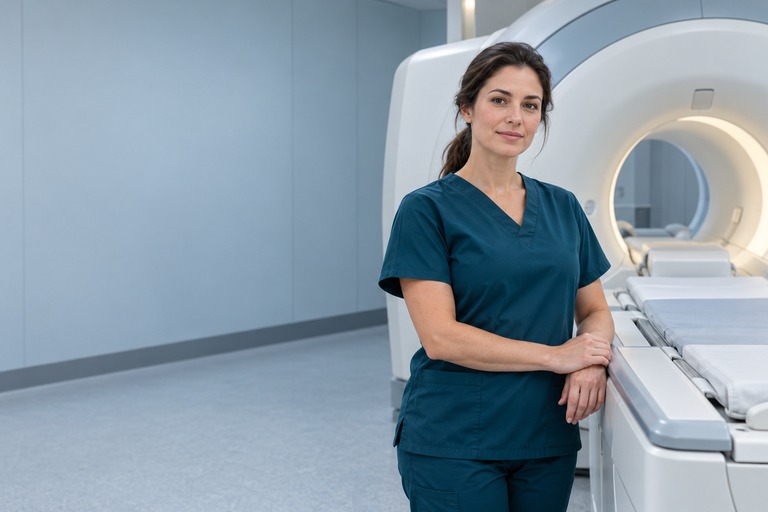
A typical MRI examination starts before the patient enters the room. The technologist checks the imaging order and completes careful safety screening for implants, devices, metallic objects, and other contraindications. They explain a noisy, confined scan to the patient, position the body and specialized radiofrequency coils, and select or adjust imaging sequences for the clinical question.
During the scan, the technologist monitors communication and image quality, watches for motion or artifacts, and works within department protocols. Some examinations involve intravenous contrast and additional patient monitoring. It is technical work, but not 'press start and wait.' Poor planning, incorrect screening, and missed artifacts can have significant consequences.
The technologist is often separated from the patient during imaging, yet patient care remains central. An anxious or claustrophobic person may need repeated coaching. A hospitalized patient may need help transferring from a bed and close coordination with nurses. MRI is particularly appealing to people who like the intersection of anatomy, computing, physics, and careful procedure. See our guide to becoming an MRI technologist for the detailed training steps.
Which career is harder on the body?
Ultrasound generally involves more sustained, repetitive upper-limb scanning. A sonographer may spend much of a shift holding a transducer at a difficult angle, applying pressure, keeping a shoulder raised, and turning toward a monitor. The American Institute of Ultrasound in Medicine (AIUM) reported in its June 2026 statement that up to 90% of survey respondents have scanned in pain. That is a warning about reported symptoms in surveyed ultrasound professionals, not a claim that 90% develop permanent injuries or disabilities. Workstation layout, adjustable beds, adequate scheduling, positioning, breaks, and employer support make a difference. AIUM's official ergonomics statement discusses prevention.
MRI avoids the constant probe-pressure task, but it is not a physically effortless alternative. MRI technologists may spend long shifts standing, assist with moving patients who cannot transfer independently, and handle specialized coils and equipment. Those tasks can stress the back and shoulders. Both roles require teamwork and safe patient-handling procedures; neither should be considered a guaranteed solution for someone already living with musculoskeletal symptoms.
The hazards are different too. Neither modality uses ionizing X-ray radiation. Ultrasound involves nonionizing acoustic energy and requires appropriate exposure practices and infection control. MRI operates around powerful magnetic fields and radiofrequency energy. The magnet may remain energized even when no patient is being scanned. Unsuitable ferromagnetic equipment, implant screening mistakes, and heating hazards make access control and technical judgment central to safety. Consult the American College of Radiology's 2026 MR safety resources.
A useful reality check: Before choosing based on injury risk, arrange observations in both departments if possible. Ask about exam volume, patient transfers, ergonomic equipment, breaks, staffing, and whether work is rotated among stations. A well-run ultrasound department can be a better working environment than an understaffed MRI service, and vice versa.
Salary and job outlook: Close pay, different job markets
The two professions are close in national median pay, but sonography has a larger workforce and more projected openings. The BLS expects about 6,000 sonographer openings a year during 2025-2035 versus about 2,300 for MRI technologists. Openings include replacements for workers leaving occupations as well as new positions. They do not equal available jobs for new graduates in a particular city.
An especially misleading comparison uses an MRI-specific median against the median for all radiologic and MRI technologists combined, or the X-ray-specific figure. For this article the comparison is strictly 29-2032 vs. 29-2035. Similarly, cardiac sonography and some cardiovascular technician roles can fall under other BLS occupational classifications; do not quietly mix their pay into the general sonography row.
Workplace can matter as much as modality
| May 2025 industry median | Sonography | MRI |
|---|---|---|
| Hospitals, state/local/private | $97,390 | $95,920 |
| Offices of physicians | $95,220 | $93,880 |
| Medical and diagnostic laboratories | $87,580 | $93,540 |
| Outpatient care centers | $127,940 | $140,390 |
These are medians for workers employed in each industry, not promised offers to new graduates. The particularly high MRI outpatient median should not drive a career choice by itself: according to BLS, outpatient care centers accounted for only a small share of MRI employment in 2025. Location, shift, experience, specialty, employer, and local supply can all change pay. A nearby employer accepting a new graduate is more immediately relevant than a national high-wage industry figure.
Hospitals can require evenings, weekends, overnights, or on-call coverage in either field. Some outpatient offices offer more predictable schedules, but that is a workplace-specific possibility rather than a universal guarantee. BLS sonography and BLS MRI provide the underlying national data.
Training routes: Beginners and working imaging professionals need different plans
The most expensive mistake is assuming there is one universal 'MRI tech degree' or 'ultrasound certificate.' Eligibility is set by the certification organization and, where applicable, state regulators. Employers then add their own hiring rules.
| Starting point | Possible route | The catch to verify |
|---|---|---|
| New to medical imaging, interested in MRI | ARRT primary MRI pathway: associate degree or higher, plus an ARRT-recognized MRI education program and required clinical competencies, ethics, and exam | Radiography is not a prerequisite to every direct-entry MRI route, but local employers may still prefer X-ray experience |
| Already certified in qualifying imaging disciplines | ARRT postprimary MRI pathway: supporting credential, 16 hours of structured education, documented MRI clinical procedures, ethics, and exam | Structured education alone is not enough; supervised clinical access is essential |
| New to MRI, considering ARMRIT | Complete a qualifying MRI program or other eligibility route approved by ARMRIT, then meet its testing requirements | Verify the exact school route, clinical requirements, state rules, and whether employers you want accept ARMRIT |
| New to ultrasound | A sonography program aligned with the desired specialty and the credentialing body's prerequisites; often a CAAHEP-accredited associate-level program | The word 'accredited' is not enough: check programmatic accreditation and the specific exam eligibility pathway |
| Already credentialed sonographer, considering MRI | ARRT recognizes certain ARDMS or ARRT sonography credentials as supporting categories for postprimary MRI | Clinical MRI experience, structured education, verification, and examination are still required |
Sources: ARRT primary requirements, ARRT supporting categories, ARRT postprimary education, and ARMRIT certification.
Can you become an MRI tech without becoming an X-ray tech first?
Yes. ARRT includes MRI in its primary eligibility pathway. You do not automatically need the Radiography R.T.(R) credential first. But the direct route is not necessarily the best available route in every town. Some hospitals prefer people who can cover radiography and MRI duties or who already know the hospital imaging workflow. Compare current hiring requirements with the credentials your intended program actually leads to.
A radiography-first pathway remains valid for people who want the broader X-ray background and plan to add MRI later. It is a two-stage choice, not a requirement for everyone. For the radiography route, see our radiologic technologist career guide.
Can a sonographer cross-train into MRI?
Sometimes, yes, using ARRT's postprimary route. ARRT names Sonography and Vascular Sonography as supporting categories for MRI and accepts certain qualifying credentials issued by ARDMS. The candidate still needs MRI-specific structured education, verified clinical procedures, and the exam. This is particularly useful for people considering a second imaging career without restarting at square one.
The reverse is not a matching shortcut: MRI alone is not an ARRT postprimary supporting category for general Sonography. A person moving from MRI to ultrasound needs to investigate a qualifying sonography program or another applicable certification prerequisite, not assume that existing scanner experience waives hands-on ultrasound training.
Ultrasound exams: Passing the physics test is not the whole credential
An RDMS applicant generally needs the SPI (Sonography Principles and Instrumentation) examination and a qualifying specialty examination, plus education and clinical prerequisites. For example, an abdominal sonographer may pursue the Abdomen specialty, while a cardiac or vascular role uses other credential routes. Passing SPI by itself does not produce an RDMS credential. Inteleos/ARDMS generally requires the needed exams to be passed within the five-year rule window. Official RDMS requirements and the five-year rule explain the process.
The 1,680-hour trap has an important exception. Under ARDMS Pathway 2, graduates of qualifying CAAHEP- or CMA/HSO-programmatically accredited sonography programs have their clinical experience covered by the program. A graduate using Pathway 1 based on a non-CAAHEP, two-year DMS/CVT education program faces a requirement for 12 additional months of qualifying clinical experience outside that program, generally 1,680 hours. But there are other routes, including Pathway 3B for qualifying bachelor's-level sonography programs, so it is inaccurate to say that every non-CAAHEP sonography graduate faces exactly the same postgraduation requirement. Ask the credentialing body which pathway applies to your exact program before paying tuition. Inteleos' July 2026 prerequisite chart sets out the distinctions.
What about the new MRI Imaging Assistant credential?
ARRT launched a separate I.A.(MR)(ARRT) credential for MRI imaging assistants. It supports patient care, positioning, and MRI safety workflow, but imaging assistants do not perform MRI scanning. It is not a faster version of R.T.(MR)(ARRT), and it does not erase the education requirements for technologists. If a school markets an 'MRI assistant' pathway, check which job and scope it qualifies you for. ARRT's credential description is explicit about this.
Three real school examples, and what their fine print teaches
These examples are illustrations of different pathways, not a ranking or an endorsement. They are not interchangeable programs, and their prices should not be compared as though they taught the same starting student.
| School and program | Who it is designed for | Published practical detail to check |
|---|---|---|
| Casa Loma College: MRI AAS | Direct-entry MRI degree-seekers | Publishes a 22-month associate-degree MRI program; the school separately says its MRI program is recognized for ARRT primary pathway and ARMRIT routes. Verify campus authorization, clinical locations, current full program cost, and acceptance locally. |
| Loma Linda University: MRI certificate | Already ARRT(R)-certified radiographers meeting its California CRT and other requirements | Six months and 40 hours/week, with four eight-hour clinical days and one class day. No part-time or evening option and clinical placement may not be close to home. |
| Austin Community College: Sonography | Beginners applying to selective sonography training | ACC says students in its sonography tracks complete both an AAS and an advanced technical certificate; the specialties are CAAHEP accredited. General college admission does not guarantee program admission. |
Loma Linda publishes $10,158 in tuition and fees plus an $880 books/materials allowance for its six-month 2026-2027 MRI certificate. It also explicitly states that financial aid is unavailable for that certificate track, although VA benefits may be available. That figure is not the cost of training a complete beginner from zero, since its applicants already need radiography credentials and other prerequisites. The school also lists separate transportation and living-cost allowances, reinforcing how expensive an unpaid clinical schedule can become.
At Casa Loma, check the current catalog rather than relying on a marketing summary for credit-hour totals: its MRI page contains inconsistent credit descriptions. At ACC, avoid treating an advanced technical certificate as an independent beginner shortcut. The official program page says the AAS and advanced technical certificate together constitute its tracks.
Questions that deserve written answers from admissions
- Which exact credential and qualifying exam will this program prepare me to pursue? Ask for the credentialing organization's current eligibility category in writing.
- Is the specific program recognized or accredited for that exam pathway? Institutional accreditation alone does not answer the question.
- Who finds and confirms my clinical site? Ask about guaranteed availability, maximum commuting distance, and what happens when placement is delayed.
- Can I keep my job during clinical training? Request the actual weekly lab and rotation schedule, including evenings and weekends.
- What is my total cost to become employable? Add prerequisites, tuition, fees, equipment, travel, exams, renewals, and income lost during clinicals.
- Will the credential meet rules in the state where I plan to work? Ask for the state board's requirements and verify them yourself.
- Which nearby employers accept this particular entry route? Check actual job postings, not only a school's placement-rate claim.
For a deeper investigation of who arranges required hands-on training, use our online healthcare clinical placement verification guide.
What employers and states really require
A real job posting is more useful than a claim that 'employers prefer certification.' For example, an October 27, 2026 Kelsey-Seybold Clinic MRI technologist posting lists ARRT-MR or ARMRIT as acceptable routes without MRI work experience. Its alternatives for certain already credentialed imaging professionals require six months of supervised MRI scanning. That is employer-specific evidence for multiple routes, not proof all employers accept all routes.
A Houston Methodist Echo/Vascular Sonographer posting requires vascular credentials from specified organizations and three years of combined echo/vascular experience, with a narrower exception for internal candidates. This demonstrates why an entry-level general sonography credential does not automatically qualify someone for every specialized ultrasound job. Employer listings are snapshots, and requirements can change.
State rules vary. Oregon's Board of Medical Imaging licenses MRI and sonography as distinct modalities and identifies accepted registries including ARRT, ARMRIT, and ARDMS. New Hampshire also has a medical imaging licensing process covering magnetic resonance technologists and sonographers. By contrast, California's radiologic health branch focuses its machine-registration rules on ionizing-radiation equipment; its radiography credential is not automatically an MRI or ultrasound license. Always confirm directly with the state agency and intended employer, especially for multi-modality work. Oregon Board of Medical Imaging | New Hampshire licensing board | California Radiologic Health Branch.
Before you enroll: The MRI-vs-ultrasound decision worksheet
There is no honest 10-question quiz that can predict how well your body, personality, employer market, and local programs will fit either career. This worksheet makes the decision more concrete instead. You can print it, take it to a college appointment, and use it to collect real answers.
Questions to check off as you gather real answers
No score, diagnosis, or saved personal data. Use these checks to prepare for a college adviser or program call.
When ultrasound may be the better fit
You like one-on-one patient interaction and finding useful images through your own scanning technique. You are comfortable with sustained close contact, repeated hand movements, and learning anatomy across more than one sonography specialty. A qualifying program with dependable clinical sites exists near you, and employers in your area hire its credentialed graduates.
When MRI may be the better fit
You enjoy cross-sectional anatomy, technical image acquisition, systematic troubleshooting, and high-consequence safety protocols. You are comfortable coaching anxious patients and assisting with transfers. You have found a legitimate beginner-eligible MRI route, or you already hold an imaging credential that supports postprimary MRI eligibility. Your local employers accept the route you are pursuing.
When neither is the right decision yet
Pause if the school cannot identify your certification exam pathway, if clinical placement is unclear, if you would have to stop earning income with no workable plan, or if nearby employers consistently ask for a credential the school does not provide. It is better to delay an application than to discover the mismatch after paying tuition.
Frequently asked questions
Which pays more, MRI tech or ultrasound tech?
The difference in national May 2025 median annual wages is small: diagnostic medical sonographers earned $96,590 and MRI technologists $95,480. Individual job offers vary much more by location, employer, shift, and experience. Do not interpret the national median as an entry-level salary.
Can I become an MRI tech without a radiography degree?
Yes. The ARRT primary MRI pathway allows a qualifying associate degree or higher plus approved MRI education and clinical competencies, without requiring an earlier X-ray credential. ARMRIT has separate eligibility routes. Some employers prefer radiography experience, so verify local postings.
Can ultrasound techs become MRI techs?
Some can. ARRT recognizes qualifying ARDMS and ARRT sonography credentials as supporting categories for its postprimary MRI pathway. Candidates still need 16 hours of structured education, approved MRI clinical experiences, ethics eligibility, and a passing exam.
Do both careers require an associate degree?
BLS lists an associate degree as typical entry education for both. ARRT primary MRI specifically requires an associate degree or higher, alongside approved MRI education. Some ARMRIT routes and sonography certification pathways have different prerequisites. A short course alone does not necessarily meet any of them.
Which is harder on your body, sonography or MRI?
Sonography typically has greater exposure to continuous probe pressure and repetitive upper-limb motion; MRI brings patient-transfer and positioning demands as well as long periods on your feet. Worksite ergonomics, staffing, and individual circumstances matter in both roles. No single profession is physically safe for everyone.
Do MRI technologists and sonographers need state licenses?
Requirements depend on where they work. Oregon and New Hampshire have distinct state medical-imaging licensing requirements. Other jurisdictions may rely more heavily on employer credential policies. Check your state board before enrolling or relocating.
Sources and editorial method
We independently rebuilt the U.S. wage and outlook figures from BLS May 2025 OEWS and BLS 2025-2035 Employment Projections, keeping SOC 29-2032 and 29-2035 separate. We checked credential and safety claims against ARRT, ARMRIT, Inteleos/ARDMS, AIUM, and ACR primary resources. Program details were checked against Casa Loma College, Loma Linda University, and Austin Community College pages; employer examples were checked against Kelsey-Seybold/UnitedHealth Group and Houston Methodist listings available October 28, 2026. Examples illustrate policies and are not endorsements or comprehensive samples. The BLS sonography profile, BLS MRI profile, ARRT, Inteleos prerequisites, and ACR MR safety resources are good starting points for your own verification. Training policies and job listings can change; confirm current details with each institution and authority.