Is HVAC Hard to Learn? Try Our Free Beginner Skills Test
The math is learnable. The electricity and refrigeration theory take practice. The real challenge is putting it all together safely, often in a hot attic or on a cold rooftop. Here's what to expect, plus a no-pressure way to see which basics you already know.


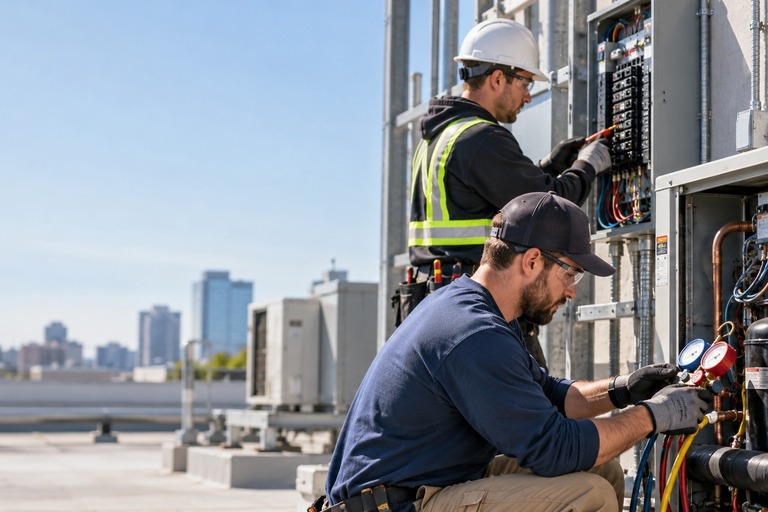
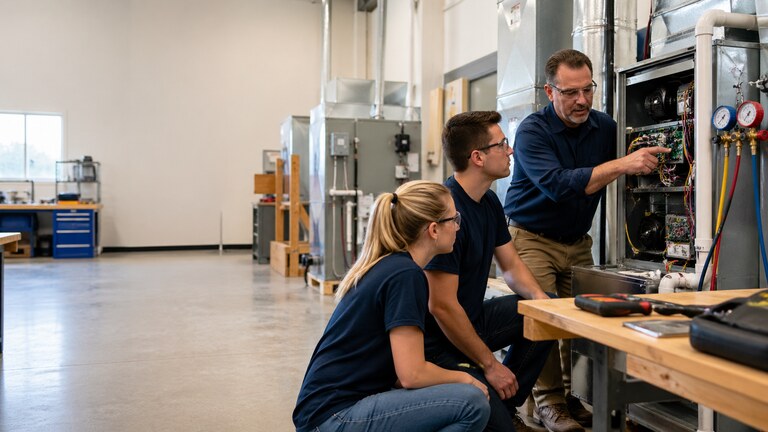
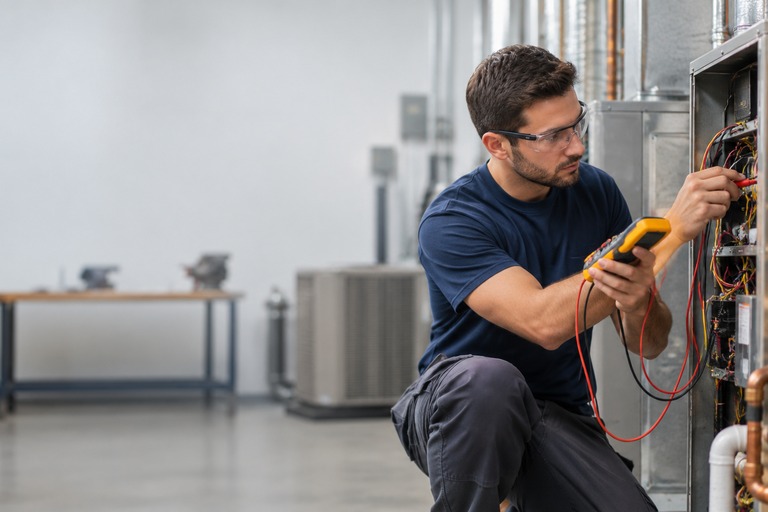
Header artwork is AI-generated for illustration; it does not depict a particular school or training program.
What makes HVAC difficult?
HVAC combines several disciplines that are often taught separately: heat transfer, refrigeration, electricity, air movement, mechanical assembly, and troubleshooting. You may understand a topic in a classroom yet need another round of practice when you're standing in front of a real system.
Electrical circuits & controls
You'll distinguish control circuits from equipment power, read wiring diagrams, and learn why a single open switch can stop an entire system. This is where methodical thinking beats guessing.
Preparation: basic circuits, series versus parallel, Ohm's law.Refrigeration & heat transfer
Refrigerant changes pressure and physical state as it travels through the system. You learn why the evaporator absorbs heat and the condenser releases it, then connect that theory to measurements.
Preparation: temperature, pressure, evaporation, condensation.Airflow & measurement
Duct dimensions, temperature differences, fan behavior, and restricted airflow all matter. The tricky part is choosing the appropriate measurement before deciding what it means.
Preparation: fractions, ratios, area, units.Troubleshooting under uncertainty
Two problems can cause the same symptom. Good technicians verify the symptom, work through likely causes, and avoid swapping parts just because the parts exist.
Preparation: read instructions, trace causes and effects.Hands-on precision
Measurements, fittings, tools, wiring connections, and safe service procedures demand care. A perfectly memorized definition won't make a crooked installation straight.
Preparation: careful measuring, following steps, asking questions.The physical work
Expect some combination of ladders, cramped spaces, lifting, outdoor temperatures, awkward working positions, customer interaction, and variable schedules. Work settings differ by specialty.
Preparation: understand actual job duties before enrolling.According to the U.S. Bureau of Labor Statistics, technicians may work in tight spaces and extreme temperatures, and typically need extended on-the-job training to become competent. Learning HVAC is not the same thing as mastering it on day one.
How much math do you need for HVAC school?
Most beginning HVAC study uses arithmetic, fractions, decimal measurements, ratios, unit conversions, and introductory algebra. More advanced work can involve formulas for electrical power, airflow, heat load, and refrigeration conditions. Programs may also require a general-education math course. You usually learn the specialized formulas during training.
You can see the actual curriculum differences below: Harper College requires Applied Math for Technical Careers for its residential HVAC certificate, while Truckee Meadows Community College recommends Math for Technicians in its associate-degree plan.
Current from voltage and resistance
A practice circuit uses 24 V across a 6 Ω resistor. Using Ohm's law:
I = V ÷ R = 24 ÷ 6 = 4 amps
The challenge isn't calculus. It's knowing which quantities belong in the equation.
Cooling capacity
One refrigeration ton equals 12,000 BTU/hour. For a system rated at 30,000 BTU/hour:
30,000 ÷ 12,000 = 2.5 tons
Here, a “ton” is a cooling-capacity unit, not the unit's actual weight.
Temperature difference
A classroom scenario has return air at 78°F and supply air at 60°F.
78 − 60 = 18°F difference
This does not diagnose a real system by itself: humidity, airflow, and equipment conditions matter.
What to review first: fractions, multiplying and dividing decimals, proportions, converting feet to inches, and solving a one-step equation. Being willing to show your work is more useful than pretending you've memorized every formula.
Free HVAC beginner skills test
Start with 12 untimed questions across practical math, electrical reasoning, heat transfer, and safety. Then try the optional 24-question practice set if you'd like more detail. No login, email, scores sent to schools, or artificial “pass/fail” judgments.
See what you know before you study
You are not expected to know all the technical vocabulary. This measures familiarity with beginner topics, not your future ability to learn them.
Safety: This quiz is educational only. Never service energized equipment, open refrigerant circuits, or work on combustion equipment without appropriate professional training and supervision.
Answers stay in this browser session; they're not used as an admissions score.
Important: This is an original educational self-check, not a validated psychometric assessment, official union test, EPA exam, admissions requirement, or authorization to perform HVAC work. Some questions describe professional situations purely for conceptual learning.
Not sure how you did? Here's a practical study plan
Getting unfamiliar questions wrong doesn't mean you're bad at the trade. It often means you're seeing the trade for the first time. Use your answers to decide which foundation to practice next.
Math & measurement
- Fractions, decimals, measurement units
- Ratios and one-step equations
- Temperature differences and area
Electrical reasoning
- What opens or closes a circuit
- Series versus parallel paths
- How low-voltage controls operate equipment
Heat & airflow
- Evaporation, condensation, heat transfer
- Basic refrigeration-cycle components
- How airflow affects performance
Safety & process
- Energy control and hazard recognition
- When to stop and ask a qualified instructor
- Systematic diagnosis rather than guessing
Want a broader mechanical reasoning practice set? Use our mechanical aptitude test. Studying refrigerant certification later on? Our EPA Section 608 practice test covers a different, credential-specific purpose.
What real HVAC programs actually teach
Rather than declaring that every HVAC school is easy or hard, here are examples from published U.S. college requirements checked October 21, 2026. They're a snapshot of coursework, not a ranking. Admission and placement details should always be confirmed with the program directly.
| Program | Coursework and length | Why it matters for beginners |
|---|---|---|
| Harper College (Illinois) | 19-credit residential HVAC certificate. Includes Applied Math for Technical Careers, Introductory Electronics, Heating and Cooling Controls, and Refrigeration Fundamentals. | Math and electrical concepts are explicitly part of the training, not assumed to be fully mastered beforehand. |
| Truckee Meadows CC (Nevada) | 60-credit Air Conditioning Technology AAS; includes Electrical and Controls, Schematic Reading, Refrigeration Servicing, and a math general-education requirement (Math for Technicians is recommended). | Associate-degree students combine trade work with general-education requirements. |
| Hawkeye CC (Iowa) | One-year heating and air conditioning diploma with applied electricity, a math course, heating, refrigeration, hands-on practice, and internship opportunities. | Technical learning is spread over multiple semesters and reinforced by practical work. |
| Collin College (Texas) | Offers HVAC certificates and an associate degree. Lists basic math skills, regular equipment-handling, lifting capacity, and working in heat or cold among its required abilities. | Some programs state physical and scheduling expectations unusually clearly: read those before signing up. |
We deliberately do not extrapolate completion rates, lab-hour percentages, universal entrance-test scores, or graduate salaries from these descriptions. Published requirements can change by term and program.
Is trade school harder than an HVAC apprenticeship?
They're difficult in different ways. A school-based program concentrates learning into classes and supervised labs. An apprenticeship combines paid work with technical instruction, so you're learning while contributing on real jobs. The amount of classroom instruction, the entry process, and the timeline vary by sponsor.
Short certificate or diploma
Typical focus: tool use, refrigeration basics, electricity, safe practices, guided labs.
Watch for: actual contact hours, lab equipment, all-in cost, and whether any hands-on requirement is arranged.
Duration varies from short programs to a year or more, depending on the curriculum.
Community college associate degree
Typical focus: broader technical coursework plus general-education requirements.
Watch for: required math or science, credit transfer, and internship availability.
Many full-time plans run about two academic years; confirm the particular program.
Registered apprenticeship
Typical focus: paid field experience, structured technical instruction, increasingly independent work.
Watch for: sponsor-specific entry exams, work eligibility, scheduling, and wage progression.
Programs often span multiple years and vary by employer and occupation.
Hawkeye, for example, describes both a one-year diploma and a four-level HVAC apprenticeship pathway. The U.S. Department of Labor likewise explains that registered apprenticeships blend paid experience, instruction, and mentorship.
For a breakdown of program durations, see how long HVAC training takes. For tuition, equipment, and out-of-pocket costs, see our HVAC school cost guide.
School, EPA certification, and licensing are different hurdles
School admission
A school or apprenticeship sponsor sets its own entry and placement process. Ask for the actual current requirements, not an online seller's description of a supposed national exam.
EPA Section 608
For covered refrigerant work, federal rules require certification through an EPA-approved testing organization. Universal certification covers multiple equipment categories; an open-book Core exam does not qualify for Universal. EPA explains the requirements.
State and local rules
Technician registration, contractor licensing, and permit rules depend on location and work performed. Completing school or earning an EPA card doesn't automatically give someone authority to operate a contracting business everywhere.
Safety note: This article is not a service manual. Hazardous voltage, stored capacitor energy, fuel gas, combustion products, pressurized refrigerants, and moving equipment require qualified supervision and appropriate procedures. OSHA's hazardous-energy control standard explains why equipment isolation and verification matter.
Is the learning curve worth it?
Only you can weigh the work itself against the time and cost of training. For context, the BLS reports a $61,010 median annual wage in May 2025 for heating, air conditioning, and refrigeration mechanics and installers (SOC 49-9021). The lowest-paid 10% made less than $40,050, while the highest-paid 10% made more than $95,210. Employment is projected to grow 11% from 2025 to 2035, with about 40,600 openings annually on average over that decade.
Those are occupation-wide numbers. They are not starting-salary promises, and wage percentiles are not interchangeable with years of experience. Local employers, shifts, specialization, credentials, and work conditions can make a big difference. Source: BLS Occupational Outlook Handbook (May 2025 wages; 2025–2035 projections).
Interested in your longer-term options? Compare HVAC career specialties, or read HVAC vs. electrician if the electrical side of the work interests you more.
Eight questions to ask an HVAC school before paying
- What math do I need to start? Ask about placement scores, prerequisites, and tutoring, not just a vague claim that math is “easy.”
- Exactly what hands-on training will I get? Request scheduled shop/lab hours, equipment types, and whether simulations replace or supplement physical equipment.
- What does the total price include? Get tuition, fees, tools, uniforms, PPE, exam fees, books, and potential transportation costs in writing.
- How is safety taught and evaluated? Ask what instructors do before students work with energized circuits, refrigerants, combustion equipment, or ladders.
- Will I prepare for and take the correct EPA Section 608 exam? Ask whether testing is included, who administers it, and what type of credential the program prepares you for.
- What precisely is accredited? Distinguish institutional accreditation from optional program-specific recognition. Ask for the name of the accreditor and verify it yourself.
- What are the actual completion and employment outcomes? Ask for the cohort, reporting period, methodology, and whether a quoted wage refers to graduates or the entire occupation.
- What happens after completion? Ask about apprenticeships, employer relationships, credit transfer, job-search support, and the credentials needed in your state.
Look at HVAC programs with a better checklist
You now know what skills you'll be learning and which questions to put to admissions. Compare programs and costs before committing.
Frequently asked questions
Do I have to be good at math to learn HVAC?
No, but you do have to use math. Fractions, measurements, ratios, and basic algebra show up often. Schools can teach technical formulas, although some programs have placement or general-education math requirements.
Do I need physics before HVAC school?
Not every program requires a prior physics course. All serious HVAC training involves physical concepts like pressure, heat, electricity, and phase changes. Check the particular program's admission and course requirements rather than assuming one national rule.
Is there an official national HVAC school entrance exam?
No single national HVAC entrance exam applies to every school or apprenticeship. Some sponsors use their own mathematics or aptitude screens; others have different admission or placement procedures. This free self-check is not an official exam.
Can I learn HVAC entirely online?
You can study theory online, but equipment installation, electrical safety, refrigerant handling, and physical diagnostics require properly supervised hands-on experience. Ask an online provider exactly how labs and any required in-person work are delivered.
How long before a beginner becomes competent?
Foundational school programs can last months to two years depending on the credential, but independent field competency typically requires substantial additional supervised experience. Training routes and licensing rules vary by location.
What if I struggle with the quiz?
That's useful feedback, not a verdict. The quiz includes concepts most beginners have never been taught. Read each explanation, review the domains that were unfamiliar, and try again after studying.
Do I need EPA Section 608 certification to enroll?
There is no universal federal rule requiring Section 608 certification before joining an HVAC school. The credential matters for covered refrigerant service activities; some programs teach and test for it as part of training. Check the provider's requirements and the current EPA rules.
Sources and verification notes
Primary sources checked October 21, 2026. Training catalogs and school processes can change; confirm directly before enrolling.
- Bureau of Labor Statistics: HVAC mechanics and installers — May 2025 wages and 2025–2035 outlook.
- EPA: Section 608 technician certification requirements — federal credential scope and exam provisions.
- OSHA: control of hazardous energy (29 CFR 1910.147) — energy-isolation principles.
- Harper College: Residential HVAC certificate — 19-credit program and math/electrical courses.
- Truckee Meadows CC: Air Conditioning Technology AAS — 60-unit plan and technical courses.
- Hawkeye Community College: HVAC diploma — one-year coursework and hands-on learning.
- Collin College: HVAC department — program options and published physical/basic skill expectations.
- Apprenticeship.gov: What is apprenticeship? — paid training structure and variability.
Method: original educational quiz questions were independently checked for mathematics and unambiguous answers. Quiz performance is not a validated measure of occupational aptitude. It isn't a substitute for a school assessment or supervised practical evaluation.