How to Become a Fiber Optic Technician: Training, Pay, and Certifications



The short answer: You can enter fiber optic work through a paid helper or trainee position, a hands-on certificate course, a community-college workforce program, or a telecommunications apprenticeship. A four-year degree is not normally the entry requirement for installation work. But there is no single job called "fiber optic technician" with one training path or one salary. Your first decision is whether you want to install outside cable, specialize in splicing and testing, connect broadband customers, or build the fiber infrastructure inside commercial buildings and data centers.
A short course may teach you to prepare, splice, and test fiber. It does not automatically make you an independent, job-ready splicer. The sensible route is to match the credential, practical training, and first employer to the work you actually want.
What does a fiber optic technician do?
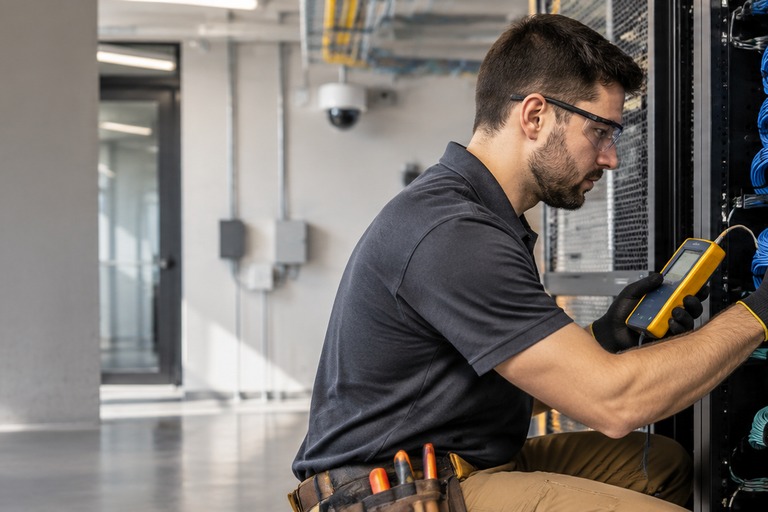
Fiber carries data as light through very thin strands of glass. The jobs around that technology include placing cable, preparing its ends, joining fibers, measuring optical signal loss, testing faults, activating customer connections, and documenting networks. In the field, "fiber tech" can mean a person pulling cable through a roadside conduit or a person inspecting tiny connectors in a data center. Those two people may share tools, but not necessarily a workday.
Five types of fiber optic work
| Career lane | Typical tasks | What the work feels like | Search these entry-level titles |
|---|---|---|---|
| Outside plant (OSP) | Place aerial or buried cable, pull or blow cable into ducts, work around poles, conduit, and access points | Physically demanding; outdoor sites, traffic, weather, sometimes travel and heights | OSP helper, telecom groundhand, fiber construction technician |
| Fusion splicing and testing | Strip, clean, cleave, splice, organize closures, verify loss, troubleshoot with an optical time-domain reflectometer (OTDR) | Precision work in a van, trailer, facility, or field enclosure; occasional night maintenance windows | Splicing trainee, junior fiber splicer, fiber test technician |
| Fiber to the home (FTTH) | Route customer drops, install connectors and optical network terminals (ONTs), activate service, troubleshoot | Local service calls, ladders/attics, customer communication and schedules | Broadband installation technician, FTTH installer, field technician I |
| Commercial premises cabling | Install building backbones, fiber terminations, racks, pathways, and patch panels; test and label links | Commercial construction and finished buildings; close coordination with IT and other trades | Structured cabling helper, low-voltage installer, fiber cabling technician |
| Data center fiber | Clean and inspect connectors, patch high-density links, manage fiber trays, test polarity and loss, record changes | Controlled facilities, strict procedures, sometimes rotating shifts | Data center cabling technician, fiber infrastructure technician |
This is a practical job-title map, not an official five-part BLS classification. Employer titles overlap. Some outside-plant technicians splice too; some splicers work indoors; some broadband field workers handle more customer equipment than fiber itself. Read the actual job description before paying for a specialization.
If you like the broader mix of cabling, cameras, security, and AV rather than fiber alone, our low-voltage technician career guide covers those other paths.
How to become a fiber optic technician: six steps
1. Choose the environment before the certification
Ask yourself whether you want heavy outdoor construction, precise splicing, customer service, or indoor facilities work. That choice affects your schedule, physical demands, licensing questions, and the value of each credential. A course focused on indoor connector cleaning may not prepare you to work on an aerial outside-plant crew.
2. Read local hiring requirements before enrolling
Search a realistic commute or travel radius for OSP helper, fiber splicer trainee, broadband installation technician, telecommunications line installer, and structured cabling technician. Save five to ten current postings and make a list of recurring requirements. Look for whether the employer supplies tools and a vehicle, expects a driver's license, requires travel, prefers a particular certification, or offers paid training.
Be alert to job ads that use "fiber" while primarily describing coaxial cable, sales, customer Wi-Fi setup, or unrelated network administration. Those may be legitimate jobs, just not the work you meant to pursue.
3. Build the fundamentals and practice safely
Learn the difference between single-mode and multimode fiber, connectors and splices, an optical power meter and an OTDR, optical loss budgets, cable handling limits, and fiber identification. Hands-on practice should include preparing cable, stripping and cleaving glass, making a splice or termination, inspecting and cleaning connectors, testing loss, and recording results. Knowing the terms is not the same as performing the task consistently.
You can start theory with FOA's free Fiber U resources. Do not try to learn live-network procedures without qualified supervision and site-appropriate safety controls.
4. Pick an entry route that matches your circumstances
Paid trainee or helper: Often the lowest-tuition path. You learn on employer equipment and get a firsthand look at the working conditions. Ask whether training goes beyond pulling cable to splicing, testing, documentation, and troubleshooting.
Short hands-on course: A compact route to foundational skills and possibly an industry exam. It can help you get an interview, but a two- or three-day course is not a substitute for months of field repetition and supervised judgment.
Community-college or workforce program: More time for structured labs, safety content, and employer contacts. Some programs are funded locally, but eligibility and funding can change.
Apprenticeship: A paid work-and-instruction pathway where available. Search Apprenticeship.gov and state apprenticeship offices for telecommunications, communications installer, line installer, or related programs. Do not assume one national apprenticeship length or curriculum.
5. Choose the relevant credential, not the biggest collection of acronyms
For broad fiber fundamentals, look at FOA's CFOT. For splicing, FOA's CFOS/S is a more focused next step. For broadband deployment, consider FBA's OpTIC Path. For commercial premises cabling, investigate BICSI and FOA's CPCT. Credentials can help demonstrate skills, but they do not replace an employer's training or whatever licensing rules apply to the work.
6. Apply with evidence of your hands-on abilities
List the systems you practiced, test instruments you used, and tasks you can demonstrate. Keep sample test records or a sanitized practice portfolio that does not expose customer network information. Be specific: "prepared and fusion-spliced single-mode fiber in a supervised lab; documented insertion loss" says more than "passionate about telecommunications." For a first job, safe habits, reliability, and willingness to learn may matter at least as much as the certificate on your wall.
Training length and cost: what real programs offer
Training programs differ enough that any single "fiber optic school cost" or "time to qualify" number would be misleading. These published examples, checked November 11, 2026, illustrate the range; they are not rankings or endorsements.
| Published program | Format and length | Advertised cost | Important limitation |
|---|---|---|---|
| Indiana University of Pennsylvania, CFOT Level I | Three days; course includes hands-on instruction and FOA exam | $1,195 | Site says to check for future training dates; verify availability before planning travel |
| University of Arkansas Hope-Texarkana, fiber optic technician | Nine-week evening program with classroom and hands-on learning; FBA OpTIC Path preparation | Free for eligible participants through regional funding | Location, eligibility, admission requirements, and grant funding are specific to this program |
| Ashland University, OpTIC Path | Ten-week hybrid program with in-person labs | $1,800 | Confirm the current cohort and exactly which credential is included |
A short course can end with a certification exam in days. Training for an entry-level job may take weeks or months, and working unsupervised on complex closures, restoration, or advanced testing can take considerably longer. Ask the provider how much actual time you spend performing each skill, not merely how many calendar days the course occupies.
Financial help may come from employer sponsorship, workforce grants, an American Job Center, or eligible apprenticeship arrangements. Do not assume a short, noncredit course qualifies for Pell Grants or other federal student aid. Verify with the program and the funding authority.
Fiber optic technician salary and job outlook
The U.S. Bureau of Labor Statistics does not publish one detailed occupation labeled simply "fiber optic technician." For a fair comparison, use the occupations that best match what the worker actually does, and label the source and period.
| Related BLS occupation (SOC) | May 2025 U.S. median annual pay | 10th–90th percentile pay | 2025–35 projected change | Average annual openings |
|---|---|---|---|---|
| Telecommunications line installers and repairers (49-9052) | $74,330 | $45,310–$103,680 | −3.4% | 8,000 |
| Telecommunications equipment installers and repairers, except line installers (49-2022) | $63,890 | $44,240–$96,730 | −3.3% | 11,300 |
| Radio, cellular, and tower equipment installers and repairers (49-2021) | $63,520 | $44,460–$103,990 | +1.2% | 1,000 |
Data note: Pay and percentile figures are from the May 2025 BLS Occupational Employment and Wage Statistics (OEWS), released May 15, 2026. Outlook, annual openings, and typical training classifications are from the separate 2025–2035 BLS Employment Projections, released August 27, 2026. The occupations include workers who do not specialize in fiber. Percentiles describe the occupation's earnings distribution; they are not entry-level or years-of-experience salary bands.
The most useful broad national wage benchmarks are often line installers for aerial and underground telecom cable work and equipment installers for much indoor/central-office/customer-equipment work. Job titles and SOC placement are not assigned solely by whether the worker has stepped across a property line. Some jobs blend tasks and may be classified differently by the employer and statistical survey.
Why do job sites report different fiber salaries?
Salary aggregators often use narrower job titles and changing samples of postings or submitted compensation, while BLS uses standardized occupation categories and employer-reported wage data. Both can be informative, but they answer different questions. A scraped "fiber splicer salary" should not be compared directly with the BLS median for every telecommunications line installer as though the samples were identical.
The BLS median for the broader telecommunications-technician group is $66,200, but the group mixes different occupations. BLS also shows differing wages by employer industry, an important reason to compare local job offers and not just national averages. Look for the base rate, guaranteed hours, overtime rules, travel reimbursement, per diem, benefits, on-call expectations, and whether the worker supplies a vehicle or tools.
Are fiber optic technicians in demand?
There is real fiber construction and upgrading work, including broadband networks and data infrastructure. But new infrastructure investment does not equal permanent national headcount growth. The BLS projects declining employment in the two largest relevant telecom occupations through 2035 while still forecasting 19,300 combined annual openings from replacements and occupational movement. Those openings are across both entire occupations, not 19,300 fiber-only vacancies. The separately reported broader telecom technician group has about 20,300 annual openings.
The federal BEAD broadband program can affect where projects are built, but awards, permitted construction, and hiring happen at different times and are not exclusively fiber projects. NTIA's 2025–26 program restructuring explicitly emphasizes technology-neutral deployment. Compare active projects and employers in your region rather than assuming national funding guarantees local jobs.
Employee vs. 1099 splicing contractor: compare net results
Advertisements for subcontracted splicing or customer-drop work may quote a payment per splice, drop, or project. That is gross business revenue, not the equivalent of an employee's hourly wage. A contractor may pay for a fusion splicer, cleaver, OTDR rental or purchase, calibration, van, fuel, insurance, rework, unpaid travel, accounting, and taxes. Contracts can also include chargebacks, acceptance conditions, and delays between completed work and payment.
Before comparing offers, write down the same terms for each one:
| Factor | W-2 employee offer | Independent contracting offer |
|---|---|---|
| Pay | Hourly/salary, with overtime terms | Price per accepted unit or project; variable volume |
| Equipment and vehicle | Confirm what employer supplies | Confirm what you buy, rent, insure, maintain, and replace |
| Non-billable time | Timekeeping rules apply | Quoting, setup, travel, invoicing, disputes, rework |
| Benefits and protections | Check employer-sponsored coverage and paid leave | Typically self-funded; legal rules depend on actual classification |
| Risk | Hours and contract stability still matter | Customer concentration, weather delays, equipment failure, slow payment |
A useful comparison: Collected contract revenue − business expenses = profit before income tax. Divide that by all hours actually worked, including travel, setup, paperwork, and rework, to estimate an effective pretax hourly return. Then separately account for taxes and the value of benefits. Do not compare a piece-rate gross to an employee's net paycheck, and do not assume that calling someone a "1099" settles their legal worker classification.
If you do not already own specialized equipment or have a reliable customer base, paid employment usually exposes you to less startup risk while learning. It is not always the highest-paying option, but it is easier to evaluate.
Fiber certifications: FOA vs. FBA vs. BICSI
A course-completion certificate, industry certification, and government-issued trade or contractor license are different things. The first documents finishing training. The second recognizes knowledge and skills under a credentialing body's rules. The third grants legal authority where the jurisdiction requires it. A certification from FOA, FBA, or BICSI does not itself grant a state contractor license.
| Credential | Best fit | Verified starting point | What to check |
|---|---|---|---|
| FOA CFOT (Certified Fiber Optic Technician) | Broad fiber fundamentals, installation and testing | No prerequisite for the approved-school training route; FOA also offers a documented-experience/direct-certification route | Approved-school status, hands-on assessment, exam inclusion |
| FOA CFOS/S, CFOS/T, CFOS/O | Splicing, testing, or outside-plant specialization | FOA lists CFOT as prerequisite for these skills-based specialties | Whether the actual tasks match your intended role |
| FBA OpTIC Path | Broadband installation and operations | FBA describes a program of up to 144 instructional hours, with a three-year credential available upon successful completion | Local delivery length, practical labs, employer connections, final assessment |
| BICSI Installer 2, Optical Fiber (INSTF) | Structured cabling and commercial fiber | Eligibility depends on current training/experience/education routes; written and hands-on examinations | Current handbook, fees, documented prerequisites, renewal rules |
| FOA CPCT | Broader premises cabling including copper and fiber | Foundational premises-cabling credential | Whether a fiber-specific CFOT or premises CPCT better fits the job |
Renewal reality check: FOA currently describes a three-year renewal cycle at $100, covering all the holder's FOA certifications under its policy. BICSI and FBA have their own renewal requirements; verify the latest handbook before budgeting. No credential guarantees placement or wages.
Start with the awarding bodies themselves: FOA CFOT, FOA specialty credentials, FBA OpTIC Path, and BICSI INSTF.
Do fiber optic technicians need a license?
There is no single nationwide fiber optic technician license. State and local rules depend on the work, system type, business structure, supervision, and sometimes whether the job is telecommunications-only or involves regulated electrical or alarm systems. Do not assume all employees are exempt or all independent contractors need the same license.
- California: CSLB's C-7 Low Voltage Systems Contractor classification covers certain communications and low-voltage systems. CSLB generally requires a contractor license if the work requires a permit, involves additional workers, or totals $1,000 or more in labor and materials, subject to legal exceptions. Older guides still cite a $500 threshold; that is outdated. See CSLB licensing rules and the C-7 definition.
- Washington: The Department of Labor & Industries licenses telecommunications contracting businesses and requires an assigned telecommunications administrator. L&I explicitly says there are no certification requirements for individuals performing telecommunications installations under that framework. Other electrical scopes have different rules.
- Elsewhere: Look up the state contractor/electrical board, county or city authority having jurisdiction, and the precise category of work. A low-voltage security installation, a public-right-of-way fiber build, and in-building premises wiring may not follow identical rules.
Before taking an independent contract, determine who holds the required licenses and permits, who supervises the regulated work, and whose insurance covers the work. Certification is not a substitute for this check.
What is the job really like? Tools, safety, and physical demands
The precise work can be satisfying but repetitive. Splicing means stripping, cleaning, cleaving, aligning fibers, sealing closures, checking readings, and documenting results. Outside-plant construction adds heavy cable handling, traffic control, ladders or aerial equipment, weather, underground work, and travel. FTTH installation adds customer visits and appointment pressure. Data-center work adds dense cabling, rigorous labeling, and scheduled maintenance windows.
Fiber-specific safety matters: Microscopic glass scraps can puncture skin or enter eyes. FOA recommends side-shield safety glasses, a dark work surface, immediate collection of fiber scraps in a marked container, and no food or drinks where glass is handled. Fiber networks may transmit invisible infrared light: never look into a fiber or connector you have not verified is inactive with an appropriate power meter. Optical hazards depend on wavelength, power, and inspection method; claims that every operating fiber will cause retinal burns are inaccurate. Follow manufacturer procedures and site rules.
Work on poles, beside traffic, during excavation, or inside vaults introduces additional hazards and regulatory controls. Not every underground utility space is automatically a permit-required confined space, but some are; the employer must assess the actual hazards and applicable OSHA rules. See FOA's installation safety guidance and its 2025 installation standard.
What if you have color-vision differences?
Color-coded fibers and buffer tubes are standard in the trade, so accurate identification can be an essential task on some jobs. That does not justify declaring everyone with color-vision differences unfit for the entire field. Requirements vary by employer and training provider. For example, one public college's posted admission criteria include a color-vision restriction; that is a specific program policy, not a national occupational law. Ask about the actual tasks, assessment method, labeling/testing tools, and possible accommodations before ruling out the career. Don't assume that recognizing a printed color chart is equivalent to correctly identifying fibers in every lighting condition.
Which fiber route fits you?
| If you most want… | Investigate first | Verify before committing |
|---|---|---|
| Physical construction and outdoor work | OSP helper or telecom line crew | Travel, weather, heights, vehicle requirements, employer safety training |
| Precision problem solving and instrumentation | Splicer trainee or fiber test technician | Supervised bench time, OTDR skills, after-hours maintenance, equipment ownership |
| Local field work and customer interaction | FTTH or broadband installation | Paid training, route expectations, weekend calls, supplied van and tools |
| Structured indoor systems and repeatable processes | Commercial cabling or data-center fiber | Shift schedule, BICSI relevance, jobsite requirements, labeling/testing standards |
Think twice if you cannot tolerate any hands-on work, repetitive detailed procedures, or the travel/physical demands of the particular role you are considering. But don't mistake one harsh OSP schedule for the whole field. If you want to configure routers and switches more than install physical cabling, explore computer networking programs. If rack, power, cooling, and site operations appeal as much as cabling, compare the data center technician career.
Seven questions to ask before paying for fiber training
- Which credential is awarded? Is it a provider's certificate of completion or an independently issued certification? Is the provider listed by the issuer?
- What must I demonstrate? Will I physically strip, cleave, splice, terminate, inspect, clean, and test fiber, or mostly watch demonstrations?
- How much equipment access do I get? Ask about splicer, OTDR, power-meter, and inspection-tool access per student; avoid assuming a course is hands-on because its brochure says so.
- What's the all-in cost? Tuition, exam, re-test, materials, PPE, travel, and any tools you must buy afterward.
- Which entry roles does the curriculum target? OSP construction, splicing, FTTH, and data-center cabling need different depth.
- What local employer evidence backs the placement pitch? Ask for actual employer partners and verifiable outcomes, not a guaranteed six-figure story.
- Will the training satisfy local requirements? Check state/licensing scope, apprenticeship credit, safety credentials, and available workforce funding directly.
Frequently asked questions
How long does it take to become a fiber optic technician?
Foundational hands-on courses can take a few days, while other workforce programs run for weeks. Getting hired and becoming proficient at field troubleshooting are separate milestones. Time to work independently varies with the job's complexity, employer standards, and supervised experience.
Do I need a college degree to work in fiber optics?
Not usually for entry-level installation work. BLS lists a high school diploma or equivalent as the typical entry education for telecommunications line installers and a postsecondary nondegree award for telecom equipment installers. Employers can set different requirements, and advanced design or engineering roles are separate paths.
Is CFOT required for fiber optic jobs?
Not nationally. CFOT is a voluntary FOA credential with a defined knowledge-and-skills standard, and some employers value or require it. Check local job postings and the actual tasks before buying a course just for the abbreviation.
What is the difference between a fiber optic splicer and an installer?
An installer may place cable, prepare pathways, mount hardware, and connect equipment. A splicer focuses on joining glass fibers and verifying link performance, but on real crews the tasks can overlap. Splicing can require more specialized tools and testing practice.
Can someone with color blindness work in fiber optics?
Possibly, depending on the job's essential tasks and how accurate identification is assessed. Some programs and employers have specific color-vision requirements. Ask about task-specific testing and accommodations rather than treating one program's requirement as a nationwide exclusion.
Does a negative BLS outlook mean fiber work is disappearing?
No. The national outlook measures net employment in broader telecom occupations, not the local hiring situation for individual fiber specialties. Replacement openings and active projects can coexist with modest long-term employment declines.
Can fiber optics training be done entirely online?
You can study theory online, but hands-on installation competency requires physical practice with cable, connectors, test instruments, splicing, and safety procedures. Verify the lab component and skill assessment before enrolling.
Sources and data checked November 11, 2026
- BLS, Occupational Outlook Handbook: Telecommunications Technicians (overview, work environments, May 2025 median wages, 2025–35 outlook).
- BLS, May 2025 national Occupational Employment and Wage Statistics and BLS occupational employment projections (wage distributions and separate occupation-level outlook/openings).
- Fiber Optic Association: CFOT, specialist certifications, renewal policy, and installation safety.
- Fiber Broadband Association: OpTIC Path.
- BICSI: Installer 2, Optical Fiber.
- California Contractors State License Board and Washington Department of Labor & Industries (licensing examples).
- NTIA: BEAD program status and reforms.
- Current provider examples: IUP, UAHT, Ashland University. Prices and cohorts may change.
Want to compare related technical training?
If you're considering fiber, look at the actual courses and employers in your area before deciding between electronics, cabling, broadband installation, and networking. Electronics technician programs and electrical/electronics technician training can give you adjacent options to evaluate. Compare hands-on labs, credential outcomes, cost, and local job requirements before submitting an application.