How to Become a Data Center Technician: Pay, Training & Career Paths


The short answer: Data center technicians maintain the physical equipment behind cloud services, websites, and AI systems. Some replace failed servers and drives. Others install fiber connections for customers. A different group keeps the cooling, backup power, and electrical infrastructure working.
You may not need a bachelor's degree. But you usually need relevant hands-on skills. An AWS server technician posting reviewed on November 7, 2026 required a high school diploma or equivalent and at least one year of related IT or hardware troubleshooting experience. The strongest training choice depends on which type of technician job you actually want. Source: AWS job posting.
Start here: Decide whether you prefer servers, customer connectivity, or power and cooling. Everything from certifications to pay comparisons changes after that decision.
What Does a Data Center Technician Actually Do?
The name sounds like one occupation. It is not. Employers use overlapping titles for different jobs, and the U.S. Bureau of Labor Statistics (BLS) has no dedicated occupation called data center technician. A server hardware repair technician, a colocation customer-operations technician, and a critical-environment technician can all work in the same building without doing remotely the same job.
For comparing training options, we divide on-site technical operations into three practical tracks. This is our editorial framework, not a formal BLS or employer classification.
| Track | What you work on | Useful starting skills | Job titles to search |
|---|---|---|---|
| A. Server and hardware operations | Failed drives, memory, server chassis, rack installations, operating-system diagnostics, hardware incidents | PC repair, server components, Linux basics, ticket documentation, network fundamentals | Data Center Technician; Hardware Operations Technician; Server Technician |
| B. Customer operations and remote hands | Fiber and copper cross-connects, customer cage equipment, rack work, physical requests from remote engineers | Structured cabling, fiber handling, labels and documentation, test equipment, customer communication | IBX Technician; Customer Operations Technician; Remote Hands Technician |
| C. Critical facilities operations | Cooling plants, pumps, generators, UPS systems, switchgear, building automation and power monitoring | Commercial HVAC, electrical systems, industrial maintenance, reading diagrams, safety procedures | Critical Environment Technician; Critical Facilities Technician; Engineering Operations Technician |
Track A: Fix the computers
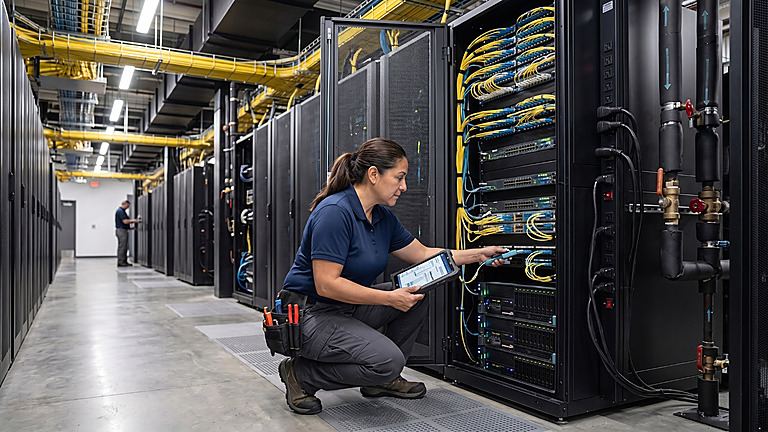
Hardware technicians work on the machines themselves. A monitoring alert or ticket identifies a failing server; the technician follows the approved process, locates the rack, diagnoses the fault, replaces or reseats the approved component, and documents what happened. Work can involve a drive, a memory module, a network interface, or a complete server swap. It can also include receiving equipment, deploying racks, and confirming a system is back in service.
AWS explicitly lists rack installation, hardware break/fix, network troubleshooting, and operating-system repair in its data center technician duties. Google describes similar server and Linux cluster work in its Global Server Operations roles. This is the right direction for someone who enjoys computer repair but wants to work on enterprise equipment rather than consumer laptops. AWS role details; Google role details.
Best early move: Build a solid foundation in computer hardware and networking, then add Linux and enterprise-server troubleshooting.
Track B: Keep physical connections and customer requests moving
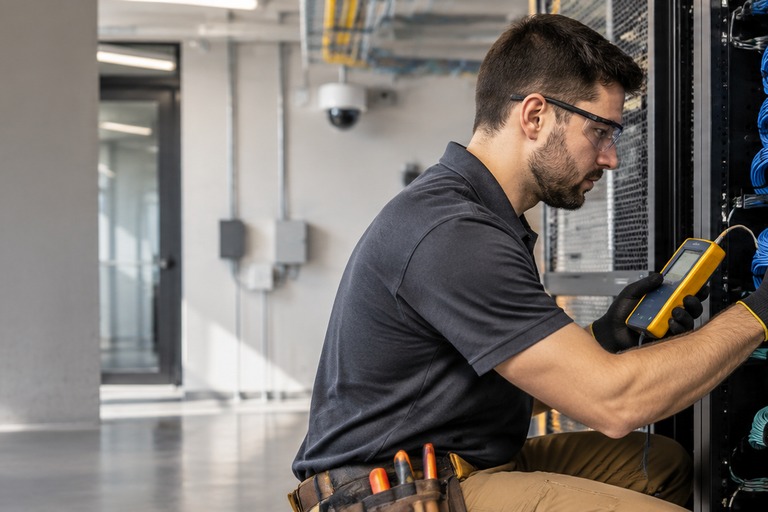
In a colocation facility, multiple customers rent space, power, and connectivity. Their own engineers may be hundreds of miles away. A remote-hands technician provides the on-site eyes and hands: checking indicator lights, installing equipment, running approved reboots, patching fiber, testing circuits, and handling a documented work order.
Equinix's 2027 Data Center Technician Trainee listing describes rack-and-stack installs, cross-connect work, ticket queues, network testing, and customer support. That is a different skill mix from repairing server motherboards or operating industrial chillers. Equinix role details.
Best early move: Look at structured cabling and fiber careers. Practice clean documentation and physical link testing, not just software networking theory.
Track C: Keep the building alive
The servers are useless without continuous power, environmental control, and safe maintenance. Critical facilities staff inspect and monitor electrical distribution, backup generators, UPS equipment, chillers, air handlers, pumps, and building-management systems. Many jobs mix inspections and alarms with supervised maintenance, vendor coordination, and emergency procedures.
Microsoft explicitly separates its Datacenter Technician role from its Critical Environment Technician, which focuses on heating, ventilation, water, air conditioning, and electrical supply. AWS Engineering Operations listings likewise emphasize mechanical and electrical systems. Microsoft job families; AWS facilities posting.
Best early move: Build from electrical training, commercial HVAC, or industrial maintenance. A generic computer-support certificate alone will not teach you to troubleshoot chillers or power-distribution equipment.
What Is the Work Environment Really Like?
Most of the work is on-site. Server halls are loud, security-controlled spaces. Hardware and cabling technicians may lift or move equipment, spend long periods walking or standing, work around ladders and cables, and follow strict handling and access procedures. Facility technicians may move between equipment rooms, generator yards, and mechanical spaces, where hazardous energy and other industrial risks require training and authorization.
This is not automatically a Monday-to-Friday desk job. The AWS Umatilla technician posting requires days, nights, weekends, holidays, and shifts longer than eight hours. Google's Reno server operations role explicitly lists swing, night, and weekend work. One AWS facilities posting describes alternating three- and four-day weeks with 12-hour shifts; those details are specific to that posting, not universal to every data center. AWS facilities shift example.
Questions to ask about the schedule
- Are shifts fixed, rotating, or on-call? How far ahead is the schedule published?
- Are nights, weekends, holidays, travel, or emergency callouts mandatory?
- What are the actual lifting, standing, hearing-protection, and confined-space requirements?
- How are overtime, differentials, standby pay, and bonus eligibility documented?
- What duties may a trainee perform independently, and what requires supervision or authorization?
The practical tradeoff: you can work on important technology without spending all day at a keyboard, but you must be comfortable with procedures, documentation, physical work, and sometimes inconvenient hours.
Job Posting Decoder: Which Track Is the Employer Hiring For?
Company names and job titles alone do not settle the question. Look at the verbs and equipment in the actual requirements. For instance, replace DIMMs points toward hardware, fiber cross-connects toward customer operations, and UPS/switchgear/chillers toward facilities.
Paste a job description to spot the likely track
This local keyword aid does not send your text anywhere. It is an orientation tool, not an employer classification or a hiring assessment. Mixed postings need human interpretation.
Eight clues that can save you from applying to the wrong job
| Phrase in the listing | It probably means |
|---|---|
| Break/fix; DIMM; BMC/iDRAC | Server components, out-of-band management, and hardware repair (A) |
| Rack and stack; asset tags | Physical installs and tracking, potentially A or B |
| Cross-connect; remote hands; customer cage | Customer connectivity and site services (B) |
| OTDR; fiber certification | Optical link testing, often B or a specialized cabling contractor |
| BMS; EPMS | Building-management or electrical-power monitoring (C) |
| UPS; ATS; switchgear | Power continuity, electrical distribution, and controls (C) |
| CRAH/CRAC; chiller; CDU | Air or liquid cooling infrastructure (C, sometimes hybrid teams) |
| MOP; SOP; EOP | Formal procedures, used across tracks; read which equipment they govern |
Employer-title reality check: AWS generally distinguishes Data Center Technician from Engineering Operations Technician. Microsoft distinguishes Datacenter Technician from Critical Environment Technician. A colocation operator may call its customer-facing team IBX or Customer Operations. Search several titles, then read responsibilities before choosing training.
Data Center Technician Salary: What Does the Job Actually Pay?
There is no defensible single national median salary for every person called a data center technician. The title combines jobs that BLS classifies separately, and national salary-aggregator pages may mix early-career hardware staff with higher-paid facilities and network specialists.
The cleaner approach is to use specific employer-published ranges for realistic job examples and separate BLS occupations as broader labor-market comparisons. Neither is a guarantee of an offer.
Pay ranges in actual U.S. employer postings
| Employer, role and location | Track | Published base pay or range | Important context |
|---|---|---|---|
| AWS, Data Center Technician, Umatilla, OR | A | $27.98–$48.99/hour | High school diploma plus at least one year of related IT/server experience; region-specific GovCloud citizenship rule |
| Google, Global Server Operations, Reno, NV | A | $105,000–$145,000/year | Also lists 15% target bonus, equity, and benefits; actual offers vary by candidate |
| AWS, Engineering Operations Technician, Columbus, OH | C | $37.00–$65.00/hour | Facilities maintenance; job posting specifies 2+ years of relevant electrical/mechanical/HVAC experience |
| Equinix, SkillBridge trainee conversion, Dallas, TX | A/B | $53,600–$80,400/year target on conversion | Not a general public opening; limited to eligible transitioning military personnel and military spouses |
Employer listings checked November 7, 2026. All amounts are U.S. dollars. Ranges are posted pay bands, not the average wage of people holding the title. Google bonus/equity and Equinix conversion pay are separate from the guaranteed base wage of an ordinary open-market hire. Jobs and pay bands can change or close.
Related BLS wages and outlook: useful comparisons, not a technician pay average
BLS's May 2025 national Occupational Employment and Wage Statistics provide the following all-industry annual medians. The separate 2025–2035 Employment Projections give occupational growth. We verified both datasets on November 7, 2026 using their active releases. These are related occupations across all industries, not wages specifically at data centers.
| Related occupation and SOC | 2025 median annual pay | 2025–35 employment change | Why it may be relevant |
|---|---|---|---|
| Computer user support specialists (15-1232) | $61,860 | −3.5% | One possible comparison for support-oriented hardware duties; not all server repair work belongs here |
| Computer network support specialists (15-1231) | $76,220 | +1.2% | Network troubleshooting and connectivity roles |
| Telecommunications equipment installers and repairers, except line installers (49-2022) | $63,890 | −3.3% | Some physical connectivity and telecom equipment duties |
| Electrical and electronics repairers, commercial and industrial equipment (49-2094) | $74,090 | +0.3% | Industrial electronics and selected facilities repair work |
| Electricians (47-2111) | $63,190 | +9.2% | Electrical installation/maintenance trade pathway |
| HVAC mechanics and installers (49-9021) | $61,010 | +10.9% | Mechanical cooling trade pathway |
Method: May 2025 BLS OEWS national median annual wage (not mean); 2025–2035 BLS Employment Projections, occupation line items. The different programs have different employment denominators and must not be combined. SOC mappings are illustrative, not a classification of any particular job posting. Wages are for all U.S. industries and levels; projections are for whole occupations, not solely data centers.
These two sets of evidence answer different questions. An AWS facility technician earning a particular posted rate does not mean the national HVAC median should be multiplied by a data-center premium. Nor should a Google pay band be marketed as a likely starting salary. If an offer matters to you, compare base pay, shift premium, overtime rules, bonus eligibility, equity, benefits, location, and actual required experience separately.
Watch out for the overtime math trap
Some online guides turn a 12-hour rotating shift into guaranteed weekly overtime or assume every overnight worker receives a fixed premium. Neither follows from the schedule alone. Pay depends on actual hours, workweek boundaries, overtime law, employer policy, and your offer. The one specific AWS facilities posting cited above describes a 13% night differential, but that is not a universal data center standard.
How to Become a Data Center Technician
Forget the mythical universal certificate that opens every data center. The shortest credible route begins with your existing experience and the equipment you want to work on.
If you have no related technical experience
Start with hardware fundamentals, basic networking, and documented practice. A community college IT support or electronics course, an employer training program, a junior PC-repair role, or carefully chosen hands-on self-study may help you build a base. Look for realistic entry listings, including equipment staging and junior operations positions, rather than assuming a famous hyperscaler will hire you directly with no evidence of troubleshooting ability.
First proof to build: A short portfolio showing that you can identify components, log a fault, replace parts safely, test the result, and explain the steps clearly.
If you already do PC repair or help desk work
Target Track A. Your diagnostic method, documentation, and ticketing experience transfer, but enterprise infrastructure adds redundant power, server firmware, out-of-band management, Linux, and physical network-fabric constraints. Study those gaps and look for listings asking for server hardware break/fix or hardware operations.
First proof to build: A small lab with Linux system diagnostics and an incident runbook. Do not claim familiarity with production clusters from watching videos.
If you come from structured cabling or telecom
Target Track B and search remote hands, customer operations, and cross-connect technician. Your clean terminations, cable management, testing, safety habits, and troubleshooting are relevant. Add data-center security procedures, change management, and customer ticketing.
First proof to build: A labeled patching diagram, a sample optical-loss test record if you have training and equipment, and a clear service ticket showing how you checked a connection.
If you are an electrician, HVAC tech, or plant mechanic
Target Track C. These employers need people who understand electrical and mechanical systems, not just someone who can swap a server drive. Add mission-critical redundancy concepts, UPS and generator systems, monitoring alarms, operating procedures, and site-specific safety knowledge. Check the scope of your trade authorization for the tasks you would actually perform.
First proof to build: An anonymized example of documenting a maintenance inspection, interpreting an approved one-line diagram, or following a safe escalation procedure. Never share confidential site diagrams or attempt high-energy demonstrations for a portfolio.
If you have military technical experience
Translate equipment maintenance, communications, electrical, mechanical, or procedural experience into civilian task language. Microsoft partners with vocational schools through its Datacenter Academy, including practical lab and mentoring components at participating institutions. Eligible transitioning service members and certain military spouses can also investigate the Equinix military-transition trainee listing. Eligibility, location, openings, and conversion terms must be confirmed; these are not general public apprenticeships or guaranteed jobs.
Degree versus experience: the distinction that matters
Without a bachelor's degree does not mean without technical skills. Microsoft says many datacenter operations roles can start with a high school diploma and potentially one or two years of experience; AWS's reviewed hardware posting specifically requires a year. Google lists related practical experience as minimum qualifications and a bachelor's degree or equivalent practical experience as preferred for its Reno role. Compare the minimum and preferred sections of each listing.
What Training or Certification Do You Need?
There is no single nationally required data center technician certificate. An IT hardware credential may be useful for Track A, a network or cabling credential for Track B, and an electrical or HVAC trade route for Track C. Buying every certification you see is an expensive way to avoid choosing a direction.
| Credential or training | Where it fits best | What it does and does not do |
|---|---|---|
| CompTIA A+ (current Core 1/2 series 220-1201 and 220-1202) | A, some B | Helps establish computer hardware, troubleshooting, operating systems and support basics; it is not a facilities trade license. |
| CompTIA Network+ (N10-009) | A/B | Useful for IP and physical networking fundamentals; employers still need practical cable, rack and ticketing skills. |
| CompTIA Server+ | A | Closer to enterprise server operations and storage; check current exam details and whether your local employers mention it. |
| Linux+ or documented Linux lab skills | A | Shows troubleshooting experience with server operating systems; does not substitute for safely handling hardware. |
| Cisco CCNA (200-301) | A/B, especially network-oriented paths | Strong network foundation; Cisco lists a $300 U.S. exam price (checked November 7, 2026). More than some entry hardware jobs require. |
| Electrical apprenticeship, commercial HVAC, industrial maintenance | C | Directly develops the power and mechanical skills needed in facilities work; occupation and jurisdiction determine training/licensing. |
| EPA Section 608 | C, when refrigerant work is in scope | Required for covered refrigerant-handling work. Type I/II/III or Universal depends on equipment; it is not mandatory for every facilities job. |
| NFPA 70E electrical-safety training | C and other electrical-hazard roles | Supports task-specific safe-work practices. A course completion certificate does not automatically make someone a legally licensed or qualified person. |
Check the exam version before buying prep materials. The dossier originally supplied older A+ and Linux+ series codes; do not buy a course for a retired exam just because it appears in an older salary guide. Issuer pricing and exam versions can change. Verify them directly before paying.
Do you need an electrical or low-voltage license?
It depends on the task and jurisdiction, not the building's label. Replacing an approved hot-swappable server module is not the same legal activity as wiring a new branch circuit. But do not assume all communications cabling is unregulated. For example, Washington requires a telecommunications contractor license for businesses doing covered telecom work, even though the state says there is no individual certification requirement for people performing telecommunications installations under that category. Washington L&I rules.
Likewise, EPA Section 608 applies to specified work with refrigerant-containing equipment. And OSHA's hazardous-energy control standard concerns trained, authorized employees carrying out lockout/tagout, not a universal rule that everyone must hold a state journeyman electrician's license to apply a lock. Employers, trade boards, local codes, and equipment-specific safe-work procedures all matter.
What should a paid training program include?
- Track fit: Which specific job titles and employers is the curriculum built around?
- Real practice: Can you handle servers, network gear, fiber test equipment, or approved facilities trainers, rather than only watch videos?
- Credential transparency: Which exam codes, vouchers, extra fees, and renewal requirements are included?
- Employer evidence: Which nearby companies hire graduates? Can the school document results without claiming guaranteed placement?
- Cost and timing: What is the total cost, how much time is in labs, and are credits transferable if your plans change?
- Safety and licensing: Does the program qualify you for the actual permitted work in your state, or only provide introductory knowledge?
To compare pathways, start with computer networking programs, electronics technician training, electrician training, or HVAC technician training. Choose based on the employer duties you want, not the course with the most fashionable name.
Explore training that matches your track
Hardware and connectivity: compare networking, electronics, and computer technician programs. Facilities: compare electrical, HVAC, and industrial maintenance routes. Ask programs exactly how much supervised practical training you receive.
Build Proof of Skill Before You Apply
For an aspiring hardware technician, a modest home lab can be more persuasive than a resume packed with unexplained acronyms. You do not need to buy a server rack. A spare desktop or used computer with a safe power supply and basic Linux installation can teach you meaningful troubleshooting habits. Your total cost depends on the equipment you already have; there is no credible universal "complete lab under $150" promise.
- Inventory the machine: Record CPU, memory, storage, network adapter, firmware version, and serial numbers in a fictional inventory spreadsheet. Remove identifying information before publishing.
- Install a server-oriented operating system: Use a Linux virtual machine or a clean test system. Practice legitimate command-line checks such as
lsblk,lscpu,ip -br link, andjournalctl -p err -b. Note what the output actually means. - Simulate one fault safely: Disconnect a test network cable or disable a virtual network adapter. Record symptoms, checks, cause, fix, and verification. Do not modify live equipment or bypass safety controls.
- Document a mock ticket: Include a timestamp, impact, device, diagnostic steps, action taken, resolution, and anything needing escalation. Good operational writing is a skill.
- Share a concise portfolio: Post a sanitized runbook and sample incident report. Use accurate language: "home lab" and "simulated incident," not "managed a production data center."
Safety boundary: Do not open power supplies or UPS units, experiment with energized switchgear, handle refrigerants, or perform live electrical work for practice. Critical facilities competency comes from authorized supervised training, not a DIY stunt.
Track B candidates can document approved cabling practice and testing. Track C candidates can focus on professional coursework, supervised maintenance records, and learning how to read operational diagrams without sharing proprietary facility details.
Is Data Center Technician a Good Career in 2026 and Beyond?
The sector is growing, but a big industry growth rate is not a personal job guarantee. BLS projects 25.1% employment growth from 2025 to 2035 for computing infrastructure providers, data processing, web hosting, and related services (industry code 518000), from 479,900 to 600,300 jobs, an increase of 120,400. Those numbers cover the entire industry, including corporate, technical, software, sales, support, and other occupations. They do not predict 25.1% growth for data center technicians. BLS industry projections, 2025–2035.
There are credible signs of hiring friction. The 2026 Uptime Institute survey reports that more than half of its responding operators had difficulty finding qualified candidates, with retention also challenging. Its sample includes more than 800 data center owners and operators worldwide. That indicates a skills bottleneck among surveyed operators, not proof that applicants in every city can find work quickly.
AI adds another complication. More demanding computing hardware increases the importance of reliable power and cooling, and some facilities use higher-density systems and liquid cooling. Meanwhile, automation can change how many people are needed for monitoring, provisioning, and diagnostics. Both can be true. It would be irresponsible to call these jobs "AI-proof" or promise that hiring will rise one-for-one with new server capacity. Uptime Institute 2026 survey summary.
Who is most likely to enjoy the job?
Potentially a strong fit if you like systematic troubleshooting, physical systems, careful procedures, and learning from equipment failures; can handle controlled access and repetitive documentation; and are willing to compare job schedules honestly.
Think twice if you want fully remote work, dislike industrial environments or rotating shifts, expect coding to be the primary task, or need a predictable 9-to-5 schedule without checking each employer's requirements. Someone who loves building PCs may enjoy Track A but absolutely hate overnight on-call work. Someone who enjoys HVAC can find Track C satisfying without ever wanting to learn Linux.
For a wider look at other data-center-supporting careers, see our data center jobs without a degree guide. If you're more interested in controls and facility monitoring than servers, also consider building automation technician and instrumentation and controls technician paths.
Data Center Technician FAQs
Do you need a degree to become a data center technician?
Not always. Some server operations jobs accept a high school diploma or equivalent with related troubleshooting experience. Others prefer an associate degree or a bachelor's degree. Critical facilities roles may be better served by trade training or an apprenticeship. Check the actual posting.
Can you become a data center technician with no experience?
Possibly through a training pipeline or junior role, but major employer postings often ask for prior hands-on experience. Build a small portfolio, look for apprenticeship or college partnerships, and be open to adjacent IT support, cabling, or maintenance work that develops relevant skills.
How much does a data center technician make?
There is no official single BLS median for this title. For example, a November 2026 AWS hardware posting in Umatilla, Oregon lists $27.98–$48.99 per hour, while a Google Reno server operations posting lists $105,000–$145,000 annual base. Those are individual job bands, not national entry-level averages.
Which certification is best for a data center technician?
Choose by track. CompTIA A+ and server/Linux skills can help for hardware operations; Network+ or relevant cabling skills suit connectivity work. Electrical, HVAC, and industrial maintenance training fit facilities work. No single certificate is right for all three.
Do data center technicians need a license?
There is no single nationwide data center technician license. Some electrical, telecommunications, and refrigerant-related work is regulated. What you need depends on your state, employer, tasks, and whether you work as an employee or contractor.
Can a data center technician work remotely?
Most hardware, cabling, and facilities technician roles require on-site physical work. Some monitoring, network engineering, or support roles may offer remote options, but those can be different jobs with different qualifications.
Sources and Methodology
Reviewed November 7, 2026. Pay data and regulatory guidance may change. We independently checked primary employer listings and official labor/credential sources rather than treating a research dossier or salary aggregator as proof.
- BLS, Occupational Employment and Wage Statistics: May 2025 national estimates (national annual wage medians).
- BLS, Employment Projections: 2025–2035 occupational projections (occupation change and typical entry requirements).
- BLS, 2025–2035 industry employment projections (25.1% for industry 518000, not a technician rate).
- AWS, Data Center Technician, Umatilla, Oregon (hardware duties, minimum qualifications, posted pay).
- Google, Global Server Operations, Reno, Nevada (hardware responsibilities, pay and nonstandard shifts).
- AWS, Engineering Operations Technician (facilities duties, qualifications and pay).
- Microsoft, Datacenter Operations Careers (hardware, asset, and critical-environment roles).
- Equinix, 2027 SkillBridge Data Center Technician Trainee (remote hands work, program eligibility and target conversion pay).
- Microsoft Datacenter Academy (partner schools and experience opportunities).
- EPA, Section 608 Technician Certification Requirements (task-specific refrigerant rule).
- NFPA, Understanding NFPA 70E (task-specific electrical safety qualifications).
- Washington Department of Labor and Industries, Telecommunications Contractor (illustrative state distinction).
- Uptime Institute, 2026 Global Data Center Survey (surveyed hiring challenges).
Compare programs with a specific job in mind
Start with two or three real job descriptions. Identify the equipment they mention, the experience they require, and whether they accept your current background. Then compare training options against those requirements.