
Diesel Mechanic vs. Auto Mechanic: Which Career Fits You?



If you like engines, diagnostics, tools, and fixing things that move, automotive and diesel technology can both make sense. The better choice depends on what you want to work on, how you want to train, what work environment you can tolerate, and whether you value higher national median pay or a larger pool of annual openings.
Quick Answer
Diesel service technicians currently have the higher national median wage: $61,770 versus $50,620 for automotive service technicians. Automotive is the much larger occupation, however, with about 66,200 projected annual openings from 2025 to 2035 versus 24,400 for diesel.
Choose automotive if passenger vehicles, EVs, ADAS, and the larger national job market appeal to you. Choose diesel if trucks, diesel engines, commercial systems, and the higher current median wage appeal to you and you are comfortable with a rougher work-context profile.
What This Comparison Covers
- Quick comparison table
- What the work actually looks like
- Pay comparison
- Job outlook and openings
- Physical demands and work environment
- Training routes
- Auto vs. Diesel Career Fit Comparator
- ASE, EPA Section 609, and CDL rules
- EVs and future technology
- Switching between auto and diesel
- Who should choose each path
- FAQ
- Sources
Auto vs. Diesel Mechanic at a Glance
| Factor | Automotive Service Technician | Diesel Service Technician |
|---|---|---|
| BLS occupation | Automotive service technicians and mechanics (49-3023) | Bus and truck mechanics and diesel engine specialists (49-3031) |
| Typical equipment | Cars and light trucks | Buses, trucks, and diesel engines |
| May 2025 median pay | $50,620 | $61,770 |
| Lowest 10% | Less than $34,660 | Less than $44,530 |
| Highest 10% | More than $81,790 | More than $88,740 |
| 2025 employment, BLS projections base | 825,800 | 316,000 |
| Projected growth, 2025-35 | 5.0% | 3.6% (4% rounded in OOH) |
| Average annual openings, 2025-35 | 66,200 | 24,400 |
| Typical entry education, BLS | Postsecondary nondegree award | High school diploma or equivalent |
| Typical OJT, BLS | Short-term | Long-term |
| ASE master series | A1-A8 | T2-T8 |
| CDL | Usually not relevant to the occupation | May be needed if the job requires operating a qualifying CMV on public roads |
Data note: Wage figures use BLS May 2025 OEWS. Employment and outlook figures use the separate BLS 2025-35 Employment Projections program. Do not treat the 10th and 90th percentiles as automatic beginner and senior pay levels.
Scope Note: "Diesel" Is Not One Giant Occupation
The labor statistics in this guide use BLS occupation 49-3031, Bus and Truck Mechanics and Diesel Engine Specialists. BLS separately classifies workers who primarily service farm equipment and mobile heavy equipment. So these pay and outlook figures should not be pasted onto every excavator, mining, or agricultural mechanic job just because the engine burns diesel.
What the Work Actually Looks Like
Automotive service
Automotive technicians inspect, maintain, diagnose, and repair cars and light trucks. Current BLS and O*NET duties include computerized diagnostics, electrical troubleshooting, brakes, suspension, steering, engines, transmissions, sensors, heating and air conditioning, and routine maintenance.
Modern automotive work also includes hybrid and electric vehicles, advanced safety systems, regenerative braking, battery-performance issues, and electronic controls. This is not a career where electronics are optional background noise.
Diesel service
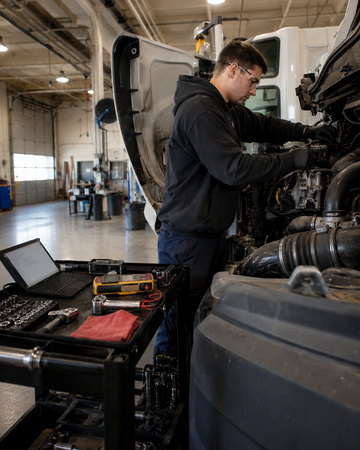
Diesel technicians inspect, repair, and overhaul buses, trucks, and diesel engines. Common work includes engines, brake systems, steering, transmissions, electrical equipment, emissions systems, preventive maintenance, and computer-based diagnosis.
BLS also notes that diesel technicians sometimes repair vehicles on roadsides or at worksites. If large commercial vehicles and diesel systems are more interesting to you than passenger cars, this is the more direct lane.
Neither trade is low-tech. In both, strong electrical diagnosis and disciplined troubleshooting are becoming more valuable, not less.
Which Pays More: Diesel or Auto Mechanics?
Nationally, diesel has the edge. BLS May 2025 wage data puts the median at $61,770 for diesel service technicians versus $50,620 for automotive service technicians, an $11,150 difference at the median.
The gap also appears toward both ends of the national distribution. The lowest 10% earned less than $44,530 in diesel and less than $34,660 in automotive. The highest 10% earned more than $88,740 in diesel and more than $81,790 in automotive.
Employer type matters. BLS reports a May 2025 median of $59,920 for automotive technicians at automobile dealers and $49,630 in automotive mechanical and electrical repair and maintenance. For diesel technicians, BLS reports $71,460 in local government, $63,070 in wholesale trade, $60,330 in automotive repair and maintenance, $60,220 in rental and leasing services, and $59,820 in truck transportation.
Do not assume one pay system
BLS says some automotive shops pay hourly while others pay based on the amount of work completed. The evidence does not support pretending every auto technician is flat-rate or every diesel technician is straight hourly.
Before accepting a job, ask exactly how technicians are paid, how diagnostic time is handled, whether overtime is available, who absorbs downtime, and whether bonuses or production incentives apply.
Which Career Has More Job Openings?
Automotive is the larger occupation. The BLS 2025-35 projections matrix lists about 825,800 automotive technicians in 2025, compared with 316,000 bus and truck mechanics and diesel engine specialists.
BLS projects automotive employment to grow 5.0% by 2035, adding about 40,900 jobs. Diesel is projected to grow 3.6%, adding about 11,400 jobs. The Occupational Outlook Handbook rounds the diesel rate to 4%.
Projected annual openings are about 66,200 for automotive and 24,400 for diesel. Most are expected to come from workers changing occupations or leaving the labor force, not just from brand-new positions.
This is the cleanest reason not to reduce the decision to salary: diesel currently pays more at the national median, while automotive offers a much larger national pool of projected openings.
Which Is Harder on Your Body?
Both jobs are physical, dirty, noisy, and capable of making your joints file a formal complaint.
BLS says automotive technicians commonly work with greasy parts and tools, spend much of the day standing, sometimes lift heavy objects, and may work in uncomfortable positions. Diesel technicians also lift heavy parts and tools, handle greasy or dirty equipment, and work in uncomfortable positions.
Current O*NET work-context data shows a stronger cramped-position signal in diesel work: 67% of diesel respondents reported working in cramped or awkward positions every day, compared with 19% of automotive respondents. O*NET also shows more frequent all-weather exposure in the diesel occupation.
That does not mean every diesel shop is brutal or every automotive bay is comfortable. Lifts, dollies, cranes, shop layout, climate control, specialty, and employer safety practices can change the experience dramatically.
If physical sustainability matters to you, tour real shops before enrolling and watch how technicians actually move through a job.
Training: Which Path Takes Longer?
There is no single national training length for either occupation. BLS assigns different typical entry paths:
- Automotive: postsecondary nondegree award plus short-term on-the-job training
- Diesel: high school diploma or equivalent plus long-term on-the-job training
That does not mean automotive school is legally required or diesel school is unnecessary. BLS says some automotive technicians enter with a high school diploma and learn on the job, while others complete certificate or associate-degree programs. Some complete apprenticeships. For diesel, employers may prefer candidates who completed postsecondary diesel training even though high school plus extensive OJT is the typical BLS assignment.
Compare hands-on shop hours, electrical diagnosis, current scan tools, employer partnerships, internships or co-ops, tool costs, and verified graduate outcomes before you spend money.
Auto vs. Diesel Career Fit Comparator
This tool is a transparent decision aid, not an aptitude test. Answer all seven questions and it will show which way your preferences lean and why. The scoring uses current BLS, O*NET, ASE, EPA, and CDL distinctions; it does not predict job success.
ASE, EPA Section 609, and CDL Rules
ASE uses different auto and truck series
ASE Master Automobile Technician status requires current certification in A1 through A8. A9, Light Vehicle Diesel Engines, is available but is not required for Master Automobile status.
ASE Master Medium-Heavy Truck Technician status requires T2 through T8. T1, Gasoline Engines, is available but not required for Master Medium-Heavy Truck status.
Passing the test is only part of professional ASE certification
Current ASE rules require relevant hands-on work experience. For A1-A9 and T1-T8, the standard repair-technician requirement is two years full-time or the part-time equivalent. Formal training can substitute for some of that requirement, and an ASE-accredited OEM-sponsored co-op can provide up to two years of substitution credit. ASE evaluates the documentation.
ASE certifications generally require recertification every five years. For more detail, see the TSNET ASE certification guide.
EPA Section 609
Anyone who repairs or services a motor-vehicle air-conditioning system for payment or barter must be certified under Section 609 of the Clean Air Act through an EPA-approved program. That can matter in both auto and truck service when the work includes MVAC systems.
Does a diesel mechanic need a CDL?
Not simply because the job title says diesel mechanic. Federal CDL rules apply when a worker operates a qualifying commercial motor vehicle. BLS notes that diesel technicians might need a CDL to test-drive buses and large trucks.
One terminology fix: federal CDL rules use an air-brake restriction when a driver has not qualified on air-brake equipment. "Air-brake endorsement" is common shop talk, but it is not the federal endorsement structure.
What EVs and New Technology Mean for Both Careers
Neither occupation is becoming a museum exhibit.
For automotive technicians, BLS says demand should be supported by the growing number of vehicles in use, owners keeping vehicles longer, and increased need for calibration and repair of advanced safety systems. BLS also describes EV-focused work involving battery performance, regenerative braking, electric motors, electronic controls, and high-voltage safety.
For diesel technicians, BLS expects freight movement and aging diesel vehicles to support demand while also noting that some courier and delivery fleets are adopting electric trucks that require less maintenance and repair.
The practical hedge in either field is to get unusually good at electrical diagnosis, networks, sensors, and systematic troubleshooting instead of betting your career on one powertrain staying dominant forever.
Can You Switch From Auto to Diesel Later?
Yes, but not with zero friction. The two occupations share electrical testing, mechanical diagnosis, scan-tool use, engine systems, braking concepts, fluids, service information, safety, and troubleshooting discipline.
An automotive technician moving into medium/heavy truck work may need additional training in diesel engines, air brakes, preventive-maintenance inspection, heavy drivetrains, and truck-specific systems. A diesel technician moving into passenger automotive work may need more exposure to gasoline engine performance, light-vehicle electronics, EV systems, ADAS calibration, and compact passenger-vehicle packaging.
ASE credentials also do not automatically convert from one Master series to another. A1-A8 and T2-T8 are separate certification paths.
Which One Should You Choose?
Choose automotive if...
- You prefer cars, SUVs, and light trucks.
- You want the larger national pool of projected annual openings.
- EVs, ADAS, drivability, and passenger-vehicle electronics interest you.
- You like dealership or independent-repair environments.
- You are comfortable with customer-service expectations and employer-specific pay systems.
Choose diesel if...
- You prefer buses, commercial trucks, and diesel engines.
- You put more weight on the higher current national median wage.
- You are comfortable with frequent awkward positions, noise, grime, and some outdoor work.
- You like commercial, fleet, government, wholesale, or rental environments.
- You are willing to pursue the appropriate CDL if a specific job requires CMV road testing.
Think twice about either path if...
- You hate physical work, greasy parts, noise, or awkward positions.
- You want a job that never requires ongoing technical learning.
- You are choosing only because of one national salary number.
- You have no interest in electrical or computerized diagnostics.
Final verdict: diesel wins the current national median-pay comparison. Automotive wins on occupation size and projected annual openings. The better career is the one whose equipment, environment, training path, and technology mix you actually want to deal with every day.
Questions to Ask Before Choosing a School
- How much of the program is hands-on shop work?
- Which current scan tools and service-information systems do students use?
- How deeply does the curriculum cover electrical and electronic diagnosis?
- Which ASE Education Foundation standards, if any, does the program meet?
- Are there paid co-ops, internships, apprenticeships, or manufacturer partnerships?
- What tools must students buy separately?
- How does the school verify graduate employment and starting-pay claims?
- Can you tour the lab while students are actually working?
Questions to Ask a Future Employer
- Is pay hourly, salary, based on completed work, or a hybrid incentive system?
- How is diagnostic time paid?
- Who pays for scan tools, software subscriptions, specialty tools, and updates?
- What tools are technicians expected to own?
- What shifts and weekend requirements are normal?
- Does the employer pay for ASE testing or manufacturer training?
- For truck work, is a CDL required, preferred, or unnecessary for this position?
- What does progression from trainee to higher-level diagnostic work actually look like here?
Frequently Asked Questions
Do diesel mechanics make more than auto mechanics?
At the national median, yes. BLS May 2025 data reports $61,770 for diesel service technicians and $50,620 for automotive service technicians. Individual earnings vary substantially by employer, location, specialty, overtime, certification, and compensation system.
Is diesel mechanic school harder than auto mechanic school?
There is no national difficulty standard. Programs emphasize different systems and vary in length and intensity. Diesel programs may focus more on heavy-truck systems and diesel engines; automotive programs may spend more time on light-vehicle systems, gasoline performance, EV technology, electronics, and ADAS.
Do you need a degree to become a mechanic?
No four-year degree is required for either occupation. BLS lists a postsecondary nondegree award as the typical entry education for automotive service technicians and a high school diploma or equivalent for diesel service technicians, although employer preferences vary.
Do diesel mechanics need a CDL?
Not automatically. CDL rules apply when a worker operates a qualifying commercial motor vehicle. BLS says diesel technicians might need one to test-drive buses and large trucks.
Which has a better future, automotive or diesel?
Both are projected to grow through 2035. BLS projects 5.0% growth for automotive service technicians and 3.6% for bus and truck mechanics and diesel engine specialists. Technology is changing both fields, so strong electrical and diagnostic skills are useful in either path.
Sources and Data Notes
Data and rules checked September 4, 2026. Current BLS pay uses May 2025 OEWS; outlook uses the 2025-35 Employment Projections release. O*NET pages are current in 2026, with work-context survey data dated separately within O*NET.
- U.S. Bureau of Labor Statistics: Automotive Service Technicians and Mechanics
- U.S. Bureau of Labor Statistics: Diesel Service Technicians and Mechanics
- U.S. Bureau of Labor Statistics: Occupational Projections and Worker Characteristics, 2025-35
- O*NET OnLine: Automotive Service Technicians and Mechanics
- O*NET OnLine: Bus and Truck Mechanics and Diesel Engine Specialists
- ASE: Automobile & Light Truck Certification Tests
- ASE: Medium-Heavy Truck Certification Tests
- ASE: Work Experience Requirements
- U.S. EPA: Section 609 Technician Training and Certification
- Federal CDL rules: 49 CFR Part 383
Related TSNET Guides



Explore Training Options
Once you know which side fits better, compare programs by hands-on training, employer connections, tool costs, and the exact systems you will learn.