
Carpentry Schools and Training Programs
By Chris Gaglardi
| Last Updated
Carpentry schools can help you build the practical skills used to construct, install, and repair structures made from wood and other building materials. Training may cover blueprint reading, measuring and layout, framing, finish work, cabinetmaking, construction math, tool safety, and jobsite practices.
But trade school is only one route into carpentry. Many carpenters learn through paid apprenticeships or entry-level helper jobs. This guide compares carpentry trade schools, apprenticeships, short classes, and on-the-job training so you can choose the path that fits your goals instead of treating the first tuition pitch like a table saw revelation.
Carpentry training quick facts
- Common training paths: trade school, certificate or diploma, associate degree, pre-apprenticeship, registered apprenticeship, union apprenticeship, nonunion apprenticeship, or entry-level helper work.
- Typical skills: measuring, layout, blueprint reading, construction math, framing, materials, fasteners, finish carpentry, safe tool use, and building-code awareness.
- Common credentials: school certificates, NCCER credentials where available, OSHA safety training, apprenticeship completion credentials, and optional specialty certifications.
- Career paths: apprentice carpenter, residential carpenter, commercial carpenter, framing carpenter, finish carpenter, cabinetmaker, remodeler, foreman, supervisor, contractor, or construction business owner.
- Reality check: carpentry is active, physical work. Expect heavy materials, sharp tools, dust, noise, weather, deadlines, and jobsite hazards.
On this page
Find Carpentry Schools Near You
Start by looking for carpentry schools, woodworking programs, construction technology programs, or pre-apprenticeship options near your zip code. Then compare each program against the checklist below, especially hands-on training, apprenticeship connections, safety training, and total cost.
Sponsored Listing

Carpentry School vs. Apprenticeship vs. On-the-Job Training
Carpentry has more than one valid entry path. A carpentry trade school can give you a safer, more structured start. A registered apprenticeship lets you earn while you learn. A helper job can get you onto a jobsite quickly, but the training may be less formal. The best choice depends on your local opportunities, finances, confidence with tools, and long-term goals.
| Path | What it includes | Typical length | Best for | Watch-outs |
|---|---|---|---|---|
| Carpentry trade school | Classroom instruction plus hands-on shop practice in tools, safety, plans, layout, framing, finish work, and construction basics. | Often several months to two years, depending on credential and schedule. | Beginners who want structured fundamentals before applying for jobs or apprenticeships. | Tuition varies. A certificate usually does not replace apprenticeship or field experience requirements. |
| Pre-apprenticeship | Short training focused on jobsite readiness, safety, basic tools, math, and apprenticeship preparation. | Often weeks to a few months. | People trying to qualify for a union or employer-sponsored apprenticeship. | Quality and direct-entry agreements vary. Ask whether graduates get priority or credit with local apprenticeship sponsors. |
| Registered apprenticeship | Paid jobsite learning with mentorship, related classroom instruction, wage progression, and an industry-recognized credential. | Often several years; many carpentry apprenticeships run about four years. | People who can enter a sponsored program and want paid, structured training. | Entry can be competitive. Requirements vary by sponsor, state, union, and local labor market. |
| Union apprenticeship | Training through a union-affiliated joint apprenticeship and training committee, often with strong commercial-construction exposure. | Commonly several years. | People interested in large commercial, industrial, infrastructure, or union contractor work. | Intake windows, tests, interviews, travel, dues, and work availability vary by region. |
| Nonunion apprenticeship | Employer or contractor-association sponsored training, sometimes through open-shop apprenticeship programs. | Commonly several years. | People who want paid training outside the union system, often in residential or mixed construction. | Verify that the program is registered and that classroom instruction, wage steps, and mentorship are clearly defined. |
| Entry-level helper job | Paid jobsite work assisting carpenters with material handling, cleanup, measuring, cutting, staging, and basic tasks. | Immediate start; advancement depends on employer and skill growth. | People who want to earn right away and learn by doing. | Training may be informal. Advancement can stall if the employer only needs cheap labor, not a future carpenter. |
| Short classes or continuing education | Introductory shop skills, woodworking, safety, home repair, or specialty classes. | Often a few weeks to a semester. | Hobbyists, homeowners, and beginners testing interest before committing. | May not include career placement, recognized credentials, or enough hands-on hours for employment readiness. |
| Online carpentry classes | Theory topics such as blueprints, estimating, codes, terminology, and safety concepts. | Self-paced or several months. | People who need flexible theory prep before hands-on training. | Online-only training cannot replace supervised tool practice, framing, lifting, layout, or jobsite safety experience. |
The main takeaway: carpentry school can make you more prepared, but the trade still rewards time on tools. Be skeptical of any program that claims it can make you a fully qualified carpenter without substantial hands-on practice, field experience, or a clear path into employment or apprenticeship.
What Carpentry School Teaches
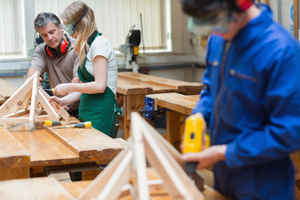 A good carpentry program should teach more than basic tool handling. Look for a mix of classroom concepts, supervised shop work, and realistic projects that build both speed and accuracy.
| Subject | What you learn | Why it matters |
|---|---|---|
| Safety and PPE | Tool safety, fall protection basics, hazard recognition, eye/ear/respiratory protection, boots, and jobsite awareness. | Construction work has real injury risks, and some employers or jobsites require safety training before you start. |
| Construction math | Fractions, decimals, geometry, area, volume, board feet, slopes, rise/run, and material estimates. | Bad math turns lumber into expensive kindling. |
| Blueprint reading | Plans, elevations, sections, details, schedules, symbols, specifications, and scale. | Carpenters need to turn drawings into accurate built work. |
| Measuring and layout | Tape measures, squares, levels, chalk lines, lasers, layout marks, and building squareness. | Layout errors can ruin every step that follows. |
| Materials and fasteners | Lumber, engineered wood, sheet goods, concrete, steel framing, adhesives, screws, nails, anchors, and connectors. | Different materials behave differently and must fit the load, environment, code, and project. |
| Hand and power tools | Safe use of saws, drills, nailers, levels, squares, chisels, clamps, and related tools. | Tool control affects speed, quality, and safety. |
| Floor, wall, and roof framing | Joists, studs, plates, headers, rafters, trusses, sheathing, and structural layout. | Framing creates the skeleton of many buildings. |
| Doors, windows, and building envelope | Rough openings, installation, flashing basics, wrap, insulation, moisture control, and air sealing concepts. | Poor envelope work causes leaks, drafts, rot, and angry clients. |
| Drywall and interior systems | Drywall installation basics, partitions, suspended ceilings, and related commercial systems. | Many carpenters work alongside or directly on interior systems. |
| Finish carpentry and cabinets | Trim, baseboards, casing, doors, cabinets, countertops, miters, reveals, and visible detail work. | Finish work is where sloppy measuring becomes very public. |
| Concrete forms and formwork | Footing forms, wall forms, bracing, reinforcing basics, and concrete placement concepts. | Commercial and infrastructure carpentry often involves concrete form systems. |
| Estimating and communication | Material takeoffs, job planning, records, coordination with other trades, and customer or crew communication. | Advancement requires more than craft skill; it requires planning, communication, and business sense. |
Practicing roof-framing math? Try the free Rafter Calculator to work through pitch, rise/run, common-rafter line length, and overhang with a live diagram.
Carpentry Specialties
Carpentry is not one neat little job title. It is a family of related specialties. Some carpenters work outside framing buildings. Others work indoors on trim, cabinets, stairs, or remodeling details. Some build concrete forms, sets, boats, or high-performance building envelopes.
| Specialty | What they do | Good training focus |
|---|---|---|
| Residential carpenter | Works on homes, renovations, decks, additions, windows, doors, and general building tasks. | Framing, finish work, remodeling, building envelope, estimating. |
| Commercial carpenter | Works on offices, schools, hospitals, stores, multi-family buildings, and large jobsite systems. | Steel framing, concrete forms, drywall systems, ceilings, safety, layout. |
| Framing carpenter | Builds walls, floors, roofs, structural openings, sheathing, and rough structural systems. | Layout, construction math, speed, accuracy, lifting, fall protection. |
| Finish carpenter | Installs visible details such as trim, baseboards, casing, doors, stairs, cabinets, and built-ins. | Precision measuring, miter cuts, joinery, sanding, doors, cabinets. |
| Cabinetmaker or woodworker | Builds cabinets, furniture, built-ins, millwork, and shop-based wood products. | Wood technology, machining, joinery, CAD/CAM, finishing, shop safety. |
| Remodeler | Repairs, rebuilds, adapts, and updates existing homes or commercial spaces. | Diagnostics, demolition, framing, drywall, finish work, codes, client communication. |
| Formwork carpenter | Builds temporary or reusable forms that shape concrete for foundations, walls, columns, bridges, or infrastructure. | Concrete forms, bracing, layout, rigging, commercial safety. |
| Scenic or stage carpenter | Builds temporary sets, platforms, scenery, and structures for film, theatre, events, or exhibits. | Fast build methods, creative problem solving, rigging basics, finish effects. |
| Foreman, supervisor, or contractor | Leads crews, schedules work, estimates jobs, manages safety, coordinates trades, or runs a business. | Leadership, estimating, project management, business, codes, communication. |
How to Choose a Carpentry School
Search results for “best carpentry schools” can get fluffy fast. A better question is: Which program fits the kind of carpenter you want to become? Use this checklist while comparing programs, talking with admissions, touring a shop, or deciding whether to enroll.
- Hands-on training: How much of the program is actual shop or lab work?
- Project quality: What will you build before graduating?
- Core skills: Does the program teach construction math, blueprint reading, measuring, layout, framing, and finish work?
- Safety training: Is OSHA 10-hour construction safety training, shop safety, fall protection awareness, or other safety preparation included?
- Tools and PPE: Are tools, boots, eye protection, hearing protection, hard hats, or materials included, rented, or purchased separately?
- Apprenticeship connections: Does the school have relationships with union programs, contractor associations, builders, remodelers, or local employers?
- Credential value: Are NCCER credentials, school certificates, or other recognized credentials available?
- Instructor experience: Did instructors work as carpenters, foremen, contractors, or builders?
- Program focus: Is it mainly residential, commercial, cabinetmaking, finish carpentry, remodeling, or general construction?
- Total cost: Ask about tuition, fees, books, tools, PPE, transportation, missed work, and exam or certification fees.
- Schedule fit: Are evening, weekend, part-time, or accelerated options available?
- Financial aid: Is the program eligible for federal aid, grants, scholarships, WIOA funding, veteran benefits, or payment plans?
- Placement support: What employers hire graduates, and what does the school actually do to help students find work?
How Long Carpentry Training Takes
Carpentry training can take anywhere from a few weeks for basic classes to several years for a full apprenticeship. Trade school programs vary by credential, school calendar, and whether you attend full time or part time. Associate degree programs are generally longer because they include broader academic or business coursework.
| Option | Common timeline | Main purpose |
|---|---|---|
| Introductory carpentry or woodworking classes | A few weeks to a semester | Basic skills, hobby training, home repair, or testing interest. |
| Certificate or diploma program | Several months to about one year, sometimes longer | Entry-level job or apprenticeship preparation. |
| Associate degree | About two years | Broader preparation, possible transfer credit, and leadership or management foundation. |
| Registered apprenticeship | Often several years | Paid jobsite training plus related classroom instruction and progressive skill development. |
| Entry-level helper work | Immediate start; advancement varies | Get paid quickly and learn jobsite basics under experienced workers. |
How Much Carpentry School Can Cost
Costs vary too much by school, credential, state, residency status, and tool requirements to give one honest number that works everywhere. Public community college or technical school certificates are usually cheaper than private programs, and apprenticeships may be tuition-free or low-cost because employers, unions, or contractor groups sponsor the training.
When comparing programs, ask for the total cost of attendance, not just tuition. Tools, PPE, books, supplies, parking, commuting, lost work time, and certification fees can all matter.
Carpenter Salary and Job Outlook
 According to the U.S. Bureau of Labor Statistics (BLS), the median annual wage for carpenters was $59,310 in May 2024. The lowest 10 percent earned less than $38,760, and the highest 10 percent earned more than $98,370.
BLS projects employment of carpenters to grow 4 percent from 2024 to 2034, about as fast as the average for all occupations, with about 74,100 openings projected each year on average over the decade.
Pay varies a lot
Carpenter pay can change with region, union status, experience, specialty, overtime, weather, seasonality, self-employment, commercial vs. residential work, and local construction demand. Apprentice and helper wages are usually lower than journey-level wages.
| Occupation | May 2024 median pay | Useful comparison |
|---|---|---|
| Carpenters | $59,310 | Broad construction trade with apprenticeship and trade school routes. |
| Helpers--carpenters | $41,600 | Entry-level support role that can lead toward carpentry experience. |
| Construction laborers and helpers | $46,050 | Broader construction entry route with short-term on-the-job training. |
| Woodworkers | $43,720 | Shop/manufacturing-focused path, including cabinets and furniture. |
| Cabinetmakers and bench carpenters | $46,020 | More specialized shop-based woodwork path. |
Licensing, Certifications, and Safety Training
There is no single national carpenter license in the United States. Licensing and registration rules depend on state, county, city, project value, contractor status, and the kind of work you perform. Many carpenters only need a contractor license once they start bidding or performing work independently. Always verify rules with your state contractor board and local building department.
Training and credentials that may help include:
- OSHA safety training: Some employers and jobsites require or prefer OSHA 10-hour construction safety training or similar preparation.
- NCCER credentials: NCCER's carpentry curriculum covers general carpentry, advanced frame and finish carpentry, and form carpentry. Some schools and apprenticeship sponsors use NCCER materials or credentials as part of structured training.
- Apprenticeship completion credentials: Registered apprenticeships provide structured on-the-job training, classroom instruction, progressive wages, and a portable nationally recognized credential.
- Specialty credentials: Depending on your goals, you may explore credentials from organizations such as the National Association of the Remodeling Industry, National Wood Flooring Association, Building Performance Institute, Green Advantage, or U.S. Green Building Council.
Is Carpentry School Worth It?
Carpentry school can be worth it if you want a structured way to build confidence with tools, safety, measuring, layout, blueprints, and basic construction systems before entering a jobsite. It can also help if local employers or apprenticeship sponsors prefer applicants with prior training.
But it is not always the best first move. A paid apprenticeship may be stronger if you can get accepted, especially because you earn while you learn. An entry-level helper role may also make sense if you need immediate income and can find a contractor who actually trains beginners instead of treating them as permanent material haulers.
Carpentry school is more likely worth it when:
- The program includes substantial hands-on shop training.
- It teaches safety, blueprint reading, construction math, framing, finish work, and tool use.
- It has connections to apprenticeships, contractors, builders, remodelers, or local employers.
- The total cost is reasonable for your finances and expected entry-level opportunities.
- You want to test the trade before committing to a multi-year apprenticeship.
Think twice when:
- The program is mostly online but markets itself as career-ready carpentry training.
- Tool, material, safety, or certification costs are hidden until late in the process.
- The school cannot explain employer connections or apprenticeship pathways.
- The curriculum is mostly hobby woodworking but you want construction employment.
- The marketing promises high wages without explaining apprentice pay, regional variation, or the time it takes to become skilled.
What Carpenters Do
Carpenters construct, repair, and install building frameworks and structures. Their work can include reading plans, measuring and cutting materials, framing walls and floors, installing doors and windows, setting cabinets, building forms for concrete, installing trim, repairing damaged structures, and directing helpers or laborers.
Work settings can include homes, commercial buildings, schools, hospitals, factories, workshops, bridges, highways, theatres, studios, industrial sites, and active construction sites. Some carpenters work mostly indoors. Others spend much of their time outside, where weather can affect schedules.
Advancement Options
With experience, carpenters can move into roles such as lead carpenter, foreman, superintendent, estimator, project manager, independent contractor, or business owner. Related training in construction and building trades, drafting, business, estimating, safety, or construction management can help with advancement.
Related Trades to Compare
If you like building but are still choosing a path, compare carpentry with electrician training, plumbing schools, HVAC training, welding schools, heavy equipment training, and CNC machining.
Carpentry Training FAQs
Are there carpentry schools near me?
Many community colleges, technical schools, career centers, and private trade schools offer carpentry, cabinetmaking, woodworking, construction technology, or building trades programs. Use the school finder on this page to search by zip code, then verify each program's hands-on training, cost, schedule, and apprenticeship connections.
What is carpentry trade school?
Carpentry trade school is career-focused training that teaches entry-level construction and woodworking skills. Depending on the program, students may study blueprint reading, construction math, jobsite safety, hand and power tools, framing, finish carpentry, cabinetmaking, estimating, and building-code basics.
How long is carpentry trade school?
Short carpentry certificates may take several months. Diplomas and associate degrees can take one to two years. Apprenticeships often take several years because they combine paid on-the-job training with related classroom instruction. Always check the exact schedule with the school or apprenticeship sponsor.
Do you need school to become a carpenter?
No. Many carpenters learn through apprenticeships or on-the-job training. Trade school can still help if you want structured practice before applying for jobs or apprenticeships.
Is apprenticeship better than carpentry school?
It can be, especially if you can get into a strong registered apprenticeship that pays wages, provides mentorship, includes classroom instruction, and leads to a recognized credential. Trade school may be better as a first step if you need basic tool confidence, safety training, or preparation before applying.
What tools do carpentry students need?
Requirements vary, but many students need a tape measure, hammer, speed square, utility knife, pencils, chalk line, level, tool belt, safety glasses, hearing protection, work boots, and other PPE. Schools may provide some shop tools and require students to buy personal tools separately.
How much does carpentry school cost?
Costs vary by school, program length, credential, residency status, and tool requirements. Ask each school for a total-cost estimate that includes tuition, fees, books, tools, PPE, transportation, certification fees, and supplies.
What is the difference between framing and finish carpentry?
Framing carpentry focuses on the structural skeleton of a building: walls, floors, roofs, headers, openings, and sheathing. Finish carpentry focuses on visible detail work such as trim, casing, baseboards, doors, stairs, cabinets, and built-ins.
Can carpentry training lead to construction management?
Yes. Experienced carpenters often understand sequencing, materials, plans, crews, and jobsite realities, which can support advancement into foreman, superintendent, estimator, project manager, or contractor roles. Extra training in management, estimating, business, and communication can help.
Are online carpentry classes enough?
Online classes can help with theory, blueprint reading, terminology, estimating, and safety concepts. They are not enough by themselves for professional readiness because carpentry requires supervised practice with tools, materials, layout, lifting, and jobsite conditions.
Sources
Salary, outlook, training, and task information were reviewed using current official and industry sources. Sources reviewed May 27, 2026 include:
- U.S. Bureau of Labor Statistics, Occupational Outlook Handbook: Carpenters
- U.S. Bureau of Labor Statistics, Occupational Outlook Handbook: Woodworkers
- U.S. Bureau of Labor Statistics, Occupational Outlook Handbook: Construction Laborers and Helpers
- O*NET OnLine: Carpenters
- Apprenticeship.gov: Career Seekers
- NCCER Carpentry Craft Catalog
Start Building Your Next Step
Carpentry can be a practical path if you want active work, visible results, and skills that grow with experience. Compare local carpentry schools, ask blunt questions, and make sure any program you choose connects to real shop practice, apprenticeship options, or entry-level work.