
Accredited Online Surgical Tech Programs: What to Verify Before Enrolling


Can you become a surgical tech online? You can study some material online. But a beginner cannot earn the NBSTSA Certified Surgical Technologist (CST) credential from online lessons alone. The standard civilian CST route requires graduation from a CAAHEP- or ABHES-accredited surgical technology program, including real laboratory and operating-room experience. The NCCT Tech in Surgery-Certified (TS-C) credential offers different routes, but still requires documented live-patient surgical cases.
"Online surgical tech program" can mean a legitimate hybrid college program, an online theory course that leaves you hunting for a hospital externship, or an online degree meant only for people who are already certified. Those are three very different purchases. This guide helps you tell them apart before you commit tuition. For the broader career path, see how to become a surgical tech.
Five Types of Programs Marketed as "Online Surgical Tech"
Start by identifying the product, not the advertisement. The word online tells you where lectures happen. It does not tell you where skills training happens, whether a hospital will accept you, or which credential you can earn.
Accredited hybrid degree or diploma
Online lecture components plus required campus labs and supervised operating-room rotations. Programs such as Lasell and Herzing describe this structure. Verify CAAHEP or ABHES programmatic accreditation for the precise offering, including its location and delivery arrangement.
Live online classes with local lab attendance
Scheduled virtual instruction is paired with travel to a specific campus and nearby clinical affiliates. ACHT in Riverside, California, markets this format. "ABHES-accredited institution" is not enough on its own to establish program-specific CST eligibility.
Online workforce course plus NCCT externship
Courses offered through university continuing education or training partners may prepare students for NCCT TS-C and offer placement assistance. The crucial question is whether you can complete and document NCCT's 125 real-patient cases, including 90 in the first-scrub role.
Online certificate with optional or self-arranged practice
If an externship is optional or entirely yours to arrange, ask what the certificate actually qualifies you to do. Completing a course, receiving a school certificate, passing a test, obtaining a professional certification, and meeting employer or legal requirements are separate milestones.
Fully online degree completion
Concorde's online associate degree is for applicants who already have active CST certification and an accredited surgical technology diploma or certificate. Its online academic courses do not substitute for beginner laboratory and OR experience.
Simple filter: If you are new to surgical technology and a program says you can qualify for CST without in-person labs or clinical training, stop and ask the certifying board to verify that claim. Don't confuse "you can learn it online" with "you can practice it in an OR."
Programmatic vs. Institutional Accreditation: Check the Exact Program
Accreditation is not one interchangeable badge. A university can be institutionally accredited while a noncredit surgical technology course offered on its website has no CAAHEP or ABHES surgical technology programmatic accreditation. The American College of Surgeons reiterated in its October 1, 2026 statement that accreditation of the surgical technology program, not merely the institution, matters for safe professional preparation.
| Claim | What it means | What it does not establish |
|---|---|---|
| Institutional accreditation | An accreditor recognizes the college or university as an institution. | That its surgical technology course qualifies graduates for NBSTSA CST. |
| CAAHEP programmatic accreditation | The particular surgical technology program is listed by CAAHEP under the relevant institution and location. | That every online partner, satellite, or newly marketed delivery track is automatically covered; verify specifics. |
| ABHES accreditation | ABHES can accredit institutions and, separately, specific healthcare programs. Confirm which scope applies. | That "ABHES accredited" in a footer necessarily means the surgical technology program itself is accredited. |
| NCCT authorization | An education provider may be authorized by NCCT for a TS-C student or graduate eligibility pathway. | CAAHEP/ABHES accreditation or NBSTSA CST eligibility. |
| State school approval | Permission to operate an educational institution in a jurisdiction. | Professional certification, OR access, hospital hiring, or portability to another state. |
Do this verification yourself
- Ask for the institution's full legal name, exact surgical technology program title, physical training location, and delivery track. A .edu address is not sufficient identification.
- Search CAAHEP's current program directory and ABHES's directory. For ABHES, review the program-specific listing, not just the institution.
- Confirm with NBSTSA or NCCT which exact eligibility route graduates can use. Ask the school for the written policy governing your cohort.
- Ask whether the approved program includes your campus, remote theory component, satellite lab, and clinical affiliates. Get any unresolved scope question answered directly by the accreditor.
For the difference between institutional accreditation and other school approvals across career fields, read our trade school accreditation guide.
CST vs. TS-C: Do Not Buy the Wrong Exam Pathway
These are different credentials awarded by different organizations. Neither a school certificate of completion nor an exam voucher is the credential itself.
| Question | NBSTSA CST | NCCT TS-C |
|---|---|---|
| Standard beginner education route | Graduate from a CAAHEP- or ABHES-accredited surgical technology program. | Attend an NCCT-authorized school or apprenticeship under its student/graduate pathways; other eligibility routes exist. |
| Other routes | Qualifying military surgical technology training; limited NBSTSA policies for accreditation transitions may also apply. | Specific experience, military, high-school, and instructor pathways with separate documentation. |
| Clinical evidence | Accredited programs follow a core curriculum requiring supervised lab and real-patient clinical experience, ordinarily at least 120 surgical cases. | NCCT's current competency form requires 125 live-patient cases, at least 90 in first scrub, with an approved facility verifier. |
| Can online-only theory qualify a beginner? | No. | No, not by itself: qualifying hands-on cases and pathway documentation still matter. |
| Who decides? | NBSTSA alone determines CST exam eligibility. | NCCT determines TS-C eligibility and documentation acceptance. |
Some online-course advertisements use "certified surgical tech" casually. Look for the exact letters, issuer, and eligibility route. A training provider preparing you for NCCT TS-C has not thereby established that you can take the NBSTSA CST exam. Likewise, an AAH or NWCA award is not interchangeable with either one. Before enrolling, ask three nearby employers whether they accept the intended credential from graduates of this specific program, not just whether they accept surgical technicians generally.
The American College of Surgeons endorses accredited surgical technology preparation and ongoing certification as a professional standard. This is an important recommendation, but it should not be misquoted as a uniform federal licensing law.
Clinical Hours vs. Surgical Cases: The Numbers That Matter
Students sometimes ask, "How many clinical hours does surgical tech school require?" There is no single nationwide hours number covering every program or pathway. A logged case is participation in a surgical procedure in the required role, and the required number and mix of cases cannot be replaced with a promise of 300 online learning hours.
Core Curriculum / accredited-program baseline
At least 80 first-scrub cases. The typical breakdown is 30 general-surgery cases (at least 20 first scrub) plus 90 surgical-specialty cases (at least 60 first scrub), including a spread across four specialties. These cases must be finished for graduation; programs can require more.
NCCT TS-C critical-skills form
At least 90 first-scrub cases. NCCT's current form also specifies 30–50 general cases and 75–95 specialty cases across at least three specialties. For the student/graduate pathway, NCCT generally allows up to two years from testing to submit complete case documentation, subject to other applicable requirements.
First scrub means doing the work, not watching it
The NCCT form describes five elements of the first-scrub role: checking needed supplies and equipment, preparing the sterile field, performing counts with the circulator, passing instruments and supplies during the procedure, and maintaining sterile technique while responding to breaks. Second scrub involves participating in the procedure without meeting all five. Observation, mannequins, classroom practice, and virtual simulations do not count toward NCCT's 125-case requirement.
There's another easily missed detail: NCCT requires the verifier to have firsthand knowledge of the clinical work, be employed by the relevant facility, and use a facility-domain work email address and direct business phone. It rejects personal contact information. A school coordinator saying "we can help" is not evidence that a local operating room has agreed to accept you and verify your cases.
Who actually books the operating-room time?
Ask whether the school maintains signed agreements with sites that accept students in the first-scrub role, how students are assigned, whether there's a realistic travel radius, and what happens when cases are canceled or a placement falls through. A hospital may have OR space but no capacity or legal ability to supervise you. An externship at a facility is not synonymous with a complete 125-case record.
For health clearance, immunization, and placement logistics shared across healthcare training, use our clinical placement verification guide. Here the central test is simpler: Who controls the scrub slots, the case log, and the supervisor's signature?
Eight Real Surgical Tech Training Models: What the Published Policies Say
These are examples for comparing program policies, not rankings, endorsements, or a list of TSNET advertising partners. We checked provider websites and primary credentialing documents on October 26, 2026. Accreditation scope and clinical availability are specific to a program, site, and cohort; no provider guarantee below has been independently established by a signed student contract.
| Program example | Delivery & intended credential | Clinical logistics | Your must-ask question |
|---|---|---|---|
| Herzing University Hybrid / beginner + bridge | Online theory, on-campus skills labs, and clinicals. Markets a CAAHEP-accredited Associate of Science path toward NBSTSA CST; site options differ by pathway. | Separate instructional sites and in-state clinicals; program webpage describes physical attendance. Campus-specific coverage requires confirmation. | Which campus and separate instructional site serve my state, and is my exact track within the program's CAAHEP approval? |
| Lasell University Hybrid / beginner | 62-credit, 16-month associate program. Lasell reports CAAHEP accreditation and online, on-campus, and hospital-based instruction. | At least 120 cases at affiliated hospitals; in-person instruction and clinicals in Massachusetts. | Where are lab days and clinical sites, what are the rotation hours, and how is my placement assigned? |
| University of Saint Francis / Franciscan Health Hybrid / beginner | Current page describes 17-month AAS, online didactic instruction, and in-person labs/clinicals in Central Indiana; says its program is CAAHEP accredited. | At least 120 cases, with 90 first scrub, and daytime rotations. An older public brochure describes a different 11-month offering. | Which curriculum and tuition schedule govern the current 17-month program? Do not rely on the old brochure's price. |
| American College of Healthcare and Technology (Riverside) Hybrid / scope not independently resolved | Markets synchronous online classes with required on-campus practical training and clinical experience. ABHES institutional accreditation is described prominently. | Riverside-specific attendance and clinical arrangements must be documented. Published 2025–26 AOS cost schedule lists $36,695 in mandatory charges. | Show the current ABHES programmatic surgical technology listing, exact awarded credential, CST eligibility, and clinical agreement details. |
| UMSL HealthCerts Online theory + externship / TS-C | Noncredit online course with virtual simulations and NCCT TS-C preparation. UMSL claims its course holds NCCT approval; the listing is not CAAHEP/ABHES programmatic accreditation. | "Support finding an externship" is offered, but a particular OR site is not promised on the reviewed page. Published state availability exclusions apply. Online simulations cannot satisfy NCCT's cases. | What clinical site will accept me, who contracts with it, and which exact student/graduate TS-C rules apply in my state? |
| UpTrain / LSU Shreveport Online theory + externship / TS-C or AAH | Advertises 350 online hours, a nondegree certificate, and optional credential preparations. UpTrain explicitly says the course is not CAAHEP- or ABHES-accredited. | Describes a 125-case externship route and placement assistance. Does not publish a guaranteed local hospital scrub slot in the reviewed program description. | Who legally enrolls me for NCCT's student route, what authorization exists, and what happens if no OR site accepts me? |
| Stepful Online + clinicals / employer cohorts | Live online surgical tech training aimed at NCCT TS-C; its page states that prior hospital experience is strongly recommended. | Individual enrollment is currently closed. The provider invites interested individuals to request reopening notification; employer options are separate. | Is public enrollment actually open for my cohort, and who guarantees the clinical placement required for TS-C documentation? |
| Concorde Career Colleges Fully online / current CSTs only | Online associate-degree completion from Concorde's Kansas City campus. Requires an already active CST and a diploma/certificate from an accredited program. | Not an entry-level clinical training substitute; incoming students completed their original technical and clinical education previously. | Will my existing diploma and certification qualify for transfer, and what total credits and fees remain? |
Publication boundary: Provider marketing claims were checked against public pages; the precise accreditor scope, NCCT authorization, institution-to-partner contract, guaranteed placements, and employer recognition were not independently certified for every listed cohort. A question mark is more useful than a made-up green checkmark.
Ready to compare local hands-on programs?
If you need a school with real labs and clinical opportunities, use the surgical technologist schools directory to explore options by location. Availability and formats vary; use the verification questions below with every school you contact.
State Law and Employer Policy Are Separate Questions
There is no single nationwide surgical technologist license that makes every course and credential equally acceptable. Some states regulate employment in particular facilities, some require registration, and hospitals can impose stricter hiring standards. State laws also contain exceptions and transition provisions; do not assume a marketing page has evaluated your situation.
| State | What the governing source says | What to ask |
|---|---|---|
| New York | Public Health Law § 2824*2 generally requires an accredited educational program and a surgical technology credential administered by a nationally accredited credentialing organization for covered facilities, with stated military, historical employment, federal, and staffing exceptions. The text does not expressly name NBSTSA as the only certifier. | Does the precise program, credential and intended facility satisfy the statute, and which exception (if any) would apply? |
| Texas | Health & Safety Code ch. 259 names both NBSTSA and NCCT as certification bodies within one accredited-program hiring route. It also includes other qualifying pathways and an employer staffing exception. | Is my education a qualifying accredited educational program for the relevant statutory route, and will the employer accept my certification? |
| Washington | WAC 246-939-030 describes who must register as a surgical technologist. WAC 246-939-020 says registration itself requires no additional education. | What state registration, facility onboarding, and independent employer certification requirements would I face? |
| Colorado | C.R.S. 12-310-104(1)(b) contains a student exemption tied to an accredited educational surgical technology program, appropriate supervision, and clear student identification. Ask the state regulator how it applies to a nontraditional online course. | Can I participate in scrub training under the student exemption, or would a different registration basis be needed? |
| California | The reviewed hospital surgical-service rule covers OR policies and recordkeeping rather than creating a universal state surgical technologist certification requirement. | What education, case experience, and certifier does the individual hospital or surgical center require? |
Why this matters: A certificate can be academically real and still be a poor purchase for your target state or hospital. Ask the employer, the state regulator where appropriate, and the credentialing board. The hospital's willingness to host your clinicals is a separate approval from whether it might hire you afterward.
Surgical Tech Program Verification Checker
Use this tool to produce an evidence checklist and a message you can send to admissions. It does not approve schools, determine legal eligibility, calculate a confidence score, or save your answers. A program director and the relevant accreditor, certifying board, state regulator, or employer must verify the conclusions.
What to verify next
Edit the message after copying it. Include the exact program name and your city/state before sending. No data leaves this page when you generate the text.
Ten Questions That Can Save You a Very Expensive Mistake
You can take these straight into an admissions call. Ask for written answers and keep copies with your enrollment agreement.
- What is the exact legal name of the teaching provider, physical campus, remote delivery track, and credential awarded at graduation?
- Where can I independently find this surgical technology program in the CAAHEP or ABHES directory? Is the campus or satellite covered?
- Which professional exam am I actually eligible to attempt: NBSTSA CST, NCCT TS-C, something else, or none? Which certifier confirms that?
- If you claim NCCT authorization, under which school name does NCCT recognize the program, and what are the test and case-documentation deadlines?
- How many live-patient cases must I log, how many in first scrub, and which specialties count? Can I see the written case policy?
- Who reserves my operating-room placement, who signs the hospital affiliation agreement, and who signs my case log?
- What hospitals have actually hosted students in my program near where I live, and what travel and shift requirements should I expect?
- What happens if your chosen hospital stops accepting students, I cannot get enough first-scrub cases, or I need to repeat a rotation?
- What is the all-in price, including books, uniforms, lab supplies, background checks, healthcare clearance, transportation, exam fees, and repeated clinical terms? What's the written refund policy?
- Have you checked eligibility in my intended state, and can you identify local hospitals that accept graduates of this exact program and credential?
A school that can answer these with documents is giving you something useful. A school that only repeats "nationally recognized" and "career ready" is giving you brochure copy. Our broader school selection checklist covers financing, contracts, and institutional fit beyond surgical technology.
Online Surgical Tech Training FAQs
Are there fully online, accredited beginner programs that lead to NBSTSA CST?
Not fully online in the sense of having no in-person surgical lab or real-patient cases. Accredited beginner training may put lectures online, but the technical and operating-room components require physical attendance. Always verify the individual program in CAAHEP or ABHES directories.
Does an accredited university certificate automatically make me eligible for CST?
No. University institutional accreditation and surgical technology programmatic accreditation are different. NBSTSA's standard civilian pathway depends on graduation from a CAAHEP- or ABHES-accredited surgical technology program; U.S. military graduates have a separate route.
Do virtual reality or mannequin cases count toward NCCT's TS-C requirement?
No. NCCT's current critical-skill form excludes simulations, mannequins, classroom practice, and observation. Its 125 required cases must involve live-patient experience with qualifying first- and second-scrub participation and verification.
Can I earn an online surgical technology associate degree if I already have CST?
Possibly. Concorde offers an online associate-degree completion program for holders of active CST certification and an accredited surgical technology diploma or certificate. That program is not intended to train surgical tech beginners.
If a course says "externship support," is a hospital placement guaranteed?
Not necessarily. Support may mean advising, introductions, or applications. Ask for the written agreement defining the school's responsibility, geographic limits, who handles hospital contracts, who verifies cases, and what happens if no placement is available.
Sources, Review Method, and Limitations
Research checked October 26, 2026. We compared published school information with credentialer documents, an accreditor program-directory framework, and selected state legal sources. This is an editorial policy comparison, not an audit of student contracts or a certification ruling. Program starts, prices, campus coverage, accreditor scope, approval status, and clinical affiliations can change; confirm them directly before paying. There is no paid ranking here, and program inclusion is not an endorsement.
- NBSTSA CST eligibility and policies
- NCCT TS-C credential and eligibility · 2025 Critical Skill Competency form (PDF)
- ARC/STSA standards and current core curriculum · Greenfield Community College clinical case summary
- CAAHEP current directory · ABHES directory
- American College of Surgeons, revised statement (October 1, 2026)
- New York PHL § 2824*2 · Texas ch. 259 · Washington WAC 246-939 · Colorado C.R.S. 12-310-104 · California 22 CCR 70223
- Program examples: Herzing, Lasell, USF/Franciscan, ACHT, UMSL, UpTrain/LSUS, Stepful, and Concorde.
The interactive checklist generates educational questions from public rules; it cannot determine accreditation or legal eligibility for any individual. If your situation is unusual, verify it with the relevant regulatory body and the institution in writing.
Related Surgical Tech Training



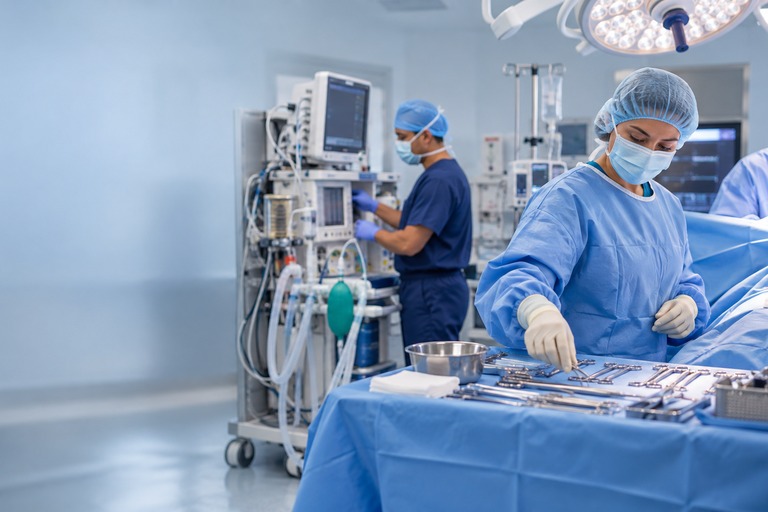
Choose a Real Path into the Operating Room
If the program you've been considering cannot document its accreditation and clinical setup, compare alternatives before paying. Explore surgical technologist programs by location, then use the questions above to check the exact offering you find.