


Explore Training Options
Use the school finder below to compare electrician training options that may be available near you or online.
Trade Schools, Colleges and Universities
Join Over 1.5 Million People We've Introduced to Awesome Schools Since 2001

Electrician school can be relatively short. Becoming a fully licensed electrician usually takes longer.
That difference is important because “going to electrician school” and “becoming an electrician” are not always the same thing. A trade school program may help you build basic electrical skills in months. But the full path to working independently often includes supervised job experience, technical instruction, exams, and state or local licensing.
Most electricians learn through apprenticeship, although some start by attending technical school. The U.S. Bureau of Labor Statistics says most electrician apprenticeships take four or five years, with about 2,000 hours of paid on-the-job training per year plus technical instruction. Licensing requirements vary by state and locality.
Short answer: Electrician school often takes several months to about two years. Becoming a fully trained or licensed electrician commonly takes about four to five years because apprenticeship or supervised work experience is usually the longest part of the path.
| Training path | Typical length | What it can help you do |
|---|---|---|
| Short electrical training or pre-apprenticeship | A few months to about one year | Learn basic safety, tools, wiring concepts, and jobsite expectations |
| Electrician trade school certificate or diploma | About six to 18 months | Prepare for entry-level helper, trainee, technician, or apprentice opportunities |
| Electrical technology associate degree | About two years | Build a broader technical foundation, often with general education and advanced coursework |
| Electrician apprenticeship | Commonly four to five years | Earn while learning through supervised work and technical instruction |
| Journeyman licensing or certification | After required hours and exam eligibility | Work more independently, subject to state or local rules |
| Master electrician or contractor path | Additional years after journeyman-level experience | Qualify for advanced, supervisory, or contracting roles in some states |
The big takeaway: school can help you get started, but apprenticeship or supervised work experience is usually where the long clock runs.
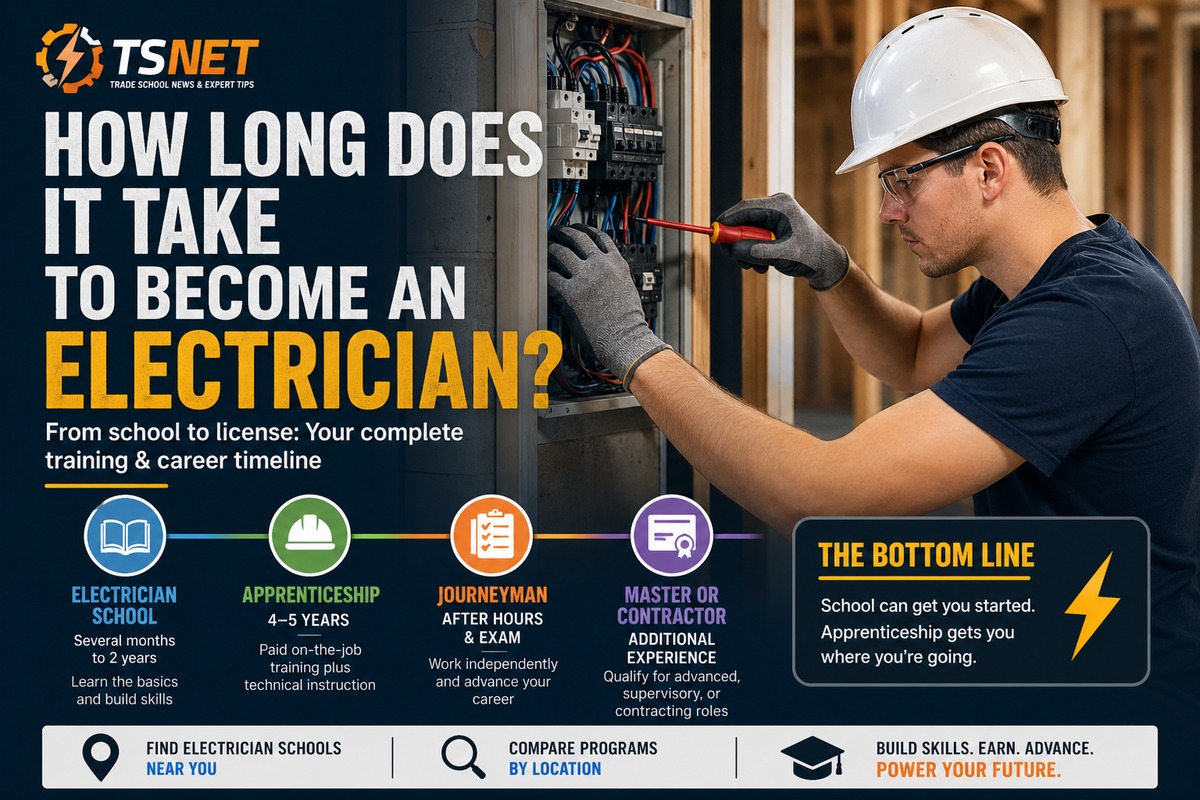
Electrician school length depends on the credential, schedule, and program format.
Some programs are designed as short career-training programs. Others are one-year certificate or diploma programs. Associate degree programs are often closer to two years. In general, electrician school may take anywhere from several months to about two years.
A shorter electrician program may cover:
Technical school can be useful if you are new to the trade and want structured training before applying for jobs or apprenticeships. BLS notes that some electricians start by attending technical school, and graduates of technical programs usually receive credit toward their apprenticeship. That credit can depend on the program, sponsor, and jurisdiction.
Key point: Finishing school may help you qualify for better entry-level opportunities, but it does not automatically make you a licensed electrician.
An electrician apprenticeship commonly takes four to five years.
During apprenticeship, you typically work under experienced electricians while also completing classroom or technical instruction. Apprenticeships are jobs, not just classes. Apprenticeship.gov describes registered apprenticeship as a career pathway that includes paid work experience, mentorship, classroom instruction, progressive wage increases, and a portable credential.
For electricians, BLS says apprentices typically receive about 2,000 hours of paid on-the-job training each year, plus technical instruction. That instruction may include electrical theory, blueprint reading, math, electrical code requirements, safety, and first aid.
In plain English: apprenticeship is usually the main road to becoming a fully trained electrician. It takes longer than school, but you can usually earn while you train.
Electrician school and apprenticeship solve different problems.
Electrician school can help you learn the basics before you step onto a job site. It may be a good fit if you want hands-on practice, classroom structure, and a stronger foundation before applying for apprentice or helper roles.
Apprenticeship combines paid work with technical instruction. It is often the main route toward journey-level status because it helps you build the supervised work hours many licensing systems require.
Neither option is automatically better. The better choice is the one that fits your local licensing rules, finances, schedule, and hiring market.
Not always.
Many electricians enter the trade through apprenticeship without completing a separate trade school program first. But some people do attend school first so they can build confidence, learn the basics, and become more competitive for entry-level opportunities.
The important distinction: Electrician school may help you start. Apprenticeship or supervised work experience usually helps you qualify.
That is especially important in states with formal hour requirements. For example, California’s general electrician path requires 8,000 hours of on-the-job experience and 720 hours of related and supplemental instruction before certification testing through the trainee route.
So yes, school can matter. But it is usually one part of the path, not the whole path.
You may be able to start earning before you are fully licensed.
That is one of the practical advantages of the electrician path. In a registered apprenticeship, you are generally paid while you learn. Apprenticeship.gov says registered apprenticeships include paid work experience and progressive wage increases as skills and productivity grow.
You may also be able to start in a helper, trainee, or entry-level technician role, depending on your state and employer. But the rules can vary. Some states require specific registration, supervision, or enrollment before you can perform electrical work.
This is why “How long does it take?” has two answers:
That second timeline is longer, but you may not have to wait four years to start working.
There is no single national electrician license in the United States.
Some states license individual journeyman electricians. Some focus on electrical contractors. Some rely heavily on city or county licensing. Some have different categories for residential, commercial, low-voltage, limited energy, industrial, or specialty electrical work.
For example, Texas requires journeyman electrician applicants to complete at least 7,000 hours of on-the-job training under the supervision of a Texas-licensed master electrician before applying for the exam, and the full 8,000 hours are required for licensure.
California’s general electrician path requires 8,000 hours of qualifying work experience, and California’s trainee route also includes 720 hours of related and supplemental instruction.
Those examples are useful, but they are not universal. Your timeline depends on the state or city where you plan to work.
Before choosing a program: Check whether it lines up with your local licensing path. A fast school program may still be valuable, but you need to know what it actually counts toward.
There are several ways to begin electrician training. The right one depends on your goals and local rules.
This route starts with a certificate, diploma, or associate degree program. After school, you may apply for helper, trainee, technician, or apprentice roles.
Best for: beginners who want training before applying for electrical jobs.
This route starts with a paid apprenticeship through a union training center, contractor association, employer, or other registered sponsor.
Best for: people who can get accepted and want to earn while they train.
Some people begin as electrical helpers or trainees. This may let you get jobsite experience before or during formal training.
Best for: people who want to start working quickly and can confirm local requirements.
This is a common hybrid route. You complete an electrician school program, then apply for apprenticeship or entry-level electrical work.
Best for: people who want a stronger foundation before competing for apprenticeship spots.
Sometimes, but do not count on it blindly.
BLS says graduates of technical school programs usually receive credit toward apprenticeship. However, the amount of credit can vary by school, apprenticeship sponsor, state, and local rules.
Before enrolling, ask the school and the apprenticeship sponsor direct questions:
A school that gives you useful skills can still be worth it. But “credit toward apprenticeship” should be verified, not guessed.
A short electrician program can be enough to help you get started. It is usually not enough to make you a licensed journeyman electrician by itself.
That does not make short programs useless. A good program can help you learn safety, wiring basics, electrical theory, tools, blueprint reading, and code concepts. It may also help you feel more prepared when applying for helper, trainee, technician, or apprenticeship positions.
But if your goal is to become a licensed electrician, ask what comes next.
A solid school should be able to explain:
If the answer is vague, keep digging.
Both union and non-union apprenticeship routes can train electricians.
Union apprenticeships are often run through joint apprenticeship and training committees. Non-union options may be offered through contractor associations, individual employers, or other registered apprenticeship sponsors. Apprenticeship.gov says registered apprenticeship sponsors can include businesses, groups of employers, industry associations, labor-management organizations, and other intermediaries.
The best choice depends on what is available near you, how competitive admission is, what wage progression looks like, and whether the program aligns with your licensing goals.
Instead of focusing only on the label, ask practical questions:
Before enrolling in an electrician school or applying for an apprenticeship, ask:
You want a program that can answer those questions clearly. Clear answers are a good sign. Vague answers are a reason to slow down and compare other options.
The best path depends on your starting point.
If you want the fastest route to paid training, apprenticeship-first may be the best option if you can get accepted.
If you want a stronger foundation before applying for jobs or apprenticeships, electrician school may be a smart first move.
If you are still comparing options, focus on three things:
Electrician training is not always quick, but it can be practical. You do not necessarily need a four-year college degree, and you may be able to earn while building the supervised experience needed for the trade.
If becoming an electrician still sounds like the right direction, your next step is to compare training options near you.
Look for electrician schools and programs that can help you build real beginner skills, understand local requirements, and move toward apprentice, helper, trainee, or technician opportunities.
You can start by exploring electrician trade schools near you or using the school search tool to find programs by location.
Electrician school often takes several months to about two years, depending on whether you choose a short training program, certificate, diploma, or associate degree.
Becoming a fully trained or licensed electrician commonly takes about four to five years because many paths include apprenticeship, supervised work experience, technical instruction, and an exam.
Not always. Many electricians enter through apprenticeship. But technical school can help beginners learn the basics, and some programs may count toward apprenticeship or related instruction requirements.
An electrician apprenticeship commonly takes four or five years. Apprentices typically receive paid on-the-job training plus technical classroom instruction.
In many places, yes. You may be able to enter through an apprenticeship or supervised entry-level work. But you still need to meet your state or local licensing requirements.
Sometimes. Some technical school graduates receive credit toward apprenticeship, but the amount of credit varies by program, sponsor, state, and local rules. Confirm before enrolling.
The fastest way to start earning is often to get hired as a helper, trainee, or apprentice. The fastest way to become licensed depends on your state, prior experience, apprenticeship availability, and whether any school credit counts toward your requirements.
It can be worth it if it teaches real skills, includes hands-on training, connects to employers, and supports your next step. It is less useful if it only gives you a certificate without a clear path into work, apprenticeship, or licensing.
Most states require electricians to be licensed, but the exact rules vary. Some states license individual electricians. Others focus on contractors or local licensing. Always check the rules where you plan to work.
Use the school finder below to compare electrician training options that may be available near you or online.