How to Become an Appliance Repair Technician: Training, Pay & Requirements



You do not need a four-year degree, a years-long apprenticeship, or a federal license just to start learning appliance repair. But becoming employable takes more than watching teardown videos and buying a multimeter.
The quick answer
For most people, the practical path is: finish high school or earn a GED, learn electrical diagnosis and appliance systems, get hands-on practice through a job or structured training, then add EPA Section 608 certification if you will open sealed refrigeration systems. State and local rules can also matter when the work crosses from the appliance itself into building wiring, gas piping, plumbing, installation, or business licensing.
BLS classifies Home Appliance Repairers as a high-school-entry occupation with moderate-term on-the-job training, meaning more than one month and up to 12 months to attain occupational competency. That is a much more useful benchmark than a school promising to turn a total beginner into a master tech in a long weekend.
What this guide covers
- What appliance repair technicians actually do
- How to become an appliance repair technician
- Training paths compared
- When EPA Section 608 is required
- Licensing: repair versus installation
- Current pay and job outlook
- Is appliance repair a good career for you?
- Questions to ask schools and employers
- Frequently asked questions
- Sources
What appliance repair technicians actually do
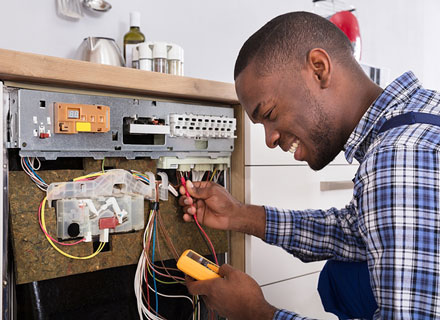
The federal occupation is Home Appliance Repairers (SOC 49-9031; O*NET-SOC 49-9031.00). O*NET defines the work as repairing, adjusting, or installing electric or gas household appliances such as refrigerators, washers, dryers, and ovens.
This is not just "replace the broken part." Current O*NET tasks include talking with customers about symptoms, reading schematics and service manuals, tracing electrical circuits, using test equipment, disassembling machines, estimating repair costs, keeping service records, maintaining parts inventory, and deciding whether a repair makes economic sense.
The work is also more customer-facing than many people expect. O*NET's 2026 profile reports daily phone conversations and face-to-face discussions for most respondents, heavy contact with the public, regular driving or time in enclosed vehicles, frequent hands-on tool use, and meaningful freedom to make decisions. It also reports awkward or cramped positions at least weekly for many workers and kneeling, crouching, stooping, or crawling for a substantial share of the day.
How to become an appliance repair technician
-
Meet the basic entry bar
BLS lists a high school diploma or equivalent as the typical entry-level education and no related work experience as the typical requirement. Employers can set higher standards, but the occupation itself is not built around a mandatory college degree.
-
Learn electrical fundamentals before you memorize appliance symptoms
Modern appliances mix motors, heaters, switches, sensors, control boards, power electronics, and software-driven diagnostic modes. The portable skill is not memorizing that one model of washer throws one code. It is knowing how to read a schematic, form a diagnostic hypothesis, use a digital multimeter safely, and prove which part of the circuit failed.
-
Get hands-on practice
Hands-on training can come from a trainee/helper job, an employer's field-training program, a private hands-on course, a technical school, or your own supervised practice on real equipment. Online training can be useful for theory and diagnostics, but physical disassembly, reassembly, measurement, tool handling, and avoiding cosmetic damage are skills you need to practice with actual machines.
-
Add EPA Section 608 when your work requires it
You do not need Section 608 for every appliance repair. You do need it for work on regulated refrigerant systems when the maintenance, service, repair, or disposal activity could release refrigerant. For factory-sealed small appliances such as many household refrigerators and freezers, Type I is the equipment-specific certification. Universal certification covers Types I, II, and III.
-
Check the legal boundary in your state and city
There is no single national appliance-repair license. The line can change when you move from servicing the appliance to altering fixed electrical wiring, gas piping, plumbing, or other building systems. Business-registration rules can be separate again.
-
Target a first job that accelerates learning
Look for an employer that provides structured ride-alongs, access to technical documentation, feedback on diagnostics, and a clear progression toward independent calls. Route-service jobs often involve driving, so a valid driver's license is common in current postings. Some employers also provide a van, specialized tools, phone or tablet, inventory support, and ongoing technical training.
Appliance repair training paths compared
There is no one required educational route. BLS captures the typical route as moderate-term OJT, but people enter from several starting points.
| Path | Best for | Upside | Watch out for |
|---|---|---|---|
| Paid employer training / trainee role | People who can get hired without formal schooling | You learn on real calls while earning a wage; BLS says moderate-term OJT is typical for the occupation. | The quality of mentoring varies. "Training provided" can mean anything from a real ride-along program to being handed a route too early. |
| Hands-on private training | Beginners who want concentrated bench practice before applying | Fast exposure to multiple appliance categories and diagnostic procedures. | Travel/lodging can add cost, and a short course is not the same thing as months of field judgment. |
| Online technical training | Self-directed learners or people training around a current job | Flexible way to build electrical, schematic, and troubleshooting knowledge. | You still need hands-on practice. A completion certificate is not a government license and does not replace EPA certification when Section 608 applies. |
| Adjacent-trade crossover | HVAC, electrical, electronics, maintenance, or mechanically experienced workers | Existing meter skills, safety habits, and diagnostic logic can shorten the learning curve. | Appliance cabinet design, service documentation, customer-home work, and model-specific diagnostics are still a new domain. |
| Registered apprenticeship | People who find a genuine registered program tied to an approved appliance-service occupation | Structured paid training plus related instruction. | It is not the typical BLS entry route for Home Appliance Repairers. Do not assume a job ad using the word "apprentice" is a registered apprenticeship. |
What current training prices look like
These are examples, not national averages. Tuition changes, and the cheapest option is not automatically the best route.
- Fred's Appliance Academy: its current Appliance & Refrigeration program advertises three weeks of hands-on training for $4,200, including EPA Type I certification.
- Master Samurai Tech: its current online Core Appliance Repair Training is $850 for roughly 50 to 80 hours of self-paced coursework. The provider itself says online theory should be paired with hands-on practice.
- Employer OJT: if you are hired directly into a trainee role, formal tuition may be zero. The tradeoff is that getting the first employer to take a chance on a total beginner can be the hardest step.
If you are shopping for formal training, use our appliance repair training and school guide for program discovery, then use the questions below to judge whether a program is worth paying for.
EPA Section 608: when it is actually required
This is where career guides get sloppy. EPA Section 608 is not a blanket license to be an appliance technician. It applies to refrigerant-related work covered by federal rules.
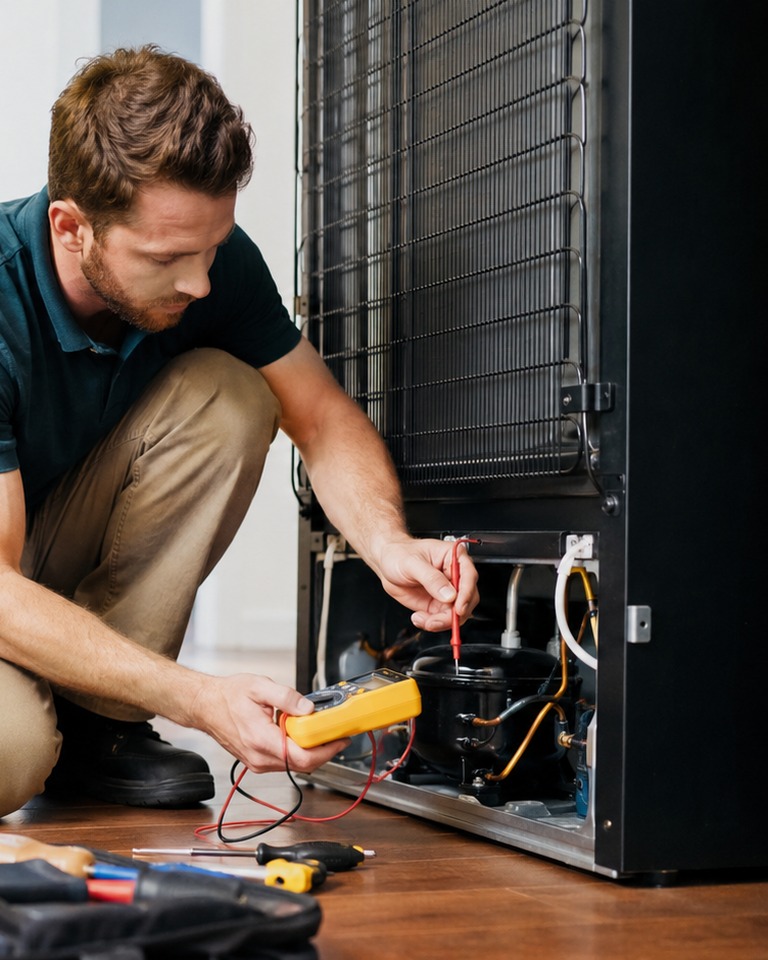
EPA says technicians must be certified when they maintain, service, repair, or dispose of equipment in ways that could release refrigerants. Activities EPA specifically treats as technician work include attaching or detaching hoses and gauges, adding or removing refrigerant, and other actions that violate the integrity of a small appliance's refrigerant circuit.
| Example work | Section 608? | Why |
|---|---|---|
| Replace washer drain pump or dryer belt | No | No refrigerant system is involved. |
| Replace refrigerator fan, control board, thermistor, door gasket, or defrost heater | Not for that work alone | These repairs do not inherently open the refrigerant circuit. |
| Connect gauges to a refrigerator sealed system | Yes | EPA explicitly includes attaching and detaching gauges/hoses in regulated technician activity. |
| Recover refrigerant, cut into tubing, replace a compressor, evacuate, or recharge | Yes | The work violates the integrity of the refrigerant circuit and can release refrigerant. |
For small appliances, Type I is the relevant certification category. EPA also offers Type II, Type III, and Universal certifications for other equipment scopes. Section 608 credentials do not expire.
For the deeper credential breakdown, see our appliance repair certification guide.
Do appliance repair technicians need a state license?
There is no single nationwide answer. The safest rule is to separate three questions:
- Can I repair the appliance itself?
- Am I altering the building's electrical, gas, plumbing, or refrigeration infrastructure?
- Does my state or city require the repair business to register or hold a specialty license?
Two current state examples show why blanket advice is dangerous:
- California: the Bureau of Household Goods and Services regulates appliance service dealers. Its current application materials say there is no exam or education requirement for the service-dealer license, but the business registration itself matters.
- Texas: TDLR explicitly exempts residential appliance dealers, manufacturers, and authorized designees from electrician licensing when they perform electrical work while repairing or servicing an existing appliance. Texas separately licenses residential appliance installation work, and local rules can override some state exemptions.
That is why "no appliance-repair license is required" is just as reckless as "every appliance technician must be licensed." Check the state licensing agency and the local building department for the work you actually intend to perform.
Appliance repair technician salary and job outlook
Current federal data paints a decent but not magical picture. This is a relatively accessible trade with moderate pay, meaningful self-employment, and steady replacement openings. It is not a hyper-growth occupation.
National pay: May 2025 OEWS
| Wage point | Hourly | Annual |
|---|---|---|
| 10th percentile | $17.40 | $36,190 |
| 25th percentile | $21.05 | $43,780 |
| Median | $24.51 | $50,990 |
| 75th percentile | $30.47 | $63,390 |
| 90th percentile | $38.78 | $80,660 |
Source: U.S. Bureau of Labor Statistics, May 2025 Occupational Employment and Wage Statistics. Wage percentiles are not experience levels. Do not read the 10th percentile as "first-year pay" or the 90th percentile as "master technician pay."
Employment outlook: 2025 to 2035
| Measure | Current BLS figure |
|---|---|
| 2025 employment | 40,500 |
| 2035 projected employment | 41,300 |
| Projected growth | 1.9% (+800 jobs) |
| Average annual openings | 2,800 |
| Self-employed share, 2025 | 20.3% |
| Typical entry education | High school diploma or equivalent |
| Typical on-the-job training | Moderate-term OJT |
Source: BLS Employment Projections, 2025–35. BLS projects 3.5% growth across all occupations over the same period, so 1.9% is slower than average.
Is appliance repair a good career for you?
It may fit well if you...
- Like proving a diagnosis instead of guessing.
- Enjoy mechanical and electrical problem-solving.
- Can explain technical problems to nontechnical people.
- Are comfortable working independently and driving between jobs.
- Do not mind kneeling, crouching, reaching, and working in tight spaces.
- Can keep learning as controls, refrigerants, and service software change.
Think twice if you...
- Hate customer interaction or delivering expensive repair estimates.
- Get frustrated when a fault is intermittent or not obvious.
- Want a fixed workstation instead of route-based field work.
- Strongly dislike dirty equipment, awkward access, or household environments you cannot control.
- Want income growth to happen automatically with seniority. The employee wage distribution tops out well below many online six-figure promises.
O*NET's current profile backs up much of that reality: troubleshooting, repairing, customer contact, vehicle operation, physical activity, and decision-making are all central parts of the occupation.
Questions to ask before paying for training
- How much live equipment will I diagnose? Ask whether you will actually use meters and schematics on functioning appliances, not just watch demonstrations.
- Who teaches electrical troubleshooting? A good course should teach circuit logic, not just a list of common parts to swap.
- Does the program include EPA Section 608 testing? If yes, which type? If no, what does testing cost and where can you take it?
- What happens after graduation? Ask for the actual career-support process, not a vague "job placement assistance" slogan.
- Are tools, books, lab fees, travel, or housing extra? A short out-of-state course can become much more expensive once the non-tuition costs show up.
- How does the program handle hands-on practice for online students? "Watch this repair" is not the same as doing it.
Our broader trade school selection guide has more questions worth asking before you enroll anywhere.
Questions to ask a potential employer
- How long do new technicians ride with an experienced tech before taking solo calls?
- Which appliance categories will I service first?
- Who reviews a difficult diagnosis before I quote or order expensive parts?
- Does the company pay for EPA testing or manufacturer training?
- Which tools do I supply, and which tools stay with the van?
- Is compensation hourly, salary, commission, piece-rate, or a combination?
- How are callbacks handled, and do callbacks affect pay?
Frequently asked questions
How long does it take to become an appliance repair technician?
BLS classifies the occupation as requiring moderate-term on-the-job training: more than one month and up to 12 months to attain competency. A short course can accelerate the basics, but independent field judgment still takes hands-on repetition.
Do appliance repair technicians need a license?
There is no single national appliance-repair license. State and local rules can differ for appliance repair, installation, fixed wiring, gas piping, plumbing, refrigerant work, and business registration. Check the rules for your actual scope of work.
Do I need EPA Section 608 certification to repair refrigerators?
Not for every refrigerator repair. Section 608 is required for work that could release regulated refrigerant, such as opening the sealed refrigeration circuit. Replacing a fan, board, gasket, switch, or defrost component does not by itself trigger Section 608.
Can I learn appliance repair online?
Online training can be very useful for electrical theory, schematics, and diagnostic logic. Pair it with hands-on practice so you learn safe disassembly, measurement, reassembly, tool handling, and real-world troubleshooting.
How much do appliance repair technicians make?
May 2025 BLS OEWS data puts the national median for Home Appliance Repairers at $24.51 per hour, or $50,990 annually. The 10th percentile was $36,190 and the 90th percentile was $80,660.
Is an apprenticeship required for appliance repair?
No. BLS says the typical route is a high school diploma or equivalent plus moderate-term OJT. O*NET does list approved apprenticeship titles related to appliance service, so registered apprenticeship is a possible route where a real program is available, but it is not the standard required path.
Sources
Labor data verified September 16, 2026 against active May 2025 OEWS and BLS 2025–35 Employment Projections datasets. Regulatory and program pages below were also checked September 16, 2026.
- U.S. Bureau of Labor Statistics: Home appliance repairers data
- BLS Employment Projections: Occupational projections and worker characteristics, 2025–35
- BLS Employment Projections definitions: moderate-term on-the-job training
- O*NET OnLine: Home Appliance Repairers, 49-9031.00
- U.S. EPA: Section 608 Technician Certification Requirements
- U.S. EPA: Refrigerant Management Program Q&A for Section 608 technicians
- California Bureau of Household Goods and Services: Electronic & Appliance Repair applicants
- Texas Department of Licensing and Regulation: Electrician licensing exemptions
- Fred's Appliance Academy: Appliance & Refrigeration training
- Master Samurai Tech: Online appliance repair courses
- ISCET/NASTeC: Appliance certification exams
- GE Appliances: Service technician careers
Explore appliance repair training
If the work sounds like a fit, compare training options after you know which skills, credentials, and hands-on experience you actually need. The goal is not to buy the longest program. It is to reach safe, employable diagnostic competence without paying for fluff.