How to Become a Small Engine Mechanic: Training, Pay & Career Paths



Small engine repair can be a good fit if you like diagnosing mechanical problems, working with your hands, and seeing a machine go from “dead on the bench” to running properly again. But there is not one small-engine career. The federal occupation group includes outdoor power equipment mechanics, motorcycle mechanics, and motorboat mechanics, and the training expectations, pay, seasonality, and technology you deal with can differ quite a bit.
The short version: you usually do not need a four-year degree. For outdoor power equipment and motorboat work, the Bureau of Labor Statistics (BLS) says a high school diploma is the typical entry education, followed by moderate- or long-term on-the-job training. Motorcycle mechanics more often enter with a postsecondary nondegree award. Across the occupation, BLS says reaching full competency can take anywhere from several months to three years, depending on the specialty and the mechanic’s ability.
The median annual wage for small engine mechanics was $49,710 in May 2025. BLS projects 3.1% employment growth from 2025 to 2035 and about 7,700 openings per year, with most openings coming from workers leaving the occupation or labor force rather than brand-new jobs.
What small engine mechanics actually work on
BLS divides small engine mechanics into three detailed occupations:
- Outdoor power equipment and other small engine mechanics work on equipment such as lawn mowers, garden tractors, chainsaws, trimmers, portable generators, and similar machines.
- Motorcycle mechanics diagnose and repair motorcycles, scooters, mopeds, dirt bikes, and similar motorized vehicles.
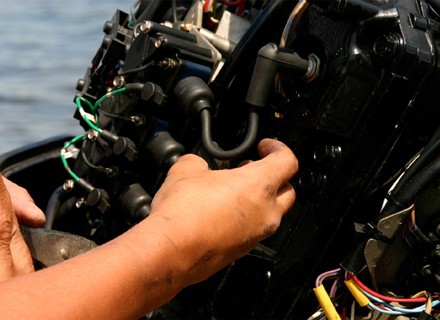
- Motorboat mechanics and service technicians maintain and repair the mechanical and electrical components of boat engines.
If your mental image is just someone rebuilding a carburetor on a lawn mower, that is now only part of the job. BLS specifically notes that troubleshooting increasingly involves electronic control systems and diagnostic equipment. O*NET also lists testing engines, inspecting for malfunctions, keeping repair records, preparing estimates, and discussing problems with customers among core tasks for outdoor power equipment mechanics.
That mix matters when deciding whether you would enjoy the work. This is hands-on mechanical work, but it is also diagnosis, documentation, and customer communication. Parts swapping without understanding the failure is a very expensive hobby, not a career strategy.
Three main small engine career paths
| Specialty | 2025 median pay | 10th-90th percentile pay | 2025-35 growth | Annual openings | Typical entry education | Typical OJT |
|---|---|---|---|---|---|---|
| Motorboat mechanics | $57,550 | $36,950-$79,330 | 4.9% | 2,600 | High school diploma or equivalent | Long-term |
| Motorcycle mechanics | $48,580 | $34,770-$74,400 | 2.1% | 1,400 | Postsecondary nondegree award | Short-term |
| Outdoor power equipment mechanics | $47,880 | $34,670-$67,260 | 2.3% | 3,800 | High school diploma or equivalent | Moderate-term |
Data note: Median and percentile wages are from the May 2025 BLS Occupational Employment and Wage Statistics (OEWS) program. Growth, openings, education, and on-the-job training are from the BLS 2025-35 Employment Projections. Wage percentiles are not experience levels; the 10th percentile should not be treated as an “entry-level salary.”
Outdoor power equipment
This is the broadest “small engine mechanic” path. You may work on consumer lawn equipment, commercial zero-turn mowers, generators, snow equipment, golf carts, or other compact machinery. BLS lists a high school diploma as the typical entry education and moderate-term on-the-job training.
This route is especially attractive if you want to enter quickly and can find a dealer, rental company, repair shop, or equipment business willing to train you. Formal school can still help, but it is not the default requirement in the same way it is for motorcycle mechanics.
Motorcycle mechanics
Motorcycle repair is more likely to reward formal training before you apply. BLS says motorcycle mechanics typically complete postsecondary motorcycle-repair programs, and employers prefer workers with that background because they tend to need less on-the-job training.
This path can involve engine work, drivetrains, brakes, suspension, electrical systems, and increasingly sophisticated electronic controls. Manufacturer-specific training can become important after hiring, particularly for warranty or brand-specific work.
Motorboat mechanics
Marine work has the highest median pay of the three BLS specialties: $57,550 in May 2025. BLS lists a high school diploma as the typical entry education but long-term on-the-job training, and it notes that boat mechanics who skip postsecondary education may need more workplace training because of the complexity of modern systems.
The job can also mean cramped engine compartments, waterfront workplaces, seasonal surges, and a mix of mechanical and electrical troubleshooting. If you live in a strong boating market, that can make marine work a very different career proposition than repairing residential lawn equipment.
How to become a small engine mechanic
There is no single national checklist, but a practical path looks like this:
1. Pick the equipment category you actually want to work on
Before paying for school, decide whether you are aiming at outdoor power equipment, motorcycles/powersports, or marine engines. Training that is excellent for lawn and garden equipment may do little for a dealership that wants motorcycle-specific skills, and vice versa.
2. Build basic mechanical and electrical fundamentals
Useful foundations include two- and four-stroke engine operation, fuel and ignition systems, electrical troubleshooting, safe tool use, measuring and inspection, routine maintenance, and reading service information. BLS also emphasizes troubleshooting, customer-service skills, dexterity, organization, and attention to detail.
3. Choose school or paid on-the-job training deliberately
For outdoor power equipment, a helper, setup, or trainee role can be a legitimate entry route. For motorcycles, formal postsecondary training is more common. For marine repair, either route can work, but BLS assigns long-term OJT and says workers without postsecondary preparation may need more training on the job.
4. Get real bench time
BLS describes trainees progressing from basic tasks such as spark-plug replacement and component disassembly to computerized diagnosis and engine overhauls. Full competence can take several months to three years. A certificate can shorten your learning curve; it does not magically replace the part where you learn to diagnose broken machinery without setting money on fire.
5. Add certification or manufacturer training when it supports your target job
Certification is not a universal federal requirement. BLS says manufacturer certifications are common in motorcycle and marine repair, while certification is a recognized industry credential in outdoor power equipment. Employers also frequently send technicians to manufacturer or dealer training, and those courses can be required for warranty and manufacturer-specific work.
Is small engine repair school worth it?
Sometimes. The right question is not “Is school good?” It is whether the program gives you something you cannot get faster and cheaper through paid shop experience.
School is more likely to make sense if:
- you have little mechanical experience and need structured hands-on instruction;
- you want motorcycle repair, where BLS lists a postsecondary nondegree award as the typical entry education;
- the program has substantial lab time with live equipment, not mostly theory;
- local dealers or marinas actively recruit from the program;
- the curriculum includes electrical/electronic diagnosis alongside traditional engine work;
- the program connects to recognized certification or manufacturer training;
- the total cost is reasonable compared with what entry-level employment would teach you while paying you.
Learning on the job may make more sense if:
- you already repair engines successfully as a hobby;
- a local outdoor-power dealer or repair shop will hire and train you;
- you can get access to manufacturer training through an employer;
- the school is expensive but vague about hands-on hours, employer relationships, or job outcomes;
- the program is mostly online and your real weakness is practical diagnosis rather than engine theory.
An online course can be useful for theory and terminology, but BLS still describes this occupation as one learned through substantial on-the-job training. Treat online-only training as a foundation, not proof that you are ready to diagnose customer equipment independently.
Explore small engine repair schools and training programs if you decide structured training is the better route.
Certification: useful, but not the same as a license
The Equipment & Engine Training Council (EETC) runs a current technician-certification program for outdoor power equipment. Its exam catalog includes two-stroke engines, four-stroke engines, compact diesel engines, electrical systems, driveline systems, mechanical systems, mobile generators, and reel technology. EETC says each certification exam has 60 multiple-choice questions and requires a 70% score to pass. Current exam pricing varies for students, members, and individual nonmembers.
EETC also accredits educational programs. Its accreditation is a quality signal for facilities, instructor qualifications, and industry-agreed competencies, but EETC explicitly says it does not endorse a specific curriculum. That distinction matters: an accredited program can be a useful filter, but accreditation alone does not tell you whether the school is affordable, conveniently located, or connected to the employers you want.
Manufacturer training is another layer. BLS says employers frequently send small engine mechanics to training run by manufacturers and dealers, and such courses are often prerequisites for warranty or manufacturer-specific work.
Do small engine mechanics need a state license?
There is no universal federal mechanic license for this occupation, and requirements can vary by state and by the equipment being repaired. One concrete example is Michigan, where mechanics who perform covered motor-vehicle repairs for compensation must be state certified in the appropriate repair category; motorcycle is one of the state’s certification categories.
Motorcycle mechanics also usually need a driver’s license with a motorcycle endorsement so they can legally road-test bikes, according to BLS.
The practical rule is boring but important: check your state before assuming a national article applies perfectly to you.
Small engine mechanic salary
The occupation-wide median was $49,710 a year, or $23.90 an hour, in May 2025. The lowest-paid 10% earned less than $35,360, while the highest-paid 10% earned more than $74,460.
Among the three specialties, motorboat mechanics had the highest median at $57,550, followed by motorcycle mechanics at $48,580 and outdoor power equipment mechanics at $47,880.
Pay also varies by industry and location. BLS reported occupation-wide median wages of $54,020 in amusement, gambling, and recreation industries; $49,470 at other motor vehicle dealers; $49,280 in repair and maintenance; and $46,040 at building-material and garden-equipment dealers in May 2025.
Those numbers describe employees. BLS OEWS wage data do not include self-employed workers, so they should not be used to estimate what an independent repair-shop owner will make.
Job outlook: stable, not a gold rush
BLS projects overall employment of small engine mechanics to grow 3.1% from 2025 to 2035, from 77,500 to 79,900 jobs. That works out to about 2,400 net new jobs over the decade.
The more useful number for job seekers is the projected 7,700 openings per year. Most of those are replacement openings created when workers change occupations or leave the labor force, not explosive industry expansion.
Motorboat mechanics have the strongest projected growth of the three specialties at 4.9%, compared with 2.3% for outdoor power equipment mechanics and 2.1% for motorcycle mechanics.
That is a reasonably steady outlook, but calling it a massive shortage would be nonsense. There should be openings. You still need useful skills and a local market that actually uses them.
What the work is really like
BLS describes repair shops as generally well ventilated but noisy. Mechanics may also make onsite service calls in poor weather, and motorboat mechanics can work in cramped positions inside boats.
O*NET’s current profile for outdoor power equipment mechanics reinforces how physical and hands-on the work is. It reports that 77% of respondents use their hands to handle tools or controls continually or almost continually, 61% stand continually or almost continually, and 76% have constant contact with other people. O*NET also reports daily exposure to contaminants and hazardous equipment for many workers.
Seasonality is a real consideration. BLS says spring and summer are usually the busiest periods, with overtime possible during peak demand. Some workers may drop to part-time hours in winter. Employers may smooth the year by scheduling major rebuilds for the off-season.
If predictable 9-to-5 hours are sacred to you, ask very pointed questions before accepting a job at a seasonal shop.
Will electric equipment kill small engine repair?
It changes the work. BLS explicitly says electric-powered equipment such as lawn mowers, chainsaws, and electric bikes may require less routine maintenance and repair than traditional engines, which could limit demand for some mechanics.
That is not the same as “the career is disappearing.” BLS still projects 3.1% overall growth through 2035, and it also points to increasingly sophisticated boat, motorcycle, and outdoor-power systems as a source of demand for mechanics who can diagnose and repair them.
For someone entering the trade now, the sensible hedge is to become good at electrical and electronic diagnosis, not just carburetors and spark plugs. California’s current small-off-road-engine rules are another sign of the direction of travel: the California Air Resources Board says its amended standards move new small off-road engines toward zero-emission requirements, with zero-emission standards for smog-forming pollutants by model year 2028.
The useful career question is not “gas or electric?” It is whether you can troubleshoot the machine in front of you as the technology mix changes.
Can you be self-employed?
Yes. BLS reports that about 7% of small engine mechanics were self-employed in 2025.
That can mean an independent shop or mobile repair operation, but the business side matters as much as the wrenching. You need customer intake, estimates, scheduling, parts sourcing, recordkeeping, insurance, tax registration, local business compliance, and a plan for seasonal demand. Manufacturer warranty work may also depend on dealer authorization and brand-specific requirements.
If self-employment is your long-term goal, working inside a busy shop first can teach you what repair volume, parts delays, customer expectations, and comebacks actually look like. A pile of tools does not automatically become a viable business because you printed a logo for the van.
Small engine repair vs. nearby mechanical careers
Small engine repair is one of several ways to build a hands-on mechanical career. If pay or equipment scale matters more to you than the specific machines, compare nearby paths before committing.
| Career | 2025 median pay | Typical entry education | 2025-35 growth |
|---|---|---|---|
| Small engine mechanics | $49,710 | High school or postsecondary nondegree, depending on specialty | 3.1% |
| Automotive service technicians | $50,620 | Postsecondary nondegree award | 5.0% |
| Diesel service technicians | $61,770 | High school diploma or equivalent | 3.6% |
| Heavy vehicle/mobile equipment service technicians | $63,850 | High school diploma or equivalent | 7% overall group |
If you love compact engines, powersports, marine equipment, or lawn-and-garden machinery, small engine work may fit better than chasing the highest median wage. If your main goal is maximizing earnings and you enjoy larger systems, diesel mechanic training or heavy equipment training may deserve a look.
For passenger vehicles, compare automotive mechanic training. If bikes are the whole reason you are here, go straight to motorcycle mechanic training. If boats sound better than mowers, explore marine mechanic training.
Who this career tends to fit
Small engine repair may suit you if you:
- enjoy hands-on mechanical troubleshooting;
- can work carefully with small parts and tight tolerances;
- like figuring out why something failed rather than just replacing random parts;
- do not mind noise, grease, fumes, standing, and seasonal workload changes;
- can explain repairs to customers without making them feel stupid;
- are willing to keep learning as controls, diagnostics, and power systems evolve.
O*NET classifies outdoor power equipment mechanics primarily as a Realistic interest type, with strong mechanics/electronics and physical/manual-labor interests. That tracks pretty well with the actual job: fix tangible things, use tools, diagnose systems, repeat until machine stops being a bastard.
Who should think twice
You may want another path if you strongly dislike dirty or noisy environments, want guaranteed year-round hours in every region, hate customer interaction, or expect high pay immediately after a short certificate.
Also think carefully if the only local training option is an expensive program with weak hands-on instruction and no clear employer connections. A career can be perfectly legitimate while a particular school is still a bad deal.
Questions to ask a small engine repair program
Before enrolling, ask:
- How many hours are actually spent in a hands-on shop lab?
- Which equipment categories will I diagnose and repair: outdoor power, motorcycles, marine, generators, compact diesel, or something else?
- Does the program teach electrical and electronic diagnostics, not only carbureted gasoline engines?
- Is the program EETC-accredited, and if not, what industry standards does it use?
- Are EETC or manufacturer certification exams included or available?
- Which local employers hired recent graduates?
- What tools must I buy separately?
- What is the total program cost, not just tuition?
- Does the school publish verifiable completion and job-placement information?
- Could I reach the same target job through paid entry-level work and employer training?
That last question is the annoying one schools may not love. Ask it anyway.
Frequently asked questions
Do you need a degree to become a small engine mechanic?
No. BLS lists a high school diploma as the typical entry education for motorboat and outdoor power equipment mechanics. Motorcycle mechanics typically have a postsecondary nondegree award. A four-year degree is not the standard route.
How long does it take to become a small engine mechanic?
BLS says achieving competency can take from several months to three years, depending on the specialization and the mechanic’s ability. A school program may be much shorter than that, but finishing school and becoming fully competent are not the same milestone.
Is small engine mechanic certification required?
Not nationally. BLS says certification is a recognized industry credential and can demonstrate competence, but it is not generally required. Manufacturer-specific certifications may matter for brand and warranty work, and state rules can create exceptions. Michigan, for example, certifies mechanics who perform covered motorcycle repairs for compensation.
How much do small engine mechanics make?
The median annual wage for the overall occupation was $49,710 in May 2025. Specialty medians were $57,550 for motorboat mechanics, $48,580 for motorcycle mechanics, and $47,880 for outdoor power equipment mechanics.
Can you learn small engine repair online?
You can learn useful theory online, but the occupation still requires hands-on competence. BLS describes small engine mechanics as learning through on-the-job training, and employers use real shop work to build skills from basic service through advanced diagnostics and overhauls.
Is small engine repair a good career in the age of electric equipment?
It can be, but the skill mix is changing. BLS says electric equipment may reduce some routine maintenance demand while overall small engine mechanic employment is still projected to grow 3.1% from 2025 to 2035. Electrical and electronic troubleshooting should become increasingly valuable as the equipment mix changes.
Sources
- U.S. Bureau of Labor Statistics, Occupational Outlook Handbook, Small Engine Mechanics. Updated August 27, 2026. source
- U.S. Bureau of Labor Statistics, May 2025 Occupational Employment and Wage Statistics. Released May 15, 2026.
- U.S. Bureau of Labor Statistics, Employment Projections 2025-2035, occupational projections and characteristics. Released August 27, 2026. source
- O*NET OnLine, Outdoor Power Equipment and Other Small Engine Mechanics (49-3053.00). Current profile updated 2026. source
- Equipment & Engine Training Council, Technician Certification Program. Accessed September 16, 2026. source
- Equipment & Engine Training Council, Accreditation Program. Accessed September 16, 2026. source
- Michigan Department of State, Mechanics / Mechanic Certification. Accessed September 16, 2026. source
- California Air Resources Board, 2021 Amendments to the Small Off-Road Engine Regulations. Accessed September 16, 2026. source
Explore Training Options
If structured training makes sense for your target specialty, compare programs only after you have checked hands-on hours, total cost, employer connections, and the equipment the program actually covers.