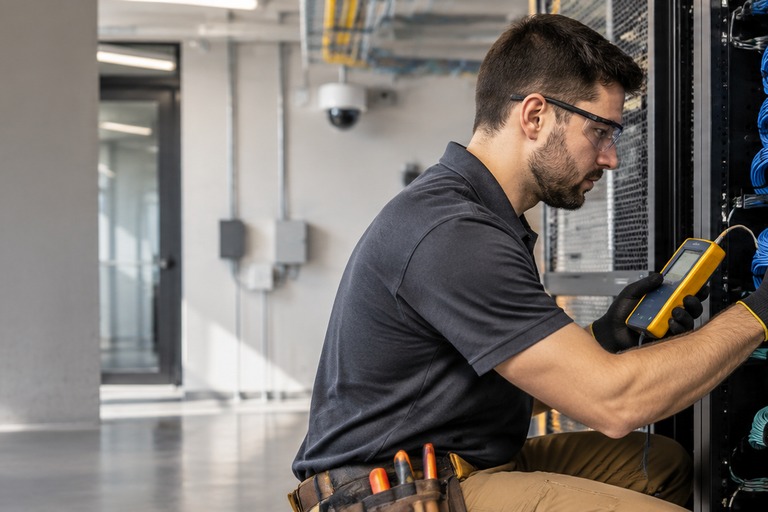
How to Become a Fire Alarm Technician: Training, NICET Certification, Salary, and Licensing


A fire alarm technician installs, tests, maintains, and troubleshoots equipment that helps warn people of fires. You can enter through supervised work or an apprenticeship, often without a four-year degree. But learning the equipment is only part of the job: you also need to know which work your state allows you to perform, what experience counts toward certification, and whether your target job is installation, service, or periodic inspection.
Quick answer: Start by checking your state's rules for fire alarm work, then compare paid trainee and apprenticeship openings with hands-on electronics or electrical programs. Build documented experience with a qualified employer. If you pursue NICET credentials, choose Fire Alarm Systems (FAS) for broader installation, service, commissioning, and system work, or Inspection and Testing of Fire Alarm Systems (ITFAS) if your job centers on periodic testing of existing systems. Neither NICET certificate is a nationwide license.
A useful federal pay benchmark is $60,070 a year (May 2025 median), but it comes from a BLS occupation that combines security and fire alarm systems installers. There is no separate national fire-alarm-only median in that dataset. BLS OEWS and 2025-35 projections provide the underlying figures.
What Does a Fire Alarm Technician Actually Do?
The work changes substantially with the building, employer, and stage of a project. A construction-focused installer might pull approved cable, mount backboxes and detection devices, and terminate wiring. A service technician might trace a ground fault or find why a panel reports trouble. An inspection specialist might spend a day testing alarms in an occupied building and recording deficiencies for its owner.
Fire alarm systems can include control panels, smoke and heat detectors, manual pull stations, audible and visible notification appliances, monitoring connections, standby power, and interfaces with other building equipment. Technicians work from drawings, manufacturers' instructions, applicable codes, and the rules enforced by the local authority having jurisdiction (AHJ). Safe testing often requires coordination with building staff and monitoring providers so alarms are managed properly and required protective functions are restored.
Five Practical Career Lanes
| Lane | Typical work | What to ask an employer |
|---|---|---|
| Installation and retrofit | Cable pathways, device mounting, terminations, checking drawings, replacing older equipment | Do trainees get hands-on panel and system experience, or mostly cable pulling? |
| Service and troubleshooting | Diagnosing system troubles, inspecting components, replacing devices, documenting repairs | Is there an on-call rotation, and what training is provided before solo calls? |
| Programming and commissioning | Configuring compatible equipment, verifying programmed responses, preparing for acceptance procedures | Which manufacturers' systems will I learn, and who signs off on final work? |
| Periodic inspection and testing | Testing existing systems, recording deficiencies, producing reports for clients | Does the work history qualify for NICET ITFAS? Who reviews the records? |
| Layout, estimating, and supervision | Plan preparation, device selection, calculations, crews, submittals, project oversight | What experience and legal authority are required for the design or sign-off tasks? |
A fire alarm installer is not necessarily a municipal fire inspector. An AHJ inspector may work for a government fire prevention office and enforce codes. A private fire alarm inspection-and-testing technician generally evaluates fire alarm systems under the authority and qualifications required locally. Those careers have different hiring and regulatory paths.
How Is This Different From Other Low-Voltage Work?
Fire alarms share wiring, meters, cable pathways, and troubleshooting skills with security and telecommunications. The difference is their life-safety purpose and code-governed operation. A dead camera or bad conference-room speaker is inconvenient; an incorrectly tested fire alarm system can have far more serious consequences.
This guide is specifically about fire alarm systems. For cabling, fiber, security/access control, and AV work beyond fire alarms, see our low-voltage technician career guide. For the broader distinction between electrical installation and technician work, compare electricians and electrical technicians.
What Is the Work Environment Like?
Expect a mix of physical and technical work. Construction installations can mean ladders, lifts, overhead cable runs, dusty ceilings, and early jobsite starts. Service work adds occupied buildings, customer questions, difficult faults, and sometimes after-hours calls. Inspection work is often more repetitive but demands careful documentation and attention to detail. Safety training matters even though many signaling circuits are power-limited: panels can have line-voltage supplies, batteries, and interfaces to equipment that must be managed by qualified people.
The job can be a strong fit if you like hands-on problem solving, electronics, clear procedures, and accountable work. It may be a poor fit if you dislike heights, meticulous recordkeeping, travel between sites, or responding to system faults under time pressure. Work conditions vary by employer, so ask about on-call duties, travel, and site access before accepting an offer.
Fire Alarm Technician Salary and Job Outlook
The Bureau of Labor Statistics places this work in Security and Fire Alarm Systems Installers (SOC 49-2098). That title matters. The figures below include security-system workers as well as fire-alarm workers; they are not a separate pay survey of commercial fire-alarm specialists.
National Wage Distribution
| May 2025 BLS measure | Annual pay |
|---|---|
| 10th percentile | $38,800 |
| 25th percentile | $47,820 |
| Median | $60,070 |
| 75th percentile | $73,690 |
| 90th percentile | $81,150 |
Do not read percentiles as career stages. A 10th-percentile wage is not necessarily an apprentice's wage, nor does the 90th percentile specifically represent NICET Level IV technicians. Location, industry, employer, overtime, job mix, and experience can all affect pay. This table reflects wage-and-salary employment, not earnings for self-employed contractors. Source: BLS OEWS, May 2025, released May 15, 2026.
For the same combined occupation, BLS Employment Projections for 2025-2035, released August 27, 2026, report:
- 6.8% projected employment growth, from about 86,300 jobs in 2025 to 92,100 in 2035.
- 8,500 average annual openings over the decade. Openings include workers leaving the occupation or labor force; they do not mean 8,500 new positions are created every year.
- High school diploma or equivalent as the typical entry-level education and moderate-term on-the-job training as the typical training category. Those national classifications do not override a state's legal requirements.
Paycheck reality check: When comparing offers, ask whether the rate is hourly or salaried, whether overtime and on-call pay are included, who covers travel, and whether the employer pays for NICET exams, codebooks, and recertification. A salary aggregator that labels its estimate "fire alarm technician" may still use a different occupational sample or job-posting method from BLS.
How to Become a Fire Alarm Technician: A Practical Route
There is no single national school-to-license sequence. These steps are a planning framework; the legal sequence depends on the state and the actual work.
- Identify the job you want. Look at local openings for fire alarm installer, fire alarm service technician, fire alarm inspection technician, and fire alarm apprentice. Read the duties rather than relying on titles alone.
- Check your legal entry route. Find your state's electrical licensing board or state fire marshal, then determine whether trainee registration, a specialty electrical credential, a fire alarm technician license, supervised hours, or a registered contractor is required. Your city or county may have additional rules.
- Compare paid training with school. A helper position or registered apprenticeship may provide qualifying work experience while you earn. A hands-on electronics or electrical program can improve your foundation but may not replace required field hours.
- Learn the actual systems. Build proficiency with wiring diagrams, safe work practices, meters, initiating and notification devices, panels, testing, and documentation. Codebook navigation and troubleshooting matter more than memorizing brand names.
- Document qualifying work from day one. Record employers, dates, tasks, systems, supervision, and the hours or full-time-equivalent months needed by your regulator and NICET. Ask supervisors about performance verification early, not years after they change jobs.
- Choose the right certification track when eligible. NICET FAS supports broader system work; ITFAS focuses on periodic inspection and testing. Complete the applicable exams, work-history documentation, performance verification, and any further requirements.
- Maintain your authorization and keep learning. State credentials, employer registration, permits, manufacturer training, and NICET recertification can each have their own rules and renewal cycles.
You can find registered apprenticeship sponsors through Apprenticeship.gov. Search terms such as "fire alarm", "limited energy", "protective signaling", "sound and communications", and "electrical apprentice" are useful, but confirm that a particular program covers the work and license you want.
NICET Fire Alarm Certification: FAS vs. ITFAS
NICET is a credentialing organization, not a state licensing board. Its certifications assess documented work experience, exams, and verified technical performance. They can help demonstrate competence, and some jurisdictions recognize them toward specific requirements. They do not, by themselves, authorize someone to install or inspect systems anywhere in the United States.
The decision is simpler when you start with the work rather than the certification name.
| Your main goal or daily work | Better NICET path to investigate | Important limitation |
|---|---|---|
| Installation, repair, commissioning, broader system work, layout | Fire Alarm Systems (FAS), Levels I-IV | Check the required experience and any state occupational license separately. |
| Periodic inspection and functional testing of existing systems | Inspection and Testing of Fire Alarm Systems (ITFAS), Levels I-II | Its focus is periodic inspection/testing, not a substitute for installation or design qualifications. |
| Mixed installation and inspection work | Compare FAS with the actual duties and work-history rules | Being allowed to count limited related experience is not the same as qualifying for every task or license. |
Fire Alarm Systems (FAS): Experience Milestones
NICET's current FAS certification requirements list the following full-time-equivalent minimums. Candidates must pass the required exams and provide supervisor verification; advanced levels have additional recommendation and project requirements.
| FAS level | Minimum relevant experience | Key additional requirements |
|---|---|---|
| I | 6 months | Level I exam, documented work, performance verification |
| II | 2 years | Levels I and II exams; at least 12 months of specified core fire alarm work, with limited related-experience allowance |
| III | 5 years | Levels I-III exams; at least 45 months core work, plus field/leadership and technical-management experience and recommendation |
| IV | 10 years | Levels I-IV exams; at least 105 months core work, project-management oversight, recommendation, and a substantial project write-up |
Those are eligibility benchmarks, not promised promotion timelines. You cannot turn two years of unrelated electronics work into FAS Level II automatically. The precise types of core and related experience are defined in NICET's rules.
Inspection and Testing (ITFAS): A Different Experience Mix
NICET's ITFAS requirements specify:
- Level I: at least 6 months of qualifying experience, including at least 4 months of periodic inspection and testing of existing fire alarm systems. Some related installation, maintenance, acceptance-testing, or suppression-system work can count within stated limits.
- Level II: the Level I minimum plus 12 additional months, including at least 6 months of periodic/maintenance inspection and testing of existing complex systems, along with exams and supervisor verification.
So Level II can have an 18-month minimum, compared with two years for FAS Level II. That does not make ITFAS a shortcut to an installation career. It measures different work. The NICET ITFAS program page explains that distinction and the available exam-credit routes.
Exam Fees, Code Editions, and Renewal
NICET's standard-model testing fees effective August 1, 2026 are $235 for Level I, $325 for Level II, $380 for Level III, and $435 for Level IV. Confirm your specific exam, possible fees, and employer reimbursement before paying; other application, evaluation, or retake costs may apply.
Current FAS exams use the 2022 edition of NFPA 72. NICET says it is updating the program toward the 2025 edition, with a planned 2027 rollout. Check the official FAS program page and its reference list immediately before ordering codebooks or scheduling an exam. The edition an exam uses may differ from the edition adopted in your state.
NICET certifications are generally renewed every three years, with 90 Continuing Professional Development (CPD) points from at least two categories under its rules. Active practice can count for up to 72 points over a three-year period. See NICET recertification for the precise caps and eligible activities. A prep-course completion certificate is not the same thing as earned NICET certification.
Fire Alarm Technician Licensing: Five States, Five Different Checks
There is no universal nationwide fire alarm technician license. States can regulate the work through electrical boards, fire marshals, or both; local AHJs can enforce additional requirements and adopted code editions. The examples below are illustrations, not legal advice or a nationwide 50-state lookup. Always verify the rules for the exact work you intend to do.
| State | What the official authority says | What readers must not assume |
|---|---|---|
| Texas | The State Fire Marshal regulates individual fire alarm licenses and company registration. The FAL path requires relevant exams, fingerprinting, and employment by a registered company. Passing NICET FAS Level II can substitute for the specified technician technical exam, but the statutes/rules exam and other obligations remain. Texas TDI | "I passed NICET, so I can work independently in Texas." |
| California | The Fire/Life Safety Technician certification experience requirement is normally 4,000 hours of specified work for a C-10 contractor. Under the regulation, NICET FAS Level II or above can satisfy the experience requirement; the California certification exam still applies. California Title 8, section 291.1 | "NICET Level II automatically gives me a California certificate." |
| Washington | The limited-energy (06) specialty generally requires 4,000 hours of specialty experience and 48 classroom hours before the examination. The state identifies a 75% minimum supervision standard for trainees in 4,000-hour specialties. Washington L&I | "All low-voltage trainees everywhere need 100% supervision" or "NICET replaces the state electrical certificate." |
| Oregon | Limited Energy Technician Class A covers protective signaling work. An applicant can qualify through an approved Oregon apprenticeship, or a documented 432 classroom hours plus 6,000 OJT hours, or an approved outside-Oregon experience route; the licensing examination applies. Oregon BCD | "Any low-voltage Class B credential covers fire-alarm protective signaling." |
| Utah | The State Fire Marshal has Basic, Fire Alarm Technician, and Master Fire Alarm Technician tiers for inspection/testing. Its published guidance describes NICET equivalencies but still requires state certification processes and fees. Utah State Fire Marshal | "Utah's inspection certificate is a blanket electrical installation license." |
Before working, bidding, or paying for a credential, use this four-question jurisdiction check:
- Who regulates my actual task? Installation, service, inspection/testing, monitoring, and system design may be treated differently. Start with the state board or fire marshal and ask your city or county AHJ.
- What must I personally hold? A trainee registration, specialty electrician certificate, alarm technician license, or other credential? Are there required exams, fingerprints, or continuing-education hours?
- What must my employer hold? Is there a licensed/registered contractor requirement, and who can supervise or sign off on my work?
- Which codes and scope apply? Confirm the editions and local amendments actually adopted, plus any restrictions on what your qualification lets you do.
NFPA 72 is a technical code, not a universal permission slip. NFPA 70 and adopted building/fire codes also matter, but the legally applicable rules depend on jurisdiction and task. This is why a recruiter saying "NICET preferred" is not enough to establish legal eligibility.
Training Options: Paid Experience vs. School vs. Exam Prep
| Path | Best reason to consider it | Main question to verify |
|---|---|---|
| Paid helper or trainee job | Earn while learning and accumulate relevant experience | Will you be properly supervised and documented for local requirements and NICET? |
| Registered apprenticeship | Structured work-based learning and progressive responsibilities | Does this specific program lead toward the license or specialty you want? |
| Community college or technical certificate | Build electronics, electrical, safety, and troubleshooting fundamentals in a lab | Are there real fire alarm panels and hands-on assignments? Will hours count toward any required education? |
| Private NICET exam-preparation course | Review code references and practice for an exam once you have the relevant experience | Is it only exam prep? Does the provider imply it grants certification or a state work license? |
| Crossover from electrician, telecom, or security work | Use existing field skills to move into life-safety systems | Which previous hours count, and what fire-alarm-specific experience is still required? |
A short course can help you pass a test, but it does not magically create months of qualifying field work. Conversely, working on a crew does not guarantee you're learning troubleshooting, programming, or documentation. Ask what new tasks you'll be able to perform, who evaluates them, and what the employer or school will certify in writing.
If you want classroom options, compare electrical and electronics technician schools and electronics technician programs. These are foundational program directories, not a claim that every listed program offers NICET preparation or fulfills your state's fire-alarm requirements. For a broader electrical entry path, read how to become an electrician.
Seven Questions That Can Save You From the Wrong Program
- Which fire alarm equipment will I physically use? Ask to see working control panels, initiating devices, notification appliances, and test equipment, not just slides.
- Will I troubleshoot realistic faults? Knowing what a detector is does not equal diagnosing an open circuit, ground fault, power issue, or panel trouble.
- Which codebooks and editions do you teach? Ask how instruction aligns with current NICET exam references and the code adopted locally.
- Does your curriculum cover documentation? Inspection records, test results, drawings, deficiency reports, and clear handovers matter in life-safety work.
- What credit, if any, does my state accept? Obtain confirmation from the licensing authority or apprenticeship sponsor. A school's marketing statement is not enough.
- What is the full cost? Include books, tools, PPE, lab fees, outside exams, retakes, and time away from paid work. Compare against employer-sponsored training.
- Who actually hires your graduates? Ask for recent local employer examples and compare the skills taught with job requirements. Placement claims need evidence.
An online course may be useful for theory and codebook practice. It cannot replace the physical skills required for installing, testing, and troubleshooting real equipment. If a program is online-first, ask precisely how those skills are practiced and assessed.
Explore Electronics and Electrical Training
The program finder can help you explore foundational hands-on options. Verify that any program teaches fire alarm systems and meets your local licensing or apprenticeship requirements before you enroll.
Which Fire Alarm Career Route Fits You?
Choose installation or service first if you enjoy hands-on construction, wiring, fault-finding, and seeing a complex system work. This is usually the better starting point for someone considering the broader FAS pathway.
Choose periodic inspection/testing first if you prefer structured checklists, visiting operating facilities, rigorous records, and identifying deficiencies. Ask employers how much work is genuinely periodic testing of existing systems, since ITFAS requires that experience specifically.
Consider electronics or electrical training first if you're new to meters, circuits, schematics, power supplies, and safe jobsite practices, or if a program helps meet your state's educational requirements. Don't buy a large tuition package before comparing legitimate paid entry routes.
Think carefully before choosing this field if you expect a desk-only job, dislike disciplined documentation, or would struggle with safety-critical instructions and customer-site responsibilities. The field is not just "pull wires and beep a smoke detector." You are helping maintain systems that people rely on when things go wrong.
Your First 30 Days of Career Research
This is a practical research plan, not a promise that you'll be qualified in 30 days.
- Days 1-7: Find your state regulator and local AHJ. Write down the job tasks you're allowed to perform as a trainee, required supervision, and the pathway to legal authorization.
- Days 8-14: Review at least ten local installer, service, and inspection job ads. Track repeated requirements, employer-paid training, travel, overtime, and on-call expectations.
- Days 15-21: Contact registered apprenticeship sponsors and two or three employers about supervised entry roles. Compare those with hands-on technical schools; ask each how work or classroom hours are verified.
- Days 22-30: Pick a primary lane, list the missing skills, estimate actual out-of-pocket costs, and confirm whether NICET FAS or ITFAS aligns with the work you'll be doing. Start an experience log the day you start qualifying work.
There is no prize for collecting the most certificates before you get on a jobsite. A well-matched training route, a legitimate employer, and a verifiable work history are usually more valuable than a stack of prep-course completion PDFs.
Frequently Asked Questions
Can I Become a Fire Alarm Technician Without Experience?
Often, yes, through supervised helper, trainee, or apprenticeship positions. You may need state trainee registration or other authorization before performing certain tasks. Start by checking the rules for your location and the responsibilities in entry-level job postings.
How Much Do Fire Alarm Technicians Make?
The BLS May 2025 median is $60,070 for the broader Security and Fire Alarm Systems Installers occupation, not a fire-alarm-only pay sample. Its 10th-to-90th-percentile range was $38,800 to $81,150 annually. Location, specialty, employer, and pay structure can change individual outcomes.
Do I Need NICET Certification to Install Fire Alarms?
Not universally. Jurisdictions set their own requirements and may recognize NICET for specific exam waivers or qualifications. NICET certification alone is not a nationwide installation license. Check your state regulator and local authority for the exact task you want to perform.
Is ITFAS Level II the Same as FAS Level II?
No. ITFAS is focused on periodic inspection and testing of existing systems; FAS covers a broader range of fire alarm system activities. They have different exams, experience mixes, and qualifying requirements. Neither name guarantees legal authority to perform a task in a particular state.
Can I Complete Fire Alarm Technician Training Online?
Theory, code reference study, and some exam preparation can be taught online. Installation, testing, equipment handling, safe work, and troubleshooting need real hands-on practice and supervised experience. Ask online providers exactly where that practical learning happens.
How Long Does It Take to Earn NICET Certification?
For FAS, NICET lists minimum experience of 6 months for Level I, 2 years for II, 5 years for III, and 10 years for IV. ITFAS has a 6-month Level I minimum and an 18-month total Level II minimum, with specific periodic-testing experience requirements. Eligibility also depends on exams, performance verification, and any advanced-level requirements.
Sources and Verification (November 8, 2026)
- U.S. Bureau of Labor Statistics, Occupational Employment and Wage Statistics (May 2025). Wage distribution and wage-and-salary employment for SOC 49-2098. Released May 15, 2026.
- U.S. Bureau of Labor Statistics, Occupational Projections and Worker Characteristics. Employment growth, annual openings, typical education, and training for 2025-2035. Released August 27, 2026.
- O*NET, Security and Fire Alarm Systems Installers. Task and occupation context.
- NICET, Fire Alarm Systems program and certification requirements. Scope, experience, exams, and planned code-edition update.
- NICET, Inspection and Testing of Fire Alarm Systems requirements. Periodic-testing experience mix and exams.
- NICET, current testing fees and recertification. Effective fee schedule and CPD rules.
- Texas State Fire Marshal, fire alarm registrations and licensing.
- California, Title 8 section 291.1. Fire/Life Safety Technician eligibility.
- Washington Department of Labor & Industries, electrician licensing. Limited-energy specialty.
- Oregon Building Codes Division, individual licenses. Limited Energy Technician Class A requirements.
- Utah State Fire Marshal, Fire Alarm Systems. Inspection/testing tiers and NICET equivalencies.
- U.S. Department of Labor, Apprenticeship.gov. Registered apprenticeship discovery.
Editorial note: Laws, adopted code editions, exam references, and fees can change. Check the issuing authority before applying or relying on a credential requirement.
Find Foundational Training to Compare
Looking for electronics or electrical training? Use this directory starting point, then verify real fire alarm equipment practice, employer connections, and state requirements before enrolling.