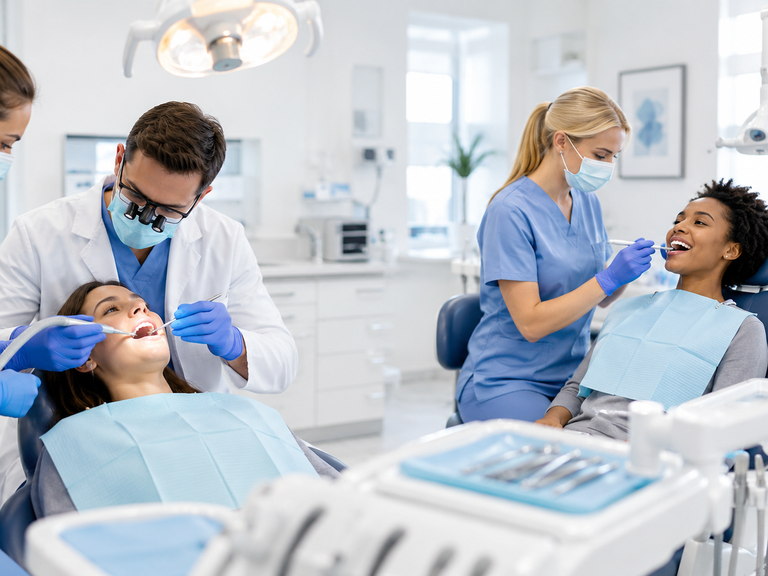
A dental assistant program can cost less than $1,000 for online coursework, several thousand dollars at some public colleges, or more than $20,000 at a private career school. Those prices do not buy identical training, credentials, hands-on experience, or eligibility to perform regulated duties. In some states, you can even enter dental assisting through supervised on-the-job training instead of starting with a postsecondary program. [1]
The most useful question isn't just “How much is dental assistant school?” It's “What will I actually be qualified to do, in the state where I want to work, after paying this price?” Compare your state's rules, the program's exact accreditation and clinical arrangements, and its written total cost before signing anything.
Quick answers:
- Real examples: Santa Fe College publishes an estimated $5,865.70 for Florida residents; Washtenaw Community College estimates $8,689–$9,275 for in-district students; Concorde's North Hollywood catalog lists $20,787 in billed tuition, books, and technology fees. These are different programs in different markets, not a national price range or a ranking. [2] [3] [4]
- What costs extra: Prerequisites, instruments, uniforms, background checks, vaccinations, CPR, exams, transportation, and sometimes unpaid clinical time can change the comparison dramatically.
- Do you need school? Not necessarily for every entry-level role. Some states allow basic assisting under dentist supervision, while x-rays, registration, or expanded functions require additional qualifications. [5] [6] [7]
- What to do first: Find your state dental board's requirements, get two itemized quotes, ask who arranges clinical experience, and compare those answers using the printable worksheet below.
Eight published dental assistant program prices, compared fairly
Here are eight distinct U.S. education providers with institution-published price information reviewed October 23, 2026. The selection illustrates training and billing differences; it is not a list of recommended schools, paid placements, or the cheapest programs nationwide. Published prices can change, and several schools include different expense categories.
| Provider and example program | Published price | What that figure represents | The critical caveat |
|---|---|---|---|
| Penn Foster, online Dental Assistant Career Diploma | $839 promotional pay-in-full / $1,039 regular or payment plan at one official-page check | Self-paced online didactic study, digital learning materials | Promotions fluctuate; verify hands-on requirements and whether the curriculum meets your state rules. Penn Foster says it does not meet California licensure/certification education requirements. [8] |
| Foothill College, California | About $4,500 | College's approximate program cost, including tuition and estimated extras | Full-time 10-month program with 300 unpaid externship hours. Residency, work-schedule, and living costs matter. [9] |
| Santa Fe College, Florida | $5,865.70 Florida resident; $14,660.20 nonresident | College's program-specific estimate: tuition, lab fees, books, screenings, uniform, equipment, testing, and other line items | The school estimates a $425 DANB fee in its budget; confirm against today's actual exam pricing. Includes in-person clinical experiences. [2] |
| Washtenaw Community College, Michigan | $8,689–$9,275 in district; $14,477–$15,497 out of state | 2026–27 campus-pathway total including many course, clinical, kit, clearance, and exam costs | Student health insurance, clinical transportation, parking, and lost earnings are outside the published total. [3] |
| Portland Community College, Oregon | $10,756 estimated | Tuition, fees, memberships, certifications, exams, uniforms, books, and supplies | Prerequisite courses excluded. In-person classes five days a week can make paid work difficult. Page does not identify an academic price year. [10] |
| Lake Area Technical College, South Dakota | $14,996 hybrid / $21,934 on campus | 2026 estimates including listed tuition, college fees, uniforms, tools, books, and a laptop | The two modalities have different published expense structures. Housing and personal costs are excluded. [11] |
| Lane Community College, Oregon | $15,594 core + $3,502 prerequisites = $19,096 | 2026–27 resident estimates including tuition, fees, materials, tools, and specified prerequisite expenses | The $7,248 core tuition alone seriously understates the full college estimate. Budget living expenses separately. [12] |
| Concorde Career College, North Hollywood, California | $20,787 | Campus catalog effective Dec. 3, 2025: $19,500 tuition, $987 estimated books/digital materials, $300 technology fee | This is billed institutional cost, not all living, travel, health-screening, licensing, or financing costs. Its program is California board-approved, which is not synonymous with CODA programmatic accreditation. [4] |
Reading this table: Prices are in U.S. dollars, reflect the particular campus, modality and residency category stated, and were checked against the named providers rather than a third-party average. A current promotional display can vary even between visits. Neither a low price nor a high one proves the quality or job placement outcome of a program.
Why the lowest sticker price may not be the cheapest useful route
Look at two public college examples. Lane lists $7,248 in resident core tuition but estimates $15,594 for the core program once required fees and supplies are accounted for. Its separate prerequisite estimate adds $3,502, bringing the published planning total to $19,096. That is an excellent reminder not to compare another school's $8,000 tuition line with Lane's complete program estimate. [12]
Santa Fe College's Florida resident budget is $5,865.70 and itemizes an unusually helpful range of expenses, including health clearances, background screening, uniforms, instrument kit, and a professional exam. But Santa Fe is also clear that its program is designed around Florida educational requirements. A prospective student planning to move to another state must independently verify portability. [2]
Neither example means one school is objectively better. Resident tuition subsidies, admissions competition, hours in clinic, cost of living, and the credential you need will determine which path makes sense for you.
The dental assistant school fees that surprise people
When you request information from a school, ask for a single list of every charge from application through graduation and initial credentialing. We suggest categorizing each price as included in the school's quote, separately required, optional, or unknown.
1. Tuition, prerequisites, and college-wide charges
Credit-hour tuition is only one layer. Public colleges may add technology and student activity fees, per-course lab/contact fees, enrollment fees, and differential fees for clinical programs. Some require anatomy, healthcare, or general education credits before the selective dental assisting cohort starts. If those prerequisites weren't already completed, they cost time and money even if the advertised program tuition omits them.
Washtenaw's 2026–27 disclosure is unusually clear: it includes $1,545 in lab/clinical contact-hour charges, a $400 dental fee kit, a $675 instrument supply fee, and additional requirements beyond core tuition. Some students may also face nonresidency tuition rates. [3]
2. Clinical supplies, equipment, and uniforms
Ask which supplies students must purchase or keep. Typical possibilities include instrument and simulation kits, infection-control supplies, protective eyewear, scrubs, closed-toe clinical shoes, and textbooks. An advertised “materials included” promise isn't specific enough: does it cover every instrument required for the final exam, or only the first-term starter kit?
Also ask whether supplies are refundable after withdrawal, whether a required kit must be purchased from a specific vendor, and whether reused equipment is permitted. Those details may be worth more than a small headline-tuition discount.
3. Health compliance and background checks
A program's clinic or externship partners may require physical examinations, immunization records, CPR/BLS, a background check, drug screening, fingerprinting, or proof of insurance. Requirements vary by placement and jurisdiction. Get the specific list, approximate cost, deadline, and refund policy before enrolling.
4. Exams, board applications, and maintaining eligibility
Completing a school program does not automatically award DANB's Certified Dental Assistant (CDA) credential or state authorization for every function. DANB currently lists $450 for the combined CDA examination covering Radiation Health and Safety (RHS), Infection Control (ICE), and General Chairside Assisting (GC). State board fees, separately purchased courses, retests, and CPR may be additional. [13]
A cost estimate that includes an exam is only helpful if you're actually eligible to take it upon graduation. Ask the program to identify the precise exam, its current price, which graduation or experience pathway applies, and whether your state requires a separate permit.
5. Childcare, transportation, and unpaid clinical hours
An unpaid externship is not necessarily a hidden tuition charge, but it may be the biggest financial constraint for someone who already works. Compare programs by their weekly schedules, required travel to off-campus clinical sites, weekend availability, and placement certainty. Foothill identifies 300 hours of unpaid externship; Portland Community College warns that its weekday attendance schedule can make working difficult. [9] [10]
Don't double-count costs: If a school already includes uniforms, exams, and lab kits in its program-total estimate, don't add the same line items a second time. Use the worksheet to mark them as included instead.
Five training routes: What are you actually buying?
A college certificate, private diploma, self-paced online career diploma, short weekend class, and paid in-office training may all use the words dental assistant training. They are not interchangeable.
| Route | What it can offer | What to verify before paying |
|---|---|---|
| Community college certificate | Structured labs, a cohort, clinical experience, and possibly CODA accreditation | Program-specific accreditation, admissions waitlist, prerequisite prices, externship supervision, and your state's credential pathway |
| Private career college diploma | Frequent start dates, packaged curriculum, lab sessions, and employer connections | Full price, actual externship assignment policy, state approvals, CODA status, aid eligibility, refund terms, outcomes methodology |
| Online-only career diploma | Flexible, lower-cost foundation in terminology, infection control, and procedures | Whether hands-on hours are included or arranged, whether local employers accept the credential, and whether state rules require additional training |
| Accelerated weekend or hybrid course | Compact scheduling, introductory hands-on practice where provided | What is performed in a real operatory, who finds the externship, state-recognized course approval, and whether payment plans cost more |
| Direct supervised employment / on-the-job training | Earn a wage while learning basic legal duties under an employer | Whether entry employment is legally permitted in your state, which procedures require certification, and whether the employer will train and document work experience |
Best fit depends on your destination, not the brochure. If you need immediate eligibility for a particular RDA application, a recognized structured program may be well worth its tuition. If your state allows supervised entry-level assisting and a local dentist will train you, an expensive diploma may not be necessary. Neither outcome is guaranteed. [1]
What “online dental assistant school” may leave out
Online learning can be useful for theory and office procedures. It cannot, by itself, replicate every required supervised chairside skill or guarantee a state radiography authorization. Penn Foster says its online dental assisting curriculum prepares students for the RHS and ICE exams but expressly cautions that state requirements may go beyond its training; its published page identifies California as a state where its curriculum does not satisfy education requirements for licensure or certification. [8]
Before buying an online program, request a written answer to four questions: Do you arrange any supervised clinical experience? Who finds the site? Which exams could I qualify for immediately after completion? Which duties could I legally perform where I live? If the answers are vague, the price tag is missing essential context.
Can you become a dental assistant without school?
Sometimes, yes. The Bureau of Labor Statistics notes that state requirements differ: certain states require accredited education and exams for some roles, while others have entry-level positions that can be learned through on-the-job training. The title and the permitted duties matter as much as whether an employer is willing to hire you. [1]
California: Basic work is possible, but additional qualifications matter
California permits unlicensed dental assistants to perform basic supportive duties under a dentist's supervision, subject to required infection-control and BLS provisions. Radiography requires a board-approved radiation-safety course. For Registered Dental Assistant eligibility, California now publishes multiple pathways, including approved education, 15 months and at least 1,280 hours of qualifying work experience, CDA certification, and specified alternative education or preceptorship routes. All have additional conditions and course requirements. Do not use pre-July 2025 summaries to plan an RDA application. [5]
Texas: Entry-level assisting and RDA registration are different steps
Texas allows basic supportive assisting without a formal education requirement at the entry-level dental assistant tier under direct supervision. The registered dental assistant (RDA) pathway has additional requirements, including training or qualifying DANB certification, CPR, coursework/assessments, and a state registration process. Some expanded functions require specific training and experience beyond RDA registration. Starting work and performing x-rays are not the same permission. [6]
Oregon: Basic assisting is unlicensed; regulated functions are certified
Oregon says dental assistants are not licensed for basic assisting, but certification is required to take x-rays and to perform specific expanded functions. The Oregon Board of Dentistry details different radiologic-proficiency and expanded-function pathways, including approved training, assessment, and demonstrated competence. Anyone considering the employer-training route should map the exact sequence before assuming a short course is enough. [7]
Michigan: Do not confuse basic office work with RDA licensing
Michigan's regular Registered Dental Assistant licensure-by-examination instructions call for graduating from a CODA-accredited assisting program and passing the required written and clinical examinations. The state also has other defined situations such as out-of-state or Canadian endorsement, and Washtenaw offers an Alternative Dental Assistant Education Project (ADAEP) pathway intended for qualifying experienced dental assistants. It is not accurate to say any on-the-job training automatically substitutes for the standard RDA route. Check your individual eligibility with Michigan LARA and the college before committing. [14] [3]
A practical employer-first test
Before paying for a program, call or email three dental offices in the area where you intend to work. Ask whether they hire entry-level assistants, which duties they allow before credentialing, which certifications they expect by the first six months, and whether they support board-approved courses. This is a screening exercise, not evidence that a job is waiting for you. If the answers consistently say “we only hire graduates from specific programs,” that is useful evidence for your school decision.
Four different things commonly sold as “certification”
The words certificate, accreditation, certification, and registration sound interchangeable in advertising. They are not.
- School certificate or diploma: Shows you completed that school's curriculum. By itself, it does not grant a state license or a DANB national credential.
- Institutional accreditation: Applies to the educational institution. It does not mean every program at the school holds specialty accreditation or meets every state's professional rules.
- CODA programmatic accreditation: Applies to a particular dental-related education program. Verify that exact dental assisting program, campus, and current status using CODA's official search. CODA accreditation is especially relevant to DANB's graduate route and some state qualifications. [15]
- DANB certification and state registration/permits: DANB administers national examinations, while state boards control legal scope, licenses, permits, and registration. Their requirements differ. A program may prepare you for an exam without making you eligible to take it immediately. [13] [16]
DANB's CDA pathways: Know which one applies to you
For the CDA credential, DANB lists graduation from a CODA-accredited dental assisting or dental hygiene program plus accepted hands-on CPR/BLS/ACLS as Pathway I. Another route, Pathway II, requires a high school diploma or equivalent, 3,500 hours of approved work experience, and accepted hands-on CPR/BLS/ACLS. Additional pathways exist for former certificants and certain dental graduates. Passing the relevant examinations remains necessary. [13]
That matters when evaluating a non-CODA 12-week program: graduation may give useful training or a school completion certificate, but it does not automatically make you eligible for the direct CODA-graduate route. If admissions promises otherwise, ask for the official eligibility rule in writing. Eligibility for an RHS or ICE component exam is not the same as immediate eligibility for the complete CDA credential.
What if you want to become a dental hygienist later?
Dental assisting and dental hygiene are distinct occupations with different training, licensure, duties, and pay. Some assisting courses may transfer in certain institutions, but a dental assistant certificate is not a shortcut that automatically awards a dental hygiene license or an entire hygiene degree. If your real objective is hygiene, look at dental assistant versus dental hygienist and dental hygienist school costs before paying for an extra credential.
Can you get financial aid for dental assistant school?
Potentially, but FAFSA does not make every school, campus, or short course eligible. Federal eligibility depends on the institution and the specific educational program, among other conditions. The school financial aid office must verify eligibility before awarding aid. [17]
Federal Pell Grants and student loans
For many standard nondegree vocational programs at proprietary and postsecondary vocational institutions, one eligible pathway is at least 600 clock hours over at least 15 instructional weeks, or the applicable credit-hour equivalent. Under defined circumstances, 300–599-hour programs of at least 10 weeks may qualify for Direct Loans only, subject to additional program performance criteria. These are regulatory categories, not promises that any named dental assisting program is eligible. [17]
Since July 2026, Workforce Pell has introduced a separate route for certain approved short workforce programs (generally 150–599 clock hours and 8–14 weeks, with other requirements). This does not mean every weekend dental assisting course automatically qualifies. State designation and U.S. Department of Education approval of the actual program are critical. [17] [18]
Ask the aid office for the exact eligible program name and identifier, which federal aid programs apply to it, the estimated grant and loan amounts based on your own circumstances, and the written cost of attendance. Don't mistake loans for discounts; you must repay loans even if you leave the program early, subject to the applicable terms.
WIOA workforce assistance
The Workforce Innovation and Opportunity Act (WIOA) may help eligible adults or dislocated workers pay for approved training through a local workforce system. Funding amounts, eligible training provider lists, participant eligibility, and available budgets vary geographically. There is no guaranteed national $4,000–$10,000 dental assistant award. Start with your nearest American Job Center and ask whether the specific program and campus are on the state's approved training list. [19]
Scholarships, college grants, and payment plans
Ask each school's aid office about institutional grants and local dental association funding. The ADAA/DANB scholarship advertised a 2026 cycle with awards of $250–$1,000 for eligible members; its listed deadline was October 23, 2026, so readers should verify the next open cycle rather than assuming applications remain available. [20]
For payment plans, request both the full-pay price and the sum of all installments. A lower monthly amount does not mean a lower total cost. Also ask whether there are financing charges, late fees, early-pay discounts, third-party lenders, and what happens to the balance if you withdraw. Read the school's actual cancellation and refund policy before paying a deposit.
Is dental assistant school worth the money?
A diploma isn't an investment simply because a brochure says it leads to a “rewarding career.” The realistic answer depends on three separate questions: (1) Would this training qualify you for the work you want? (2) Could you reach the same authorized role another way? (3) Can you carry the cost while training and if employment takes longer than hoped?
What the wage statistics really say
BLS reports a May 2025 national median annual wage of $48,070 ($23.11/hour) for dental assistants (SOC 31-9091). The bottom 10 percent earned less than $37,130, and the top 10 percent earned more than $62,250. These are percentiles across employed workers, not guaranteed starting salaries, years-of-experience bands, or a return on a particular school. BLS projects approximately 7% employment growth from 2025 to 2035 and around 53,000 openings annually, many due to worker replacement. [1]
A student who earns a certificate tomorrow may make less or more than the national median depending on the region, legal duties, work hours, experience, specialty, and employer. A state authorization allowing additional duties may be valuable, but don't assume it creates a specific raise without local employer evidence.
Three honest decision scenarios
Scenario A: You can lawfully enter through supervised employment, and an office offers real training. Before buying a $15,000 program, investigate that option. You may earn wages sooner, but you still need to fund necessary radiography, infection-control, or registration steps. You also need the employer to document qualifying work when a certification requires it. An offer of training is meaningful only if it exists in writing and fits your state's rules.
Scenario B: You need a particular board-approved educational route and reliable supervised clinic access. The right in-person program may be worth more than cheap online theory. Prioritize state eligibility, the institution's responsibility for externships, total clinical hours, certification preparation, and demonstrated outcomes over sticker price alone.
Scenario C: You are changing careers and cannot stop earning. Schedule flexibility and clinical location may outweigh a nominal tuition difference. Ask if all required daytime labs or unpaid rotations can fit around work. A weekday-only $5,000 program can be financially harder than a more expensive program if it forces months out of employment, but that is an individual budget problem, not a universal ROI formula.
A better way to model cost without fake payback precision
Estimate direct training cost = tuition + mandatory school fees + supplies + required exams and clearances + prerequisites + extra travel/childcare − confirmed grants and scholarships. Keep loan principal and interest separate: borrowing finances the bill but does not reduce it. Then add your personal estimate of lost earnings from work hours you realistically cannot maintain. Don't count the same expense twice or subtract hypothetical Pell Grants you haven't been awarded.
If you're comparing programs, use our trade school cost and payback calculator for scenarios, not promises. Model more than one possible wage, time to hire, and loan payment. A crisp-looking payback date based on an invented starting salary is not knowledge; it's decoration.
Your printable two-program cost and credential worksheet
Use this during admissions calls. Fill in amounts only after receiving written school information, and mark any unanswered item “unknown.” An unknown item should never quietly become $0.
| Question or cost | Program A | Program B |
|---|---|---|
| School, campus, modality, intended state of employment | __________ | __________ |
| Base tuition for my residency/status | $__________ | $__________ |
| Mandatory enrollment, lab, technology and clinical fees | $__________ | $__________ |
| Books, kits, uniforms and required equipment | $__________ | $__________ |
| Required prerequisite courses | $__________ | $__________ |
| CPR, health compliance and screening | $__________ | $__________ |
| Required exam, registration and permit fees not already included | $__________ | $__________ |
| Extra transportation, parking and childcare | $__________ | $__________ |
| Total direct charges and personal costs | $__________ | $__________ |
| Minus confirmed gift aid (not loans) | −$__________ | −$__________ |
| Remaining personal cost to fund | $__________ | $__________ |
| Loan amount, interest rate, term and estimated payment | __________ | __________ |
| Work hours or earnings I would actually forgo | __________ | __________ |
| Exact program CODA accreditation? Verified where? | __________ | __________ |
| Board approval for my intended state and duties? | __________ | __________ |
| Which DANB CDA eligibility pathway, if any, at graduation? | __________ | __________ |
| Radiography and expanded-function courses included? | __________ | __________ |
| Clinical hours and who arranges placement | __________ | __________ |
| Graduation / certification / job outcomes: cohort, definition, year | __________ | __________ |
| Refund terms and final date to withdraw with minimal liability | __________ | __________ |
Interpretation: A program that cannot demonstrate its credential outcome in your state is a bad deal at any price. A clear answer about who finds the externship is part of the product you're buying. Print this section, take notes, and ask admissions to email missing answers.
Ten questions worth asking before you pay a deposit
- Exactly which program and campus does this written quote cover, and what academic year or effective date applies?
- What is the all-in required cost, including prerequisites, clinic supplies, tests, and costs billed by external vendors?
- Is this exact dental assisting program CODA accredited? If not, which separate state approvals does it have?
- Does graduation make me eligible for the specific state registration, radiography authorization, or exam I need, without additional work experience? Show the board's requirement.
- Which DANB CDA pathway applies upon graduation, if any? Does the school distinguish CDA from RHS/ICE component exams?
- How many supervised hands-on hours are scheduled, and who is contractually responsible for obtaining the externship placement? Is the site reasonably accessible?
- What percentage of the most recent clearly defined cohort graduated, passed each named exam, and obtained a relevant job? What are the definitions and follow-up period?
- What grants or scholarships have I actually been approved for? How much is borrowed, and when would repayment begin?
- Which course, lab, clinic, and attendance requirements would stop me from keeping my current job or meeting family responsibilities?
- If I withdraw after two weeks, after halfway, or before externship, what do I owe and what is refundable? Please email the signed-policy language.
Red flags: guaranteed credential claims without board documentation; a “total” price that omits obvious clinical requirements; admissions pressure before providing refund policies; unverified job-placement percentages; or a school telling you that institutional accreditation automatically means CODA accreditation.
How to take the next step without buying the wrong training
First, select the state where you intend to work. Read the state dental board rules and use DANB's state-by-state requirements directory as a starting point. Second, use CODA's program finder to check any claimed programmatic accreditation. Third, compare at least two written estimates using the worksheet above. [16] [15]
If you decide school would genuinely help you reach your intended duties, explore dental assisting training and school options in your area. Program availability and outcomes vary by school and location; request confirmation of the particular program before committing. For the broader career pathway, read how to become a dental assistant, and for funding fundamentals see financial aid for trade school. This cost guide is editorial and is not a guarantee of school acceptance, licensure, or employment.
Frequently asked questions
How much is dental assistant school in the U.S.?
There is no single national price. In current examples we checked, Foothill estimates approximately $4,500, Santa Fe lists $5,865.70 for Florida residents, Washtenaw lists $8,689–$9,275 for in-district students, and Concorde North Hollywood lists $20,787 in published school charges. These figures cover different items. Check residency, prerequisites, and costs not included before comparing them.
Can you become a dental assistant without going to school?
Yes, for some basic entry-level duties in some states. Texas, California, and Oregon allow certain supervised work without a postsecondary dental assisting credential, but have separate rules for radiography, expanded functions, and professional registration. Check your state board's current rules and ask local employers about paid training.
Is an online dental assistant diploma enough to take x-rays?
Not necessarily. Online didactic coursework is not itself a radiography permit. You may need a state-approved course, skills verification, a particular exam, employer supervision, and/or a state-issued credential. Review your state's rules before purchasing online training.
Does finishing any dental assistant course qualify me to take DANB's CDA exam?
No. DANB's CDA has distinct eligibility pathways, including a CODA-accredited-program graduate route and a pathway requiring 3,500 hours of approved work experience. Some shorter courses prepare students for RHS or ICE components but do not confer immediate eligibility for the complete CDA exam.
Is a CODA-accredited program always required?
Not to perform every basic entry-level task in every state. But CODA accreditation matters for certain national certification and state licensing pathways. Verify the program, not just the institution, and check which state duties you want to perform.
Can FAFSA or a Pell Grant pay for a 12-week dental assistant program?
Not automatically. Federal aid eligibility is program-specific. Standard Title IV, Direct-Loan-only short-term eligibility, and Workforce Pell each have different regulatory conditions. A school must confirm its actual program eligibility and your individual aid status; the course length alone does not prove it qualifies.
What if a school promises a dental assisting externship?
Ask who finds and confirms the site, whether clinical hours are mandatory, how far you may have to travel, whether the placement is paid, and what happens if no site is available. Get the arrangement in writing before paying a deposit.
Sources and verification notes
All URLs below were reviewed for this article on October 23, 2026. School prices are estimates or posted charges, not binding offers; verify updated disclosures directly with the school. Government wage sources have their own specific reference periods. Program accreditation and state regulations may change.
- U.S. Bureau of Labor Statistics, Dental Assistants, Occupational Outlook Handbook, May 2025 wages / 2025–35 projections: https://www.bls.gov/ooh/healthcare/dental-assistants.htm.
- Santa Fe College, Dental Assisting C.C., program-specific estimated resident/nonresident budget and clinical details: https://www.sfcollege.edu/academics/programs/7301.html.
- Washtenaw Community College, Dental Assisting Estimated Costs, explicit 2026–27 campus pathway and alternative pathway: https://www.wccnet.edu/learn/departments/alhd/dental/cost.php.
- Concorde Career College, North Hollywood Program Costs, effective December 3, 2025: https://northhollywood-catalogs.concorde.edu/program-costs-hollywood.
- Dental Board of California, RDA applicant pathways and allowed auxiliary duties: https://dbc.ca.gov/applicants/become_licensed_rda.shtml and https://dbc.ca.gov/consumers/dental_auxiliaries_faqs.shtml.
- DANB, Texas Dental Assistant and RDA requirements, state-level requirements descriptions: https://www.danb.org/state-requirements/texas-dental-assistant and https://www.danb.org/state-requirements/texas-registered-dental-assistant.
- Oregon Board of Dentistry, Dental Assistants, basic duties and Oregon certification requirements: https://www.oregon.gov/dentistry/pages/dental-assistants.aspx.
- Penn Foster, Dental Assistant Career Diploma, program overview and live tuition (promotion-dependent): https://www.pennfoster.edu/programs/healthcare/dental-assistant-career-diploma and https://www.pennfoster.edu/programs/healthcare/dental-assistant-career-diploma/tuition.
- Foothill College, Dental Assisting, $4,500 estimated cost and unpaid externship details: https://foothill.edu/dental-assisting/index.html and 2026–27 catalog https://catalog.foothill.edu/degrees-certificates/dental-assisting/index.html.
- Portland Community College, Dental Assisting FAQs, estimated program costs and excluded prerequisites: https://www.pcc.edu/programs/dental-assisting/faqs/.
- Lake Area Technical College, Dental Assisting, 2026 on-campus and hybrid published estimates: https://www.lakeareatech.edu/programs/explore-programs/dental-assisting/.
- Lane Community College, 2026–27 Dental Assisting Certificate, itemized core and prerequisite estimates: https://lanecc.smartcatalogiq.com/en/current/lcc-catalog/programs-of-study/health-professions/dental-assisting-1-yr-certificate.
- Dental Assisting National Board, Certified Dental Assistant, exam costs, components, and eligibility pathways: https://www.danb.org/exams/exam/cda-exam.
- Michigan LARA, Registered Dental Assistant Licensing Guide, revised January 26, 2026, and RDA exam instructions: https://www.michigan.gov/lara/bureau-list/bpl/health/hp-lic-health-prof/dental/lic-info/registered-dental-assistant-examination.
- Commission on Dental Accreditation, official program search: https://coda.ada.org/find-a-program.
- DANB, state dental assisting requirements directory: https://www.danb.org/state-requirements.
- U.S. Department of Education, 2026–27 Federal Student Aid Handbook, eligible programs and shorter-program requirements: https://fsapartners.ed.gov/knowledge-center/fsa-handbook/2026-2027/vol2/ch2-program-eligibility-written-arrangements-and-distance-education.
- Federal Student Aid announcement, Workforce Pell effective dates, June 4, 2026: https://fsapartners.ed.gov/knowledge-center/library/electronic-announcements/2026-06-04/effective-dates-workforce-pell-and-federal-pell-grant-ineligibility-provisions.
- U.S. Department of Labor, WIOA training-provider policy and local-system overview: https://www.dol.gov/resource-library/performance-accountability-eligible-training-providers-labor-market-information.
- American Dental Assistants Association, official ADAA/DANB scholarship cycle and eligibility information: https://adaausa.org/.