
How to Become an Electrician: The 2026 Career Roadmap



Let's cut the noise. You aren't here because you want to read a dictionary definition of electricity. You're here because you want a career in 2026 that pays well, can't be automated by AI, and doesn't require a mountain of student debt.
But the internet is full of conflicting advice. "Join the union," says one forum. "Go to trade school," says another. "You need calculus," warns a third.
This guide is the reality check. We are going to break down exactly how to become an electrician in the United States, addressing the fastest ways to get hired, the real math you actually need, and the salary you can expect based on official government data.
The "Fast Track" vs. "Mastery": Speed to Paycheck
One of the biggest confusions for new students is the difference between starting and finishing.
If you are searching for the "fastest way to become an electrician," you need to know this: You can become an electrician's helper or apprentice and start earning money in as little as 6 to 9 months through a pre-apprenticeship program.
However, becoming a fully licensed Journeyman Electrician—the person who can work unsupervised and pull permits—takes roughly 4 to 5 years of experience, often documented through state agencies like California's DIR. There are no shortcuts to the license, but there are shortcuts to the paycheck.


Choosing Your Path: Union vs. Trade School
There is no "best" path, only the path that fits your life. You generally have two options: The Union Route (through the IBEW) or the Open Shop/Trade School Route.
| Feature | Union Apprenticeship (IBEW) | Trade School / Open Shop |
|---|---|---|
| Cost | Very Low (often free tuition) | Tuition required (Financial Aid available) |
| Speed to Entry | Slow (Waitlists can be 1-2 years) | Fast (Start classes immediately) |
| Pay | Higher negotiated rates & pension | Competitive market rates |
| Best For... | Those willing to wait for the "gold standard" benefits. | Career switchers who need to start working ASAP. |
The Strategy: Many smart students enroll in a trade school program to learn the basics (Ohm's Law, conduit bending) and start working immediately. This experience often helps them rank higher if they decide to apply to a union later.
How To Become An Electrician In 6 Steps
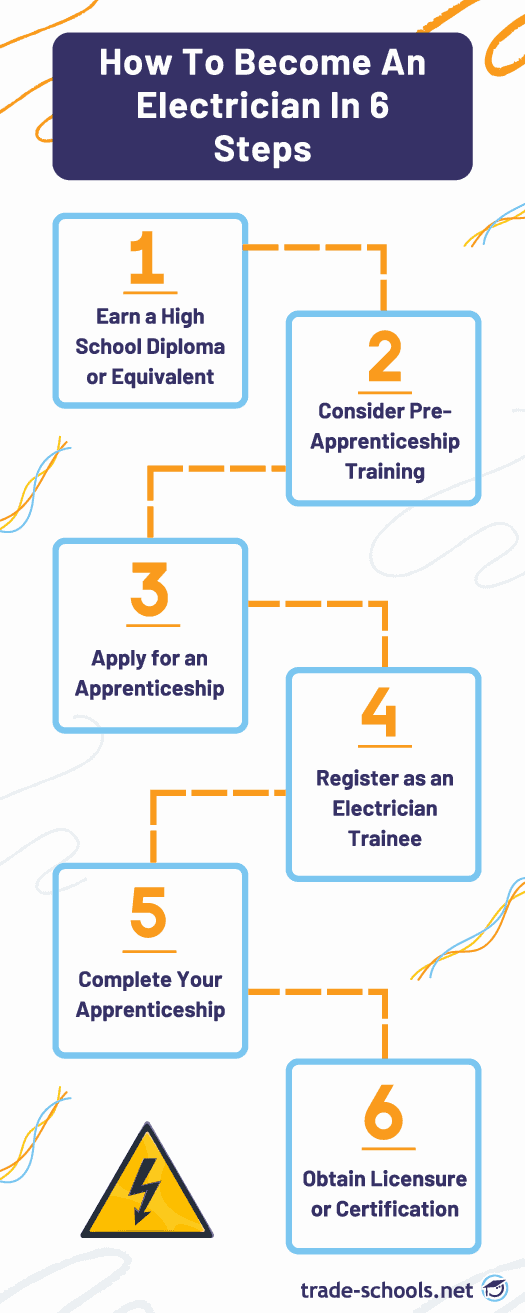
1. Earn a high school diploma or GED
This is non-negotiable. Whether you go union or private, you need proof of high school completion. If you are still in school, focus on Algebra. You don't need Calculus, but you must be comfortable with Algebra 1.
2. Consider Pre-Apprenticeship Training
If you have no experience, walking onto a construction site can be intimidating. A 6-12 month program at a technical college gives you the "hands-on" confidence to handle tools, read blueprints, and understand safety protocols before your first day on the job.
3. Register as a Trainee (State Dependent)
In states like California and Texas, you cannot legally work as a helper without registering with the state. This usually involves a simple form and a small fee. For specifics, always refer to your state's official body, such as the Texas Department of Licensing and Regulation (TDLR) or the California DIR.
4. Apply for an Apprenticeship
You can find apprenticeships through:
- Union: The International Brotherhood of Electrical Workers (IBEW).
- Non-Union: Independent Electrical Contractors (IEC).
- Federal Database: Search for open spots at Apprenticeship.gov.
5. The Grind: 8,000 Hours
This is the heart of the trade. Over 4 to 5 years, you will work full-time under a Master Electrician while attending classes at night or in blocks. You will be paid for this work, with your wages increasing every year as you gain skills.
6. Pass the Licensure Exam
Once your hours are documented, you are eligible to take the Journeyman Exam. This test covers the National Electrical Code (NEC), safety standards, and electrical theory. Pass this, and you are a licensed professional. You can verify licensure requirements across the US using the National Occupational Licensing Database.
Breaking Barriers: Math, Age, and Background Checks
"Do I need to be good at math?"
Stop stressing about Calculus. The math you need is Applied Algebra. Can you read a tape measure? Can you add fractions? Can you use Ohm's Law?
Most electrical math is this simple:
Volts = Amps × Resistance
If you know two numbers, you can find the third. If you can handle 8th-grade algebra, you can handle this trade.
"Am I too old?"
The "Mature Apprentice" is a real asset. Contractors often prefer apprentices in their 30s or 40s because they have "soft skills"—they show up on time, stay off their phones, and take the job seriously. It is physically demanding work, but age is not a disqualifier.
"Can I work with a felony?"
The trades are known as the "Second Chance" industry. While residential service companies (who enter people's homes) may have strict background checks, commercial and industrial construction sites are often more lenient. Your work ethic matters more than your past.
Real Salary Expectations (Beyond the Hourly Rate)
According to the Bureau of Labor Statistics (BLS), the median annual wage for electricians was $61,590 (approx. $29.91/hour). But that number doesn't tell the whole story.
Electricians are hourly workers. That means Overtime (1.5x pay) and Double Time (2x pay) can drastically increase your take-home pay. A Journeyman willing to work shutdowns, travel for per diem, or work emergency calls can often clear $80,000 to $100,000+ per year.
Furthermore, the demand is real. The BLS projects huge growth in solar and wind energy jobs, with solar photovoltaic installer roles expected to jump by nearly 48%.
Hidden Costs: Your First Tool Bag
While you earn while you learn, you will need to invest in your own hand tools. Expect to spend $300–$500 in your first month for the basics:
- Lineman's Pliers (Klein or similar)
- Wire Strippers
- Screwdrivers (#1 & #2 Robertson/Phillips)
- Voltage Tester (Tick Tracer)
- Side Cutters (Dykes)
FAQs on Electrician Training and Careers
How Long Does It Take to Become an Electrician?
To become a Journeyman: 4 to 5 years. To start working as an Apprentice/Helper: Immediate to 6 months. The timeline depends on whether you count "learning" or "licensed."
What Education Do You Need?
Minimum: High School Diploma/GED. Recommended: A certificate from a trade school to skip the "unskilled laborer" phase and enter the trade with tools in hand.
Is It Hard to Become an Electrician?
It requires grit. You will work in the heat, the cold, and tight spaces. The academic side requires focus, but it is practical knowledge. If you enjoy solving problems and working with your hands, the difficulty is manageable.
How Much Does It Cost?
Union apprenticeships are often free (paid for by union dues). Trade school programs can range from $5,000 to $20,000 but qualify for Federal Financial Aid and can get you into the workforce faster.
Start Your Electrical Career
Ready to stop researching and start working? Find a program near you to get the skills you need.
* The terms "Journeyman" and "Journeyperson" are used interchangeably in the trade to refer to licensed professionals of any gender.